Showing posts with label Properius II. Show all posts

Friday, August 19, 2011

Appetitive: Birthday Books

Birthday Books
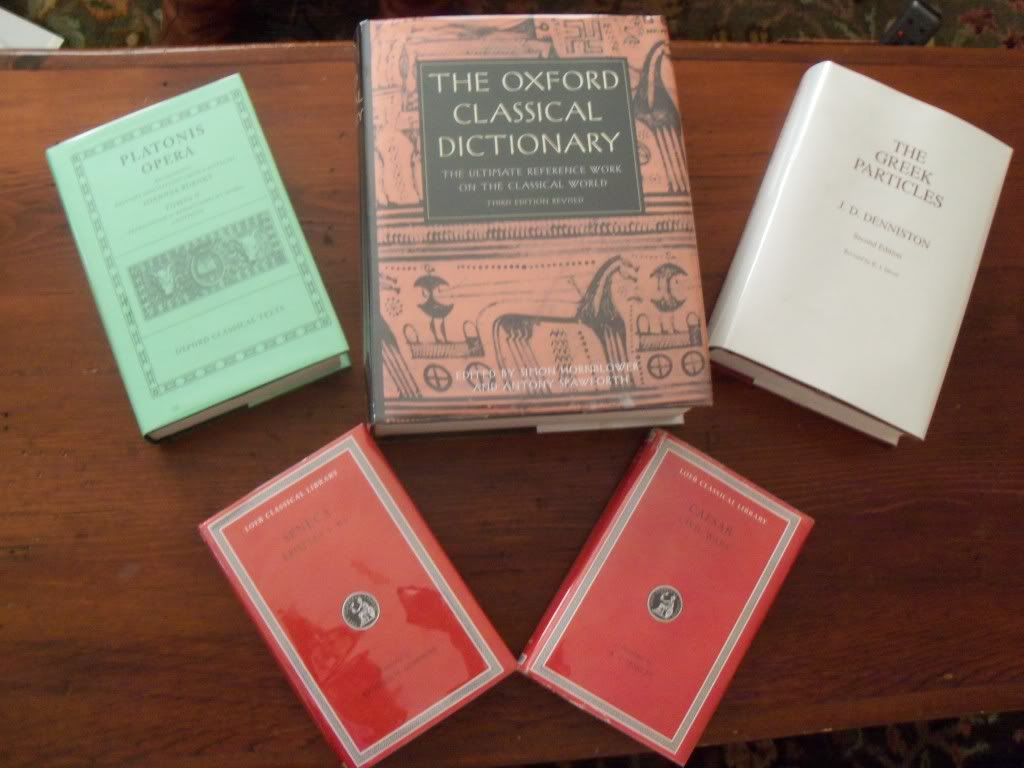
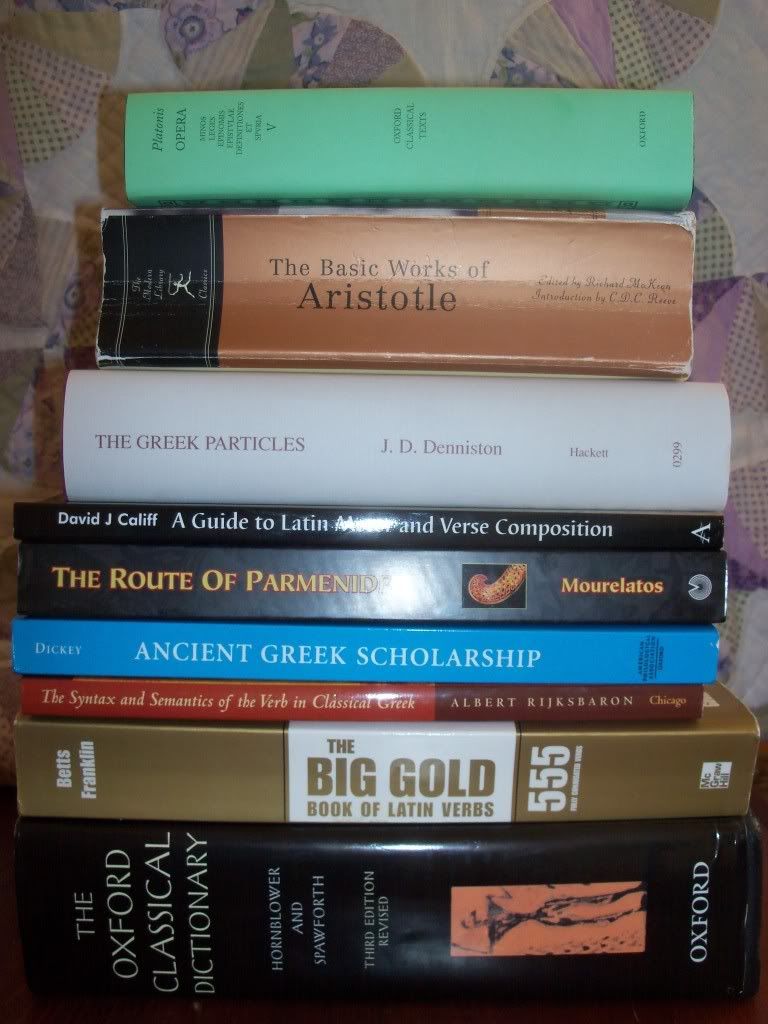
My birthday was recently. As I am starting up classes as the local large university in classics. So the theme of my recent birthday was books that will prepare me for school (or various other classically-related things). I am very excited by all of this. Propertius II, with whom I shared a thesis desk had a copy of the Oxford Classical Dictionary (OCD), and I used it a little. I really enjoyed it and I especially needed it for my current art history class where mythological background is crucial and my art history professor takes very unkindly to websites as resources. I am also really excited about having the OCT of the Laws so that I may reference the Greek easily and a copy of The Greek Particles, to which my Greek History professor sang paeans in my Herodotus class.
Covered books
I took the opportunity today between my German midterm and my doctor's appointment to cover some of the books. My mom volunteered at the library of both my elementary school and high school and she got me into those library covers over dust jackets to protect the books. Covering books is a very relaxing activity.

Monday, June 20, 2011

Spirited: Horace 1.30

A while ago, Propertius II and I read 25 poems of Horace. My goal was to read 30 (based on a sample reading list from Berkeley which I mentioned in a previous blogpost), but after 25 poems I was pretty tired of Horace. As I have been reading Greek lately, I decided I would try to translate five more Horace poems that I selected a while ago. The translations of these subsequent poems may be a little shakier because I am doing them completely on my own, but hopefully they will be reasonably decent. I am still using the Bennett edition for commentary. I started with Horace 1.30.

"O Venus regina Cnidi Paphique,
sperne dilectam Cypron et vocantis
ture te multo Glycerae decoram
transfer in aedem.


fervidus tecum puer et solutis
Gratiae zonis properentque Nymphae
et parum comis sine te Iuventas
Mercuriusque."
 "O Venus, queen at Cnidos and Paphos,
Put aside beloved Cyprus and bring yourself

to the fetching temple calling you
with much incense.

The fiery boy and the Graces with unfastened girdles
hasten and the nymphs too, but Youth
is not sufficiently charming without you
and Mercury."

It's a funny little poem but I rather like it. The conceit of the poem (if you're not up on your Roman geography) is that Horace is asking Venus to come from the famous seats of her worship (Cnidos, a Doric city of Caria and Paphos, a city on Cyprus which was considered Venus' homeland) to, presumably, a little tiny temple with not much to recommend it except that is is well-adorned and is burning incense to try to tempt her.

More soon. I have a lot of Greek (and German) to read.

Saturday, June 18, 2011

Reasoning: Ancient Philosophy Lectures

While I am doing menial tasks such as organizing my notes for graduate school and vainly trying to clean my desk, I decided to revisit the lectures I listened to from UC Berkeley's Fall 2008 Philosophy 25A which I mentioned in a previous post. David Ebrey's voice is still annoying , but the lectures are engaging and easy to follow. His analysis is rather basic as he is speaking primarily to first-year philosophy students with little background and no Greek. They have been enjoyable anyway, especially as I recently began reading Crito with Propertius II.

I have the benefit, this time around, of having read each of the texts up to the Nichomachean Ethics more than once. However, I have not read any of the other Aristotle and I thought I might give it a shot as the lectures move toward the Physics, etc. Is there a particularly fabulous translation that anyone recommends?

Monday, April 18, 2011

Reasoning: Constructs of Ethnic Identity in the Ancient World

Instead of what I was supposed to be doing today (reading Medea), I spent a lovely cool spring day on the porch reading the Landmark Herodotus and the Iliad (which I do have to read in preparation for reading book 14 in Greek with Propertius II). Much of Herodotus, in my mind, is a combination of political science and a quest to understanding ethnic identity. The way that the Greeks defined themselves and others is a fascinating question int he ancient world and one i would like ot expore more thoroughly.

In the last few days, both AWOL and Egyptology News have recommended a new open-access journal and magazine called Egyptological. I decided to browse around and read an article on Ancient Egyptian perceptions of Ethnic identities that sounded intriguing. The article was a comparison between two different books on ethnic identity in ancient Egypt which each take a different anthropological view of the way that Egyptians perceived foreigners.

Sunday, April 17, 2011

Appetitive: Greek History Review #9: Reading Herodotus

I have been enjoying the Berekeley podcasts I have been listening to so much that I started reading Herodotus. Professor Pafford discusses Herodotus often, and I became so excited about Herodotus that I decided to read it in, at least at the moment, in lieu of my other Greek History studying.
The Landmark Herodotus: The Histories
I am reading the Landmark Herodotus, edited by Robert Strassler. Cerinthus gave me this absolutely stunning a thorough volume for Christmas a few years ago. I read the introduction this morning out on the porch in between a desperate (and successful) attempt to salvage some badly-mangled pizza dough and an attempt to talk to Propertius II about Isocrates (sadly unsuccessful due to technical difficulties with skype). The introduction is written by Rosalind Thomas, and is a delightful and meandering introduction (divided into sections for easy reference by the text itself) and it goes through some of the big issues in Herodotus, such as his accuracy, in a way that provides new information to either a layman or someone with an undergraduate degree in classics. Her writing style is warm and accessible. More reviews on the volume as I continue.

Thursday, March 24, 2011

Spirited/Reasoning: Reflections on Gorgias

Gorgias' prose is very troubling. It looks simple, but it is deceptively frustrating. The text is corrupt, to be sure, but his actual way of writing is more problematic than that. Most of his sentences require the reader to work backward to understand the meaning and even then are often quite confusing. His prose is often so repetitive that editors make emendations to try to make it less so.

Plato's prose often plays with words, repeats words for a particular effect, but there is something less confusing than Gorgias' prose which seems meant almost to move the audience into such a befuddled state as to trick them into following his lead. Plato's prose, to be sure, manipulates his readership, but he does it in one of two ways. Either he uses the elentic argument where the questions that Socrates asks and his interlocutor answers cudgel the reader into a particular thought pattern or, when Socrates provide answers the audience is carried through various flights of rhetoric and myth which leave the audience questioning many things and possibly wondering about the logic, but, at least for many, not in such a way that they simply agree like the interlocutors do. Maybe I am assuming every reader follows Plato the same way that I do. I now think I understand why the sophists appeared as such a threat to Plato.
Encomium of Helen (BCP Greek Texts) (English and Greek Edition)
Propertius II and I are finished up the Encomium of Helen tomorrow. I am hoping that the Greek starts to get easier with Isocrates' Helen, but maybe I just have lost the logic of Greek prose.

Friday, March 4, 2011

Reasoning: The Politics of Helen

Helen was one of the most discussed characters in the Greek world. However, no ancient author seems to agree on Helen's nature, and even the portrayal of Helen in the Iliad and the Odyssey are different. I have been reading Gorgias' Encomium of Helen with Propertius II (although more slowly than I intended) and noticed that one of the defenses that he uses is that if she were seized, specifically under the will of the gods, then it is not her fault but the fault of the person who seized her (and the gods).

This immediately struck me as interesting. I remembered reading the beginning of the Histories in my fabulous Herodotus class. Herodotus introduces his tale of the Persian wars with an incredible prologue [1] and then launches into a discussion of the causes of the war: specifically a long train of young women captured by the opposing side starting with Io and moving on through Helen and finally to Medea. In each case, he blames the woman, rather than the sailors who seize her, for her capture. Gorgias makes the opposite argument. As the two wrote relatively close together, I was wondering which argument about captured women might have been more persuasive to an audience. Food for thought.
Encomium of Helen (BCP Greek Texts) (English and Greek Edition) Herodotus Book I (Greek Commentaries Series; Book 1) (Bk. 1) The Landmark Herodotus: The Histories
Endnotes
  1. There is an amazing article by Egbert Bakker on Herodotus' prologue called "The Making of History: Herodotus' Histories Apodexis" from Brill's Companion to Herodotus.

Saturday, February 19, 2011

Appetitive/Reasoning: Encomia (?) of Helen

Encomium of Helen (BCP Greek Texts) (English and Greek Edition) 
Propertius II and I are almost done with Horace! It's been a long journey. We are reading the last of the 24 poems in our set (Epode 17) this week. Although the plan is to read Iliad Book 14, Propertius II is not done with Book 13 yet (he has been reading through the entire Iliad in Greek of the last two years (although he was interrupted by classes and having to write a thesis). So, in the meantime, we are planning to read Gorgias' "Encomium of Helen." We may also read Isocrates' "Encomium of Helen."

I have had a very busy week. Back to regular posting soon.

Tuesday, February 15, 2011

Spirited: Horace Epode III

Bennett titles this epode "Oh that Guilty Garlic." As it had such an amusing title, Propertius and I decided to read it and I mentioned that I would translate it in a recent blogpost. Here it is.
Parentis olim siquis impia manu
   Senile guttur fregerit,
Edit cicutis allium nocentius.
   Oh dura messorum ilia!
Num viperinus his cruor
   Incoctus herbis me fefellit? an malas
Canidia tractavit dapes?
   Ut Argonautas praeter omnis candidum
Medea Mirata est ducem,
   Ignota tauris inligaturum iuga
Perunxit hoc Iasonem;
   Serpente fugit alite.
Nec tantus umquam siderum insedit vapor
   Siticulosae Apuliae,
Nec munus umeris efficacis Herculis
   Inarsit aestuosius
At siquit umquam tale concupiveris,
   Iocos Maecenas, precor,
Manum puella savio opponat tuo,
   Extrema et in sponda cubet.
If ever any man breaks
the old neck of his father,let him eat garlic, 
which induces more injury than hemlock.
O tough intestines of harvesters!
What poison rages furiously in my heart?
Surely no viper's blood has been boiled
with these herbs to decieve me? Or did
Canidia serve bad dishes?
When Medea was amazed at the leader,
shining beyond the other Argonauts,
she anointed Jason, going to bind the bulls\
with unknown yokes, with [garlic];
Having steeped the gifts in [garlic]
for his concubine, she flees in her dragon chariot.
And not at any time so great a heat
of the stars sat over arid Apulia,
nor did such a glowing gift burn
the shoulders of powerful Hercules.
But if anyone ever will have desired
such a thing, jocular Maecenas, oh heart,
may your girl place a hand opposite your kiss
and may she lie on the far-side of the bed.


I used Bennett's commentary and text and discussed the text with Propertius II. I took some liberties-- especially with tense-- to attempt to make this into decent English.

Monday, February 14, 2011

Spirited: The Horace to Come

Properitus II and I are finally finishing up our stint of Horace poems. Since we finished the list of typical odes plus a few that we picked out, we decided to move on to the epodes. The first epode we read (Epode III) was quite funny; it was much in the style of Ode 2.13. The second one was...well not what I was expecting. Although Bennett, the editor, failed to write a commentary due to Epode VIII's "crude" subject matter, I figured this was simple 19th century prudishness. I was mistaken. The ode was rather revolting. I don't suggest it and I shall not put up a translation. I will, tomorrow, put up the "Garlic" ode which was charming and silly.

Thursday, February 10, 2011

Spirited: Horace 3.30

It has been a long day so I will not post a translation of 2.13 until tomorrow.  Here is my translation of 3.30:

Exegi monumentum aere perennius
Regalique situ pyramidum altius,
Quod non imber edax, non Aquilo impotens
Possit diruere aut innumberabilis
Annorum series et fuga temporum.
Non omnis moriar multaque pars mei
Vitabit Libitinam: usque ego postera
Crescam laude recens. Dum Capitolium
Scandet cum tacita virgine pontifex,
Dicar, qua violens obstrepit Aufidus
Et qua pauper aquae Daunus agrestium
Regnavit populorum, ex humili potens
Princeps Aeolium carmen ad Italos
Deduxisse modos. Sume superbiam
Quaestiam meritis et mihi Delphica
Lauro cinge volens, Melopomene, comam.
I have completed a monument more durable than bronze
and higher than the majestic place of the pyramids,
because no consuming rain, nor powerless North Wind
can destroy [it] or the innumerable succession of years
and the flight of the seasons.
Not entirely shall I die and parts of me
will evade Death: on and on I will increase
in new praise. While the pontifex
mounts the Capitol with a silent virgin
I will be celebrated, where the furious Aufidus
makes a clamor and Danus, poor in water, once ruled
over rustic people, powerful from humble [origins]
the Aeolian song transferred into Italian poetry.
Take the proud honor sought by the meritorious and
graciously wreath my hair with Delphic laurel.

I used Bennett's edition of Horace (my copy is the first edition) and pieces of may translation amended from his notes. I also discussed the translation with Propertius II, although I did not take particularly good notes so I may have made mistakes that he urged me to correct.

Tuesday, January 4, 2011

Appetitve/Spirited: To Learn Sanskrit (and German)?

One of my friends just decided we should learn Sanskrit together. Our plan is to work through William Dwight Whitney's Sanskrit Grammar[1], which Propertius II used two summers ago and possibly the supplement that goes with it (Roots, Verb-forms and Primary Derivatives of the Sanskrit Language) that I discovered as a free Google edition.


Sanskrit Grammar Roots, Verb-forms and Primary Derivatives of the Sanskrit Language
We will probably begin in late January. If anyone has any tips for books or on how to work through a Sanskrit grammar, let me know.

Endnotes
  1. Free Google edition of the Grammar. To get to it, "buy" the book (it's free), click "read it now" then find the "i" (about this book) icon and click on it. Click "read on your device," scroll to the bottom and download the PDF.

Tuesday, December 28, 2010

Appetitive/Spirited: More Horace on Wine

I always enjoy picking wines for Christmas dinner. Since I am going to put up a new edition of "Wine Snob" very soon on my cooking/personal blog, I thought I would continue the tradition of translating Horace 1.38 and translate the last stanza of 2.14 (also about wine):
Absumet heres Caecuba dignior
     servata centum clavibus et mero
tinguet pavimentum superbo,
     pontificum potiore cenis.
The worthier heir will quaff the Caecuba [1]
     protected by one hundred keys and glorious
unmixed [wine] dyes the floor [2],
     more potent than the dinner of the priests.
The rest of the Horace poem (2.14) was about death and it was not particularly interesting [3]. The last stanza amused me, so I thought I would post it.

Some holiday wines.

Endnotes
  1. Caecuba is a type of Roman wine.
  2. I cannot decide whether the wine dies the floors from spillage or vomit. Either way, it shows the excess of the heir.
  3. I mentioned to Propertius II that "anyone can write 28 lines about death" and he quipped "but can anyone write 28 lines about death in Alcaeic strophs?"

Thursday, December 23, 2010

Appetitive: Ancient Greek Drinking Songs for the Holidays

Music and wine for the holidays [1]! I have always liked the idea of Greek drinking songs, but only actually participated in the singing of them once. At one of the parties at our apartment, Cynthia brought out a Loeb and tried to have us sing one. Really the only adequate singer was Propertius II because my Greek pronunciation is terrible and Cynthia's voice does not quite have the robustness for drinking songs [2].

Anyway, I found some modern Greek musical interpretations of Ancient Greek lyric poetry on one of my searches for Ancient Greek drinking songs. From what Propertius II has told me of Ancient Greek music, this is far too melodious. However, I have only heard a little of it and it might be interesting. I also found an English translation of an Archilochus fragment that is one of the drinking songs at Extraface. I searched through an online archive of Archilochus for a while but I could not match it up to the Greek. I think I just was not looking hard enough because I was rushing. If someone figures out which fragment it is, please comment it or email me.

Greek Iambic Poetry: From the Seventh to the Fifth Centuries B.C. (Loeb Classical Library No. 259)


Perhaps I'll hunt down the Loeb in the library and see if I can find it after the holidays. Happy holidays, everyone!,

Endnotes
  1. It is amusing that all of my holiday posts seem to be about booze, because I have almost no alcohol tolerance at all and do not drink very much. However, I like the idea of drinking and being merry, even though I mostly have to be merry without the drinking.
  2. Her voice is much more suited to the indie songs that she sings with her ukulele.

Monday, December 20, 2010

Appetitive/Spirited: A Translation of Horace 1.38 for the Holidays

Horace 1.38

Persicos odi, puer, adparatus,
     displicent nexae philyra coronae,
mitte sectari, rosa quo locorum
     sera moretur.

simplici myrto nihil adlabores
     sedulus curo: neque te ministrum
dedecet myrtus neque me sub arta
     vite bibentem.

I hated Persian styling, boy, woven crowns 
     from the linden tree displease [me],
do not seek out haunts 
    where the late rose lingers.

I take pains that you, diligent, endeavor nothing 
     [other than] plain myrtle: neither is myrtle unsuitable 
for you as you serve nor for me 
     drinking under the thick-leaved vine.
Advice on the translation was taken from the notes in the Bennett edition I borrowed from the library as well as from Propertius II. However, it has been over a month since I read the poem and the notes that I took for myself were not nearly as detailed as they should have been. However, this is a rendering of what I remember.

The reason I chose this poem for the holidays is twofold. First, at the Aimee Mann Christmas Show, Paul Tompkins did comic bit on the two versions of Christmas. He claimed that there was one for religious people and one for everyone else, which was a drinking holiday. I thought this was pretty funny, especially because of the tradition of my family's Christmas wine selection (although no one drinks very much), and because it reminded me of Horace, who mentions wine in almost every poem I have read thus far. Second, although I had to return the my Bennett to the library, I remember something about the "late blooming rose" in line 4 being the Egyptian rose, which was known to bloom until December, which further reminded me of the holidays.

So, crown yourself in myrtle, pour a glass of wine, and read Horace by the fireside.

Wednesday, December 1, 2010

Appetitive: Nunc est Bibendum!

I'm going to be at my Alma Mater for the next few days. Cynthia and one of my other best friends are turning in their theses and I am joining them to celebrate. I may or may not have the time and internet access necessary to post over the next few days. My explanation on date of the Laws, the last in the "Dates in the Platonic Corpus" series, will probably have to wait until I get back.

"Nunc est bibendum" is a quotation from Horace poem 1.37. It roughly means "now is [for] drinking" or, more colloquially, "let's party." The poem is about celebrating a homecoming of a comrade-in-arms. It is certainly appropriate for my (brief) return to my Alma Mater, although we will be celebrating the completion of theses rather than my journey. The Horace ode is fabulous; Propertius II and I read it recently, and we both highly recommend it. I also really liked 1.38, which is about temperance and is very short and sweet.

Monday, November 8, 2010

Reasoning/Appetitive: Fragments from the Indo-European Studies Conference #1

One of the things that I noticed about the presenters at the Indo-European conference was their skilled pronunciation of words. Over the course of the conference, only one person mentioned that their pronunication was not perfect (and it only applied to his Sanskrit and not his Greek) and even those people with thick accents pronounced words impeccably. I was most impressed by the speaker who pronounced fabulous Latin although his own speech was layered with a thick Japanese accent.

This ability was one of the things that really impressed me about the eclectic people who spoke and attended such a conference. Gregory Nagy even displayed both Classical and Homeric Greek pronunciation.

This reminded me that although I was working with Vox Graeca, my pronunciation is not getting significantly better. I also realized that I cannot actually roll my r's. I can essentially do a half-trill with it but I cannot sustain that trill and it's not a real rolled r anyway. I decided I needed to learn because proper pronunciation of Greek requires this rolled r. I looked up a couple of tutorials online: wikihow and eHow. Propertius II warned me that it is possible that I might never be able to do it (lame!) but I will keep trying (although at the moment I sound like an idiot). If anyone has some hints, I would love to hear it.

Vox Graeca: The Pronunciation of Classical Greek

More fragments from the conference coming over the next few days.

Thursday, November 4, 2010

Reasoning: IndoEuropean Language Conference

I may not be around much in the next few days. Properitus II is coming into town and we are going to an Indo-European Studies conference. Gregory Nagy is speaking, which should be pretty awesome, and there are another few talks that look interesting (most of it is too technical for me).

I will post any interesting notes from the conference as I get the chance. Have a nice weekend everyone!

Friday, October 29, 2010

Appetitive: The Sound of Ancient Greek

There is a fabulous sample of Greek pronunciation (of both poetry and prose) online. Since I would like to improve my Greek pronunciation significantly before graduate school. Propertius II directed me to The Sound of Ancient Greek. Stefan Hagel, the speaker, uses pitch accents as well as indicating the type of phrase (e.g. interrogative, declaratory) in tone and pitch. It's fabulous. I listened to the messenger speech from Aeschylus' Agamemnon and the introduction to Plato's Symposium just this morning; they are great. Enjoy!

Hagel uses one of the same texts that I am trying to read through, Vox Graeca: The Pronunciation of Classical Greek. Maybe my Greek will sound like that someday!
Vox Graeca: The Pronunciation of Classical Greek

Saturday, October 23, 2010

Reasoning: Useful Internet Miscillany

Horatian Meter: I am still continuing on my quest to read Horace. Propertius II has finally succeeded in convincing me that meter is both awesome and useful, which has lead me to scan the poems I am reading. Horace employs a variety of lyric meters that he borrowed from Alcaeus and Sappho. Since I am a fairly new student to the study of meter (although I did some dactyllic hexameter in high school Greek), I do not tend to have a sense of what lyric meters go with which poem. However, I found a great page on Diotima which provides the background for and explanations of Horatian meter.

Digital Papyrology Navigator: A friend recently sent me a blogpost from AWOL: The Ancient World Online, which is a fabulous site that appears to compile vast amounts of classics data for online access. One of it's recent entries talks about the updated version of the Digital Papyrology Navigator, which allows classicists and friends to digitally search for information in papyri and suggest emendations. The blog by the people who run this awesome resource also will probably be pretty cool.

Art Index [1]: After stumbling across a semi-dormant blog called "What do I know...?," I realized that I should create a better system for organizing the art that I discuss on Platonic Psychology. So I created a new page, An Index of (Mostly) Art on Platonic Psychology, which organizes the art I have discussed by the period to which it belongs. The page is still in progress because I have not figured out a comprehensive system, but there is also a list of archaeological sites on the bottom, mostly with pictures from Cerinthus' adventures around Greece.

Endnotes
  1. Placing a feature I created after these two fabulous resources is not trying to compare my work with that of greater digital monuments, it was just a convenient place to introduce the topic. No arrogance intended.