Showing posts with label Greek Drama. Show all posts

Sunday, March 4, 2012

Appetitive: A Summery of My Weekend

"κναπτόμενος δ'ἀλὶ δεινᾷ
φεῦ
σκύλλονμαι πρὸς ἀναύδων
ἠέ
παίδων τᾶς ἀμιάντου.
ὀᾶ."

I slightly modified a line that reminded me of the way I feel this weekend. I don't think I altered the meter (although I could be wrong). Although it's pretty obvious, can anyone guess what this is from? I hope the rest of you had a better weekend than I did...

Friday, February 24, 2012

Spirited/Reasoning: Stagecraft in Aeschylus

Usually when I read Greek drama, I don't consider the actual theatrical performance of the plays. Instead, I think about the language and the themes. The first time the actual staging became important to me was when I was assigned large portions of Oliver Taplin's The Stagecraft of Aeschylus in my Agamemnon class at my alma mater. Taplin explains the importance of the entrances and exits of the characters and the staging.

Recently, in the Garvie commentary which I have been raving about of late, the staging has come to my attention. Garvie explores a lot of the controversial aspects of the staging of the Persians in his introduction. I ended up dealing with this specifically in my presentation today in my Persians class. Taplin (and Garvie citing Taplin) discuss the difference between the two entrances of Atossa. At the first entrance, the chorus greets the queen with a full body prostration and the queen arrives decked out in rich clothing and she presumably arrives in a chariot. In the second entrance, she arrives on foot, possibly dressed in black, and carrying a set of libations. Her change in attire demonstrates the change in fate of the empire.

The presentation went reasonably well, thanks to some help from Propertius II with regards to the meter. Now back to more Lysias (of which I have completed two pages today and am hoping to read two more tonight).

Friday, February 3, 2012

Appetitive: The Joys of Greek

Although I have had a number of pitfalls so far, ever since I started taking this graduate seminar on the Attic Orators, I've begun to really enjoy Greek. Antiphon and Andocides are quite a joy to read, although they have their frustrating moments. My reading speed (for prose, although not for Aeschylus) is increasing significantly-- it seems like the effects of Greek prose composition finally caught up with me-- and I am beginning to learn the typical terms.

Nowhere did this joy manifest itself more than in reading Plato last night with Ovid II. When I read Crito over the summer with Propertius II, I was still struggling a lot with parts of the prose and my reading speed was quite slow. Now, I can carve a few hours out of my schedule and process the Greek pretty decently before going over it. While the orators are fun in their persuasive energy and the window they provide on Greek culture, the Symposium has a bit of wonderful colloquial wit that is just fantastic.

After that, even my remaining 50 lines of Vergil did not seem so dreadful, although the battle scenes are certainly grim. I'm actually beginning to appreciate parts of Vergil, finally.

To pass my little glimmer of exuberance on, I thought I would post a link to A.E. Houseman's "Fragment of a Greek Tragedy." My professor in the Persians class passes this out to us. I had seen it many years before, but it still absolutely cracks me up.

Have a lovely weekend, everyone. I will (I hope) be posting some interesting tidbits from Antiphon.

Thursday, July 21, 2011

Appetitive: The Most Amazing Birthday Gift

It's not my birthday, but my birthday is coming up. Cerinthus came down and gave me the worlds greatest birthday present: a copy of the 1988 production of the Medea in the original Greek (Peter Steadman, director. Commentary by William Arrowsmith). It's a DVD copy that I had to swear I would only use for educational purposes. I'm really excited. Cerninthus and I are going to watch it (I think tomorrow) with Servia and I will post a review when we watch it again.

If you can get a hold of a copy of this movie, I highly suggest watching it. It's absolutely fabulous.

Saturday, June 25, 2011

Reasoning: Death Outside Attica

I wrote my undergraduate thesis on Plato's views on Greek tragedy. Much of this centers around Plato's perspectives on lament and the portrayal of death in tragedy and poetry. I contextualized this with evidence on the evolution of death ritual over time in Attica (which contains the greatest wealth of evidence). AWOL posted a link to an open access journal which, among other things, deals with death ritual in the Peloponnese.

Wednesday, December 15, 2010

Reasoning: Thoughts on the Medea

I have been reading the Μήδεια in Greek with a friend of mine who is in Turkey (skype is awesome). One of the things that we notice recently was that not only is there an ever-present sense of doom in the beginning of the text, but it is clear from the rhetoric that the Τροφός (Nurse) and the Παιδαγωγός (Tutor) use that they know from the beginning (or at least fear) that Μήδεια will kill her children in an act of vengeance in a way that does not seem as imminent in the English.

Two questions emanate from this: 1) do we (as the audience) ignore the rhetoric because we know the ending, but notice it reading the Greek because we focus on it word by word (and therefore the Greek audience would not have noticed this aspect) or 2) if Euripides' version was the original version of the myth in which Μήδεια killed her children, what would the audience have been thinking during this opening scene?

Just food for thought.
Euripides: Medea (Cambridge Greek and Latin Classics)

Saturday, October 16, 2010

Reasoning: Iconography of Greek Theater #8, T.H. Carpenter

The second to last talk on that Friday was T.H. Carpenter. I am sure that I have read Carpenter before in some class, but I cannot remember. T.H. Carpenter teaches at Ohio University, and his work focuses on Greek art. His most recent work is on South Italian vase painting and the archaeology of Apulia.

My description of both T.H. Carpenter and his talk is not as vibrant as the others. this is because I spent most of the talk trying not to fall asleep. This is not because Capenter was boring-- his talk was actually quite fascinating. However, I had been up since 6am and I had not consumed any food or caffeine for quite a few hours by the time he got up to speak, so my notes were not as easy to interpret as usual.

If any of the factual information in this section is incorrect, I apologize. This is not the fault of Carpenter, but rather the fault of an inaccuracy in my notes or understanding. If anyone notices anything, comment or email me.
Map of Apulia from this website.

Carpenter's talk primarily concerned the Italiac settlements in Apulia (as opposed to the the Greek settlements in that region, like Taranto). He explained that although there was certainly an theater loving population in the Greek settlements [1]. However, Carpenter makes the surprising case that the Italian settlements also enjoyed Greek theater. There was something in Carpenter's air-- almost sheepish-- that at first made me want to be skeptical of his claims, but his style was engaging and his logic was persuasive so I ended up agreeing with him in the end.

Apulia is the region in the heel of the Italian boot. Taranto was a Spartan settlement in Apulia and Tarantines were supposedly addicted to theater. In the Laws, Plato talks about the Italian and the Sicilian love of theater (659b-c) when he criticises the demos-lead system for deciding upon the winners of theatrical competitions.The Athenian Stranger, the main character in the Laws, seems to see this as a system which encourages typically hedonistic mentality of those who love theater.

There is a lot of imagery that seems to relate directly to theater found in this area, but most of it was not exported. There was only 1%  of these vases outside Apulia, so market for the vases were probably not to sell in Attica. There are a lot of rich tombs in Ruvo, an Italic city in Apulia, which include vases as well as collections of gold and silver. New evidence [1], as well as the evidence from Plato and others, demonstrates that there was tragedy and comedy in this area. One of the tombs at Ruvo had seven vases, four of which had a relationship to theater. The vases came from between 450 and just after 400, and the theater vases came from around 400 which means that the vases were probably not on the second hand market before they went into the tomb. Some of the vases have Attic dialect which hints that the someone understood enough tow ant the vases in their tomb.

Carpenter's conclusion was that even the Italic settlements must have witnessed the performance of tragedy and comedy. Obviously, this seems problematic as both genres were written and performed in Greek and at tragedy contained both Attic and Doric dialect. Also, for poets such as Aeschylus, the language was elevated and formalized far beyond that of everyday speech. How would those in the Italic settlements be able to understand it? But Carpenter hypothesized that because the vases were both produced in Apulia and buried in tombs there, it seems reasonable to conclude that those who chose to have them in their tombs would have been lovers of theater rather than collectors of pottery they did not understand.

The Pronomos Vase was the only vase in the rich Ruvo tomb that was Attic in origin. Carpenter hypothesized that the vase was commissioned by a person who had fallen in love with theater in Athens and perhaps wanted to bring it back to demonstrate the importance of theater. He explains that the volume krater, the particular shape of the vase, was not popular in Athens, but it was popular in Italy where the vase was found. This became a very contentious topic during the question and answer session. Oliver Taplin among other argued that it was probably bought on the second-hand market, since it seems to be commemorating a victory of a particular poet. I am not sure which side I fall on when considering who commissioned the vase and whether or not it was on the second hand market. However, I do think it is reasonable that some of the more educated and wealthier of the Italic people might know Greek and travel to the Greek settlements for the sake of theater. Rather than to collect the Pronomos Vase in order to demonstrate the importance of theater, it might be a momento of a passion and pasttime of a particular group of elites.

Endnotes
  1. Plato Laws 659b-c.
  2. Oliver Taplin makes this claim in his talk, from which I will post the notes tomorrow.

Wednesday, October 13, 2010

Reasoning: Iconography of Greek Theater #7, Jeffrey Rusten

Jeffrey Rusten spoke next. He is a professor at Cornell and he specializes in Thucydides as well as working on Greek comedy and tragedy. The most memorable quality about Rusten was his earnestness; he seemed so sincere in his attempt to persuade the audience of the importance of the Phanagoria Chous. It was nice to see a scholar not only passionate about his ideas but who so vehemently tried to convert his audience.

Rusten presented on the importance of an attic chous, a type of small vase, found in Phanagoria on the Black Sea. The vase is from around 400 BCE and is currently housed in the Hermitage State Museum, Talman collection ΦΑ869.47, and is currently in a box in the basement. It was discovered in 1869 in a Ukranian village and a line drawing was published five years later. Part of the reason it has taken me so long to post this is that I cannot seem to find an image of the pot on the internet anywhere. This, of course, actually backs up Rusten's claim. If anyone knows of an image, and could send it to me or post it in a comment, that would be great.

Jeffrey Rusten claims that this is a unique chous which provides important information for the study of Attic comedy, but has unfortunately fallen under the radar of almost all modern scholars. This vase has spent a lot of time in storage and has, according to Rusten, not appeared in scholarship since 1981. His passionate and sincere argument in his talk was that the chous should not be ignored.

The chous is 9.5cm high and shows a surprising five figures and five masks which is paralleled on no other vase of this size. It depicts three actors, one in costume and two in comedy undergarments, and two aulos players in full stage attire. Obviously since there are only three actors, there should only be three masks, but instead there are five. This adds to the incredible symmetry of the vase, where the three center players are framed by the two aulos players who are all facing a center character.

Aside from the costumes which are symbolic of comedy, the central figure sits on a bedroll and carries a twisted staff which indicates that he is a traveler, a character commonly depicted on comic vases. Rusten explains that two of the masks are undistinguished, one is comic, one is tragic, and one looks like a Zeus mask. The scene seems to be taking place backstage, but leaves open a number of questions as to what play it might represent (if it represents a specific scene) and why the vase was found so far from its point of origin.

I thought that Rusten made a persuasive case for the importance of the vase, and I hope that more scholarship will be written about this fascinating depiction of comedy.,

Monday, October 11, 2010

Reasoning: The Iconography of Greek Theater #6, Alan Shapiro

Alan Shapiro was a scholar whose work I had a read in some of my college classes. Shapiro a professor of Archaeology at Johns Hopkins and he writes on Greek vase painting, iconography, and mythology. Alan looked like the stereotypical fabulous professor; he was perfectly

The paper that he presented at the Getty was about depictions of the birth of Helen. Specifically, he spoke about one particular piece of art that showed a representation of the birth of Helen from an egg.
This is a picture of part of the pot from this website. [1]
Alan Shapiro opened his talk with an introduction about miraculous births in Greek mythology. Specifically he focused on the different versions of the myth of Helen. The first version involved Zeus perusing Nemisis. Nemisis, in her flight from Zeus' advances turns herself into a swan. Zeus turns himself into a goose, and rapes her. The egg she lays produces Helen; from the very beginning, Helen is an instrument of retribution. According to Shapiro, Leda was not introduced into the story until later.

The first version including Leda introduces Leda as adopting the baby Helen from Nemisis, who does not want it. One possible way in which this adoption takes place is when Hermes brings the egg to Leda and leaves it by her while she is asleep. Later in the evolution of the myth, Zeus chases Leda and turns into a swan in order to rape her. Another possible story, one which does not involve the birth from an egg, is that on Leda and Tyndareus' wedding night, before Tyndareus could join Leda in their marraige bed, Zeus sneaks in and then leaves, so all of Leda's children are conceived on the same night.

There are a variety of red figure vases that show the egg from which Helen is born. These paintings often depict Leda, Zeus, and the Dioskari surrounding the egg. The Dioskari, Castor and Pollux, are usually portrayed as Helen's older brothers, but are sometimes portrayed as her contemporaries [2]. Some of the vases also portray Leda with a look of astonishment on her face, which can either be interpreted as caused by the first time that she has seen the egg or as an astonishment at the hatching egg. Artists competed for the birthplace of Helen-- some portraying Helen as a native of Athens while others placed her as a native of Sparta. According to Shapiro, Kretinus [3] and Euripides both represented the story in plays.

The end of the lecture focused on the comic portrayal of the image of Helen's birth on the stage. Specifically, this particular vase (shown above) portrays, presumably Leda watching surreptitiously through the door into a room in which a character, presumably Tyndareus is swinging an ax at an egg sitting on the table. On the other side, someone, possibly a slave, looks horrified. Out of the egg, Helen bursts, holding out her hand as to stop the attack.

Much of the question and answer session was devoted to the possible interpretations of this vase. Shapiro noted two possibilities. The first was that Tyndareus hears of Leda's marital infidenlity and attempts to murder her offspring with the offender. This was a typical comic trope. Another possibility is that Tyndareus was trying to break the egg open and managed it. Helen emerges and stops him from delivering another blow. There are any number of possibilities.

My thoughts on this scene is that it might come from a play or represent a story where Tyndareus decides to see whether the offspring in the egg is actually his (which borrows from both of the plotlines above) and cracks the egg open, hoping to have some kind of a traditionally ridiculous Greek recognition scene between family member or to realize that this was the product of another man. Shapiro mentioned that the audience would have been steeped in the layered visuals surrounding the different possibilities for the mythology, which makes this avenue possible.

Endnotes
  1. Unfortunately, I could not find the part of the vase that is important to Shapiro's argument. If anyone knows what the vase was called or where I could find a complete picture of it, please post it in a comment.
  2. One image that Shapiro showed was a wonderful mosaic on the floor of a Roman villa which depicted Leda and Tyndareus and an egg which is depicted as housing Helen, Castor, and Pollux.
  3. I am not sure about the spelling on this.

Thursday, October 7, 2010

Reasoning/Spiritied: A Second Addendum to the Barbara Kowalzig Post

The Oxford Classical Dictionary 
The Oxford Classical Dictionary sheds (some minimal) new light on "new music." I ended my last post with a question about the dramatic date of Plato's Laws (that was proposed by Zuckert) in light of Kowalzig's argument about new music. My question was, if "new music" (the experimenting with meters of dithyrambic choruses) was contemporary with Plato (as an author) rather than with Zuckert's proposed dramatic date (460-450), then must we discard the dramatic date she proposes. Alternatively, could the Athenian Stranger and be discussing early "new music" or something which sounds like a description of "new music" but actually is something different? So I decided to research the date of "new music" to see if it began c. 450 or whether it was a much later invention.

I have not been able to find much, but I managed to get access to an online version of the Oxford Classical Dictionary. Although there is no specific date for the beginning of "new music," this entry seems to me to create a beginning date of about 430, but this is just an estimate from the names on the list and their careers. Other than the transliterated Greek words, all italics are mine (in order to establish emphasis on the particular sections that are important).
"Choral lyric, an indissoluble blend of poetry, melody, accompaniment and, dance, was already an admired art in the 7th cent., notably in Sparta and at the Delian festivals; competition was endemic and essential in this genre too (see particularly Alcman fr. 1 Poetae Melici Graeci, and the Homeric Hymn to Apollo). We hear of many types: the story of the two that later achieved highest status, dithyramb and tragedy , cannot be retold here. Both originated in the singing and dancing of choruses to the auloi, which always remained the accompanying instrument: the dialogue of drama perhaps grew out of interchanges between the chorus and its leader. Other choral genres, such as paeans, maiden-songs, and victory-songs, were often accompanied by a kithara, sometimes by aulos and kithara together (but the question whether Pindar's victory-songs were indeed choral, or were solo pieces prefacing choral singing, is now the subject of lively dispute). Poet-composers of the late 6th and early 5th cents.— Lasus , Pratinas , Pindar , Simonides , and others—were often self-consciously reflective about their art: traces of various musical controversies survive, and Lasus is said to have written the first treatise on music. Pindar repeatedly proclaims himself a musical innovator (e.g. Olympian Odes 3. 4–6, fr. 61 B. Snell and H. Maehler ). But to moralists from Aristophanes (1) onwards, their period marks the pinnacle of the ancient, simple, educative, and edifying style: afterwards there is nothing but decline into theatricality and populism. As the 5th cent. progressed, melodies came to be embroidered with ornaments and turns, both in the vocal line and independently in its accompaniment. Modulations between scale-systems, facilitated by developments in instruments (more finger-holes on auloi, added strings on the kithera) became common, undermining old links between genre and musical structure. Traditionally distinct genres, such as kitharidia and choral dithyramb, began to merge into new and indeterminate forms. Technical expertise and startling dramatic effect were untiringly pursued: star instrumentalists and singers were idolized by the public, and like their modern counterparts enhanced their musical acts with striking costumes and histrionic bodily movements. Whereas previously the sense, rhythm, and cadence of the words had dictated their musical interpretation, now they were progressively subordinated to musical ideas worked out in their own terms and for their own sake. These developments spelled the downfall of an integrated art closely allied to religion and civic tradition; but it also meant the emancipation of pure music from ritual and, crucially, from poetry, which came gradually to be seen as a separate art. This musical revolution went hand in hand with the radical political and social changes of the later 5th cent., and with the individualistic, questioning modes of thought exemplified in the sophists and Socrates. The main names associated with it are Phrynis, Melanippides (2) , Cinesias , Philoxenus (1) , and especially Timotheus (1) : Cinesias and other purveyors of the ‘new music’, including Agathon and Euripides, are regularly pilloried by Aristophanes (1) . The Theban school of auletes (see Thebes (1) ), notably Pronomus and Antigenidas, achieved astonishing new levels of technical virtuosity and emotional expression.

The new music met with resistance not only from Aristophanes and Plato. A 4th-cent. source paraphrased at [ Plutarch ] De musica 1137–8 lists a string of musicians who deliberately rejected the elaborate styles and theatrical tricks of Timotheus in favour of older and severer forms. But as always in musical history, the new music gradually became old hat. The subtle nuances of intonation and the complex modulations characteristic of Timothean music came to seem heavy and ‘classical’ in their turn, and were supplanted by straightforward diatonic progressions lightly flavoured with chromaticism." (Oxford Classical Dictionary, the entry on "music," section 4: history)
This evidence is problematic for the date of the that Zuckert proposes for Plato's Laws. However, this data is still inconclusive, as is the fact that Plato was talking about "new music" rather than some kind of precursor to that genre. Furthermore, if anyone has a anymore ideas about this, that would be lovely.

Wednesday, October 6, 2010

Reasoning/Spirited: An Addendum to the Barbara Kowalzig Post

At Barbara Kowalzig's talk, she talked about the differing depictions of chorality in ancient Greece and ancient Egypt. She explains that the Eygptian depictions were much more rigid and formulaic than the corresponding artistic representations in Greece. Also, she mentioned that the according to Herodotus, the Egyptians did not use choruses in their celebrations of Dionysus, which were otherwise much these same as the Greek celebrations (Herodotus 2.48). This aroused my curiosity because of the way that the Athenian Stranger in Plato's Laws advocates employing Egyptian principles for musical and choral dance.

I tried to ask the following question, but unfortunately Mary Louise Hart ended the question-and-answer session before I got the chance:
"In the Laws, the Athenian Stranger suggest using Egyptian Laws for music, but to use them in order to celebrate Dionysus with a chorus. Does Plato's schema alter the civic Hellenic culture of choruses by incorporating the Egyptian rhythms and musical modes (which were different than the Greek choruses) into the musical and military education?"
At the end of the conference during the wine and cheese social, I managed to find her and ask her this question. Gratifyingly, she told me that it was a good question. She explained that at the time that Plato was writing, the art of dithyramb was changing. This change involved the incorporation of new rhythms and modes and came to be called New Music. She explained that the regulation with the unchanging Egyptian rhythms would be a way to strain out the new experimental influence.
The Landmark Herodotus: The Histories The Laws (Penguin Classics)
This may indeed have been the case. However, it brings up two new questions. First, if this is true, it might call into question Zuckert's dramatic timeline for Plato's dialogues. I say might because I am not sure whether the introduction of New Music happened in around 450 (Zuckert's hypothesis for when the Laws took place.). On the other hand, I cannot seem to find much on New Music at all, so this might not throw off the timeline. [1] Second, if Herodotus, who I strongly believe that Plato would have read for reasons that I can substantiate at some other time, pointed out the connection between Egypt and chorality, could Plato have been trying to make another point, rather than just considering the rigidity of Egyptian rhythms, with the references to the system?

Endnotes
  1. If you have any ideas for articles about New Music, please comment or email me.

Tuesday, October 5, 2010

Reasoning: The Iconography of Greek Theater #5, Barbara Kowalzig

Barbara Kowalzig is a historian and anthropologist who is currently a visiting associate professor at NYU. She appears to work primarily on Greek religion and its relationship to music and ritual. Kowalzig received her PhD from St. John's College, Oxford, and speaks with a fabulous Oxford accent that drifts easily between English and French. She is quite a striking woman of average height with a mane of curly flaxen hair and this strange combination of stance and gesture that makes her seem at once both extremely persuasive and rather meek. Her general air is charming, but with a surprising frankness and without any trace whatsoever of the superficiality that often accompanies charm. She comes off as having a brilliance that is neither easy nor labored but clearly demonstrates an engaged thought process working behind it.

Her talk focuses on the imagery of chorality (i.e. choruses and chorus dancing) on archaic and classical Greek vases. Specifically, she discusses the interaction between the dolphins, choruses, and hoplites. Through these images, she illustrates the relationship between the development of the chorus and chorus rituals and the evolution of Greek political institutions.

Generally, classicists and historians consider theater to be a specifically and uniquely Athenian institution. However, evidence highlighted at this conference demonstrates that theater, although it might have started in Athens, began to spread out through magna Graeca. Kowalzig expands the importance of theater and specifically chorality as part of a Hellenic rather than simply an Athenian identity.

Barbara explains that the social transformation in the 7th and 6th century coincided with a transformation and upsurge in the importance of chorality. Consequently, chorality becomes a part of the Hellenic identity and a connective medium through the expanse of the Greek world. Choral dancing existed throughout Indoeuropean and other cultures in the Mediteranean including in Mycenean, Cypriot, Hittite, Egyptian civilizations, as well as other eastern cultures. She explains that the Greeks considered there to be something unique about choruses, which is probably why they figure so heavily into treatises of the political imaginary such as Plato's Laws.

In her talk, Kowalzig employs a number of different surviving cultural instances to demonstrate the importance of chorality and its ties to politics and culture. The first image is the red figure pyskter below from the Metropolitan Museum of Art. Barbara explains that this image comes at the end of a long process of the development of images, language, and chorality.

This picture comes from The Met's website
One of the stories that she uses demonstrates the link between language, images, and chorality is the Story of Arion from Herodotus' Histories. In the story, merchants turn pirates who threaten Arion, a wealthy man who needed passage back to Tarentum, and tell him either he can jump over the side of the ship (leaving his money behind) or they will kill him. Arion asks if he can sing before he jumps over the side. As he sings, dolphins gather around the ship and he jumps on the back of one of them and rides to safety. He later named the song he composed and sang the dithyramb, and taught it at Corinth (Herodotus 1.23-24). She explained that this story took the shape of a traditional "Dionysiac resistance myth" because a Dionysian practice is first rejected and then accepted. it also demonstrates the traditional understanding of the seas where merchants become pirates. The dolphin is also linked to Dionysus as far back as the Homeric Hymn to Dionysus, where sailors leap overboard into the sea and become dolphins. Kowalzig explains that the riding on dolphins and the transformation into dolphins is turning into a dancing chorus in the cultural imaginary of dithyramb.

Many other vases show the morphing of people and sailors into dolphins or have patterns of humans with equivalent patterns of dolphins on opposite sides of the vase. This evokes chorality and the idea of dithyramb. In the picture above, as in many of the other vases, the dolphin-riders or dolphin-men are armed, using imagery to invoke civic duty and the hoplite phalanx. This is because, as Barbara Kowalzig argues, the quintessential citizen not only in Athens but in Greece, includes both the civic duty of war and that of dancing and Dionysian celebration. Choruses were made up, so far as can be discerned, of ephebes, men right on the brink of military age. Plato's Laws effectively demonstrates this though the emphasis laid on the dual nature of education: the physical military training and the musical chorus training.
The Landmark Herodotus: The Histories The Laws (Penguin Classics eBook)
Kowalzig argues that the transition from sailor to dolphin corresponds to the transition from pirate to hoplite whereas in other traditions pirates/sailors became satyrs on shore. She also emphasizes that this is a Hellenic rather than Athenian piece of imagery.

Friday, October 1, 2010

Reasoning: The Iconography of Greek Theater #4, Francois Lissarrague

The second speaker was the charming and wonderful Francois Lissarrague (apologies for my inability to make a cedilla. Could someone tell to make one in unicode script?). I believe that I have read some of his work before because knew his name and that he worked on Greek art, but I am not entirely sure what I read. Francois, according to the brochure from the conference, is the director of the Centre Louis Gernet. He writes about the layering of images for increasingly complex narrative effects.

Francois started his talk by providing a brief note on the history of the satyr. He explained that satyrs are an Attic invention of the early sixth century, which are depicted as a cross between man and horse. There are other human animal hybrids and even human-horse hybrids (like centaurs) that are depicted, but satyr imagery only begins to show up int he 6th century. I found this to be fascinating because I assumed that the depiction of satyrs came long before the invention of the satyr play.

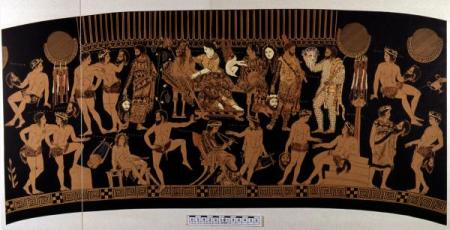
He then moved on to discuss the Pronomos Vase (pictured below) which is a depiction of a celebration after a victory in the Athenian tragic competition. The actors, having finished their satyr play are still in costumes and holding masks as they celebrate. Francois Lissarague actually used this particular photo of the famous Pronomos Vase. He explained that the vase was put in storage following an earthquake in Naples. Francois and a few other scholars were allowed to take it up to the roof of the museum to photograph it (which is why it sit here on a roof on a piece of newspaper).

I got this from a Google Image Search that lead me to this website [1].
Here is a slightly clearer picture so that some of the detail is discernible.
This lovely and clear image comes from this website, which also includes other wonderful theatrically-related images.
This final image flattens the vase in order to show the full range of characters depicted on the front of the vase. The back shows another scene.
A flattened version of the Pronomos vase from this website.
Francois' theme, which began with the Pronomos Vase and employed a number of other spectacular vases from Athens and South Italy seemed to be to show the variety of instances of the satyr, and especially the satyr in theater, portrayed on vases as well as the way in which theater is bound up with Dionysus on these vases. He also demonstrated the use of "metatheatricality" or the interplay between "real" mythological beings and theatrical portrays of those in the same scenes.

The front portion of the Pronomos Vase depicts Dionysus and his consort, presumably Ariadne, lying on a bed which looks suspiciously like a matrimonial bed rather than a symposium couch, according to Francois, amongst the victorious actors, choregos, and playwright after their performance. The victory is indicated by victory tripods, although these would not be the traditional indication of victory for a theatrical performance. All of the saytrs, save one who is still dancing, have taken off their masks and most hold them in various positions. The chorus, which is all uniformly dressed in costume, still has a large degree of variety to it and the citizen names of each individual are etched above the depiction.

Although there is a back panel and a front panel, the panels are continuous to some degree. The back panel depicts a group of "real" stayrs, not from a theatrical performance, with maenads and Dionysus and Ariadne, emphasizing the Dionysiac nature of theater.
A drawing of the back panel of the Pronomos Vase from Perseus.
The other eight vases that he showed demonstrated a variety of similar themes as well as depicting some fascinating images such as female satyrs, possible scenes from specific satyr plays such as Euripides' Cyclops, satyrs and Eros (which Lissarrague referred to as a "late improvement"), and a possible image of Dionysiac epiphany (which is one of my favorite Greek vases of all time [3]).

Although Francois Lissarrague did not voice much of a strong argument, he provided detailed instruction on the depiction of satyrs. Furthermore, his charming air and his excitement about his work prompted a number of the guests, my mom and me included, to immediately run up to see the Pronomos Vase after he finished speaking. He was quite fabulous.

Endnotes
  1. I have tried to link the "this website" under each photo to the website from which it came.
  2. Another version, possibly more easily accessible, of this image can be found here in Perseus's archives.
  3.  This pot is number 12 out of 17 in the Getty Slideshow. It is called "Mixing Vessel with Dionysus and Comic Actors."

Wednesday, September 29, 2010

Appetitive/Reasoning: Cerinthus Reports on the Theater at Epidaurus

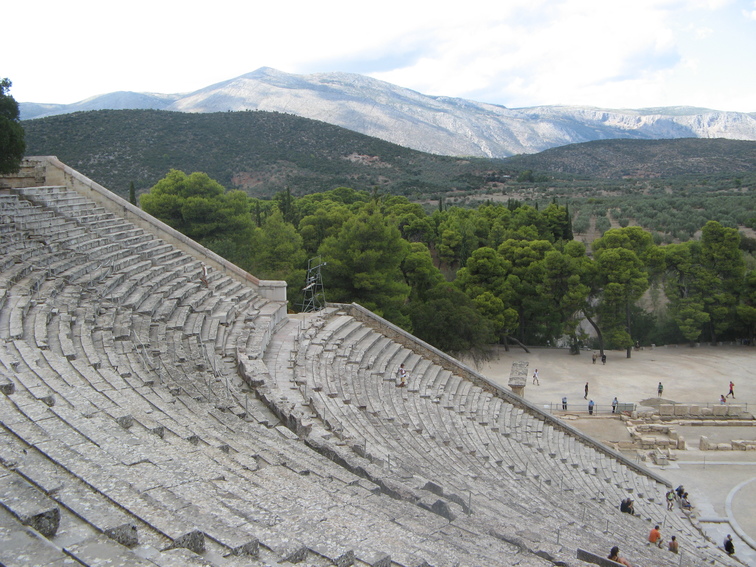
Cerinthus' panorama from Epidaurus


So after enjoying the amazing pottery concerning theater at the Getty Villa that I have written about in my recent blogposts (#1, #2, #3), I was feeling marginally less jealous of Cerinthus' trip to Greece. That was until I saw his most recent photos.

On his trip, he visited Epidaurus. The theater is incredible. According to an article on LiveScience as well as Wikipedia, the theater was built by Polykleitos the Younger in the 4th century BCE. Cerinthus explained that the limestone of the theater was the reason that the acoustics are so perfect. The LiveScience article explains the phenomenon. Specifically, the porous and grooved limestone absorbs the lower frequency sounds made by the audience while heightening higher frequency sounds made by the actors. Although it might seem as though the sound would be distorted by the lack of lower frequency sounds, the human brain fills in these sounds so that the sound does not seem distorted.


Earlier theaters, like that in Athens, were originally made of wood which does not have the same acoustic effect of the limestone. Even other theaters built after these period did not have the same perfect acoustics. The LiveScience article claims this is because the Greeks did not understand that the perfection of this theater came from the limestone combined with the shape and slope (LiveScience article).

More of the Theater from Cerinthus,


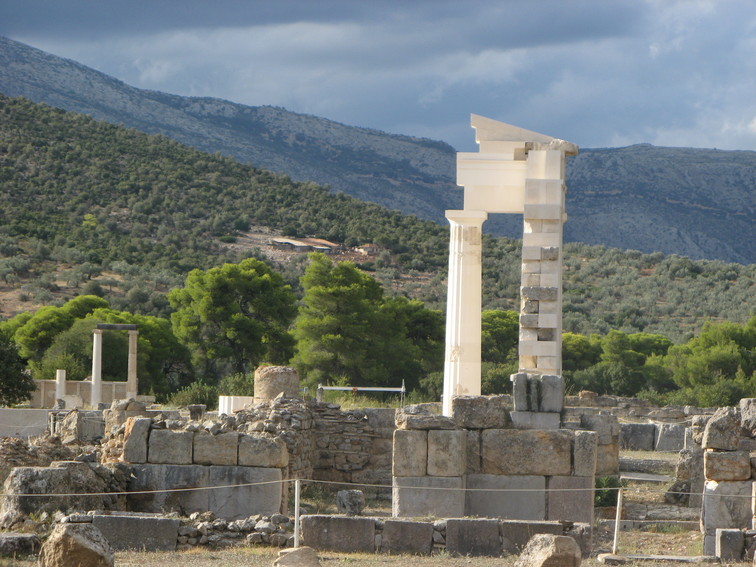
Correction: I mistook this picture for part of the theater because of the countryside. It is actually the Temple of Aesclepius at Epidaurus.
Temple of Aesclepius. Photo by Cerinthus.

Tuesday, September 28, 2010

Reasoning: The Iconography of Greek Theater #3, Ralf Krumeich

My mom took this picture in the gardens.

Ralf Krumeich spoke first, after Mary Louise Hart's introduction. I had not heard of him, because it appears that he writes only in German, but he is Privatdozent (which I assume is like a professor) of classical archaeology in at the Universitat Bonn and writes on archaeology, satyr plays, and the relationship between classical monuments in Athens and Delos as conceived by different cultures in the Hellenistic and Imperial periods.

Krumeich was a fascinating character. He was immediately likable and charismatic. His English was fabulous, although heavily accented. It made me realize how differently the Germans pronounce Greek names like Atreus (he said "aahh-traus"). He was perfectly understandable, and oddly enough when he was answering questions his English was better and more fluid than when he was reading his presentation. I want to be able to do that in German, someday.

Ralf Krumeich's ideas were also rich and well-explicated. He created a system for categorizing pottery and its relationship to theater and mythology:
  1. Images which explicitly show Athenians (or those from South Italy or Sicily) in or around the performance of a tragedy/satyr play/comedy.
  2. Mythological images which can be connected with theatrical performance through visual tropes such as masks, costumes, aulos players, etc.
  3. Myths where a character or characters are portrayed in theatrical costume. One of the main features that places a pot in this category is the lack of masks, as well as only some rather than all of the characters in theatrical dress.
He explained that a large portion of evidence about theater is tainted because it blurs these barriers. Most of the evidence that he problematized is scholars using pieces of pottery from the last two categories in order to make suppositions about the plot or staging of plays which remain only as fragments or titles.

From this information and these categories, he draws two interrelated conclusions. First,Theater, including rehearsals, and those who participated in theater (actors and dancers) have a social and religious significance which made them common themes. But second, although there are many images which incorporate the iconic tropes of theater, most of them are mythological paintings with a gesture toward theatrical performance and its cultural significance in the mythic narrative rather than any specific portrayal of theater or a theatrical performance.

I thought the paper provided valuable insights on the missteps of scholarship in equating art too closely with potential instances of theater. It also seemed to me that the three-level categorization was clear and useful. Overall, Ralf gave a great talk, accompanied by a wide variety of pictures of the different types of potter of which he spoke.

Saturday, September 25, 2010

Reasoning: The Iconography of Greek Theater #2, The Overview

getty villa,Greek Art
A picture from the exhibit "The Art of Ancient Greek Theater" at the Getty Villa [1].

The conference, "Artists and Actors: Iconography and Performance in Ancient Greece," was held over the last two days (although due to obligations at work I was only able to attend the first day). As Mary Louise Hart, the associate curator of antiquities at the Getty, remarked, it was primarily concerned with the "culture of performance," and the powerful images it inspired. The conference was held alongside a wonderful exhibit curated by Hart and entitled "The Art of Ancient Greek Theater." Although i did not get to see much of the exhibit, what I saw was magnificent. Mary did an incredible job not only gathering all of the wonderful pieces of pottery in one place for the first time, but also in the arrangement of the vases. Vessels with similar themes were placed together in order to display the juxtaposition of the depictions from different artists, places, and eras.

For my part, I would like to say thank you to Mary Louise Hart . To see all of this incredible craftsmanship in one place and to gather such an illustrious group of scholars, both among the contributors and the audience, was a phenomenal task. Hopefully, I will be able to return in the next few days to see the exhibit again and take the opportunity to study it.

Mary also put together a book, The Art of Ancient Greek Theater, from the images in the exhibit. The bookstore was a bit of a nightmare, so I did not get to look at it, but I can only imagine it's awesome.

The Art of Ancient Greek Theater

Endnotes
  1. Red-figured Neck Amphora showing Orestes slaying Klytaimnestra (detail), Paestum, South Italy, about 340 B.C. Terracotta, 18 3/4 x 7 13/16 in. The J. Paul Getty Museum, gift of Stanley Silverman (citation from the website). © 2010. The J. Paul Getty Trust. All rights reserved

Friday, September 24, 2010

Appetitive/Reasoning: Iconography of Greek Theater #1, Thoughts

I went to an incredible symposium today on the Iconography of Greek Theater. I was a little worried because I read the edited transcript of the last symposium held by the same people in 2003 and was highly irritated by it's contents (JSTOR). However, the symposium was absolutely incredible. Every single speaker was fabulous, the display was incredible-- gathering much of the available pottery that deals with tragedy, comedy, and satyr play, and it was a distinguished group of scholars.

I will tell more details of the conference over the next few days (as well as what I hated about the 2003 transcript). It was just so incredible to be there. I was totally starstruck when I saw Helene Foley, whose research I utilized in my thesis. I was like a little kid who had just seen her favorite movie star.

I also saw Kathryn Morgan, with whom I was told I should work if I go to UCLA. She seemed brilliant and terrifying and she reminded me very much of my Greek history professor. Overall, it was a pretty awesome day.

Saturday, September 18, 2010

Reasoning/Appetitive: An Introduction to Greek Tragedy

From Didasaklia

When I was searching for some of Oliver Taplin's work online last night, I came upon this brief, but succinct illustrated guide to Greek tragedy. It deals mostly with the material evidence of tragedy-- the theater as well as masks and the skene, but it provides an interesting overview of its evolution.

Friday, September 17, 2010

Spirited: Euripides and the Gods

The first time I saw Euripides' Orestes I though the actor playing Apollo, jarringly dressed in gold with a red and golden sun headdress,  had forgotten his lines. When I got home after words, I Googled the play and found out that it was not the acting, but rather the writing of play that had caused me such surprise and confusion. As I found out through further reading, the Orestes is only one of many of Eurpides' di ex machina that for an audience member may feel like something that came out of nowhere. [1]

For the most part [2], Euripides seems to use these incredible entrances of the Gods to force the play back into the mold of the traditional mythology, e.g. Orestes, Electra, and Bacchae [3]. However, I think the most notable and fascinating of these is the deus ex machina in the Medea.

There is a extremely vast array of incredible scholarship on the Medea, with which I shall not try to compete. If you have not read the Medea, read it right now. You can read in HTML or download a free version from Project Gutenberg. Although I don't know anything about this translation, you will be happy you read the Medea [4]. I will only reference the end, which is probably my favorite part of the Medea [5].

The mythology of Medea (pre-Euripides) so far as we know involved Medea leaving Jason and going to Athens to marry the king where she would try to dispose of his son Theseus while Jason dies by being hit from a falling timber from the Argo. There is, according to my wonderful Greek Tragedy professor, little or no evidence for the trope of Medea killing her children before Euripides' version. So, Euripides had a difficult task in front of him: how could he create an incredibly tragic story (the slaughter of her own children) and still provide for Medea's escape. At the end of the play, Medea arrives in the chariot of Helios (her grandfather) and explains that she is on her way to Athens. The audience might ask, "how can the gods condone such an action?" There are two instructive passages:
Medea: "Long would be the answer which I might have made to / these words of yours, if Zeus the father did not know / how I have treated you and what you did to me." (Medea lines 1351-1353)
and
Chorus: "Zeus in Olympus is the overseer / of many doings. Many things the gods / achieve beyond our judgement. What we through / is not confirmed and what we thought not god / contrives. And so happens in this story." (Medea lines 1415-1419)
So in these two passages it is clear that Zeus condones Medea's action and is happy to let her punish Jason for his misdeeds. However, the chorus is at a loss that the gods would condone such an action. Medea, now acting as a being partially between humans and gods demonstrates certain godly characteristics: a desire for revenge above all else, arrogance, and vanity. The gods here do not seem moral, but rather amoral human like beings with power far beyond the reach of humans that provides a system frightening because of the lack of standards in the system.

At times, Euripides' gods can be human seeming, almost comic (e.g. the Herecles of the Alcestis or the Apollo of the Orestes). They appear to be governed neither by the strict but uncomfortable hierarchical system of Aeschylus' gods nor by the extreme and frightening moral code displayed by Sophocles' gods (see my previous blogpost for elaboration). In Euripides, they almost seem human, but vein and powerful humans, living for revenge, who are interfering and conniving and have no sense of accountability. This makes them dangerous, unpredictable, and sometimes cruel, which seems to be a fair assessment of nature and the living conditions under which Hellenes of this period found themselves (and certainly a decent picture of the conditions of the Greek past).

Endnotes
  1. This image comes from http://baatheatrehistory.blogspot.com/
  2. Bear in mind, I have only read six (plus excerpts) of the seventeen surviving Euripides plays:  Bacchae, Electra, Medea, Orestes, Suppliant Women, and Trojan Women (as well as excerpts from Hecuba, Andromache, and Helen) plus Eurpidies' pro-satyr play, Alcestis, which was performed in place of a satyr play.. I also have read the Cyclops, the only surviving satyr play by Euripides (and the only complete extant satyr play).
  3. In the Bacchae, I speak specifically of the weird story about what is going to happen to Cadmus, which Dionysus relates (Bacchae lines 1329-1339).
  4. There was an amusing anecdote related in my Greek tragedy class one day. We read the Medea a few weeks before the end of the term and a number of the students in the class-- shockingly-- had never read it before. Our lovely professor asked us each for a reaction to the play or a favorite part at the beginning of the class. The reaction to the text was extremely positive, although people differed in their support of different characters and their personal favorite portions. By far the best reaction came from one of my favorite students in the class who had a particularly colloquial and perhaps somewhat frat-boy like vernacular which clashed magnificently against his thorough classics education and his insights that seemed divine in their origin given that they were unexpected because of this contrast and because they were usually shockingly accurate. He said something along these lines: "I am so glad that I finally read the Medea. Whenever my dad did something that would piss of my mother-- like leaving the top of the peanut butter jar-- and she found it he would say to us 'run kids, it's Medea.' I never knew what that meant." I believe that the professor responded something along the lines of "that's a fascinating insight into your parents."
  5. The greatest version of the Medea was a production put on in New York in the 1980s in the original Greek. It seems that primarily academic institutions (among them Williams College, UCLA, and Reed College) own versions of this rare and fabulous film. If you get a chance, watch it. It is breathtaking and it demonstrates the power and persuasion of Medea with a force and clarity that could never be rivaled in English. There are English subtitles if your Greek is lacking, but they only gloss the most important points, so it's easy to follow along it the Greek with a little help if you're interested in practicing your auditory understanding.