Showing posts with label Euripides. Show all posts

Saturday, June 14, 2014

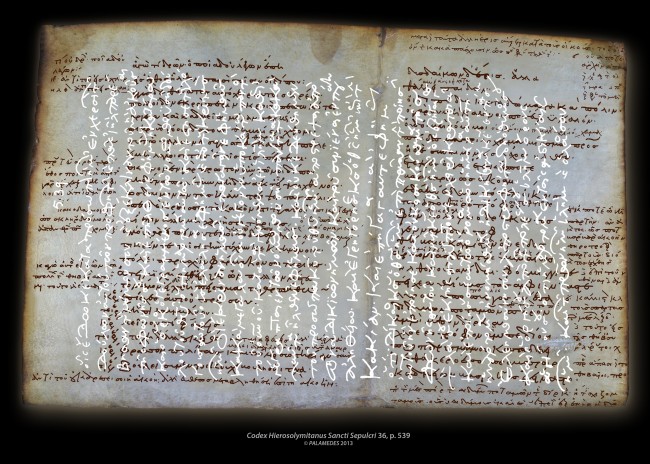
Reasoning/Appetitive: New Euripides Fragment Found

Coolest Picture Ever can be found here

Scientists Discover a new fragment of Euripides along with a new commentary on Aristotle under a 13th century copy of the prophetic books of the Greek old testement. More information can be found at medievalists.net or from Göttingen University.

Thursday, July 21, 2011

Appetitive: The Most Amazing Birthday Gift

It's not my birthday, but my birthday is coming up. Cerinthus came down and gave me the worlds greatest birthday present: a copy of the 1988 production of the Medea in the original Greek (Peter Steadman, director. Commentary by William Arrowsmith). It's a DVD copy that I had to swear I would only use for educational purposes. I'm really excited. Cerninthus and I are going to watch it (I think tomorrow) with Servia and I will post a review when we watch it again.

If you can get a hold of a copy of this movie, I highly suggest watching it. It's absolutely fabulous.

Thursday, April 7, 2011

Reasoning/Spirited: Publishing and the Internet

I found this article on Twitter. I thought it was especially interesting for classicists/grad students. Apparently some publishers get really jumpy about publishing books from dissertations that appear online in digital form. Others seem to feel that this means that there is already a market for the product. I wonder whether publishers will end up moving digital information backward by forcing students not to share their work if they want to be considered publishable.

Euripides: Medea (Cambridge Greek and Latin Classics)
I read over 80 lines of Μήδεια today and I am exhausted (how will I ever survive grad school?) so I am not going to finish my addendum to the comments on "Μήδεια and Rhetoric" tonight. However, they should appear in a semi-coherent form in the next few days along with some addenda to "Μήδεια and the 'Royal We'," some thoughts on Isocrates, Parmenides, and a review of the most recent Marathon 2500 talk.

Tuesday, March 8, 2011

Spirited: Μήδεια and the "Royal We"

In English, there is a phenomenon known as the "royal we" where a speaker used first person plural as a stand-in for first person singular. Generally, this phenomenon associates itself with arrogant and schizophrenic-type personalities. In Greek or Latin, poets often employ the first person plural so it is essentially the "poetic we" rather than the "royal we."

Herodotus II and I have recently doubled our number of lines per week in order for us to finish before summer vacation. Although this certainly requires more time, it also provides me with a greater sample size in which to notice patterns. One of the things that stood out to me as I read our most recent section was the use of the "poetic we." Μήδεια employs this tactic quite frequently, although she also uses the first person singular within 2-3 lines of her first person plural. I did not notice, although I might have missed it, Kreon using the poetic plural, nor any of the other characters (I am happy to be corrected if someone notices an instance). So, I wondered why Medea, specifically, might use this rhetorical device.

Euripides, as I remember reading in my Bacchae class freshman year, likes to use "halved" characters, i.e. two main characters who each represent one set opposing characteristics usually housed in a single person. Unlike his half characters, Medea seems to be a duel (or possibly more) character. She switches from courageous and fearsome at one moment, to helpless and despairing the next, to conniving and persuasive, sometimes within a single speech. Like Hekate (Μήδεια line 397), the goddess she worships, to whom each of the three main Gods (Zeus, Poseidon, and Hades) gave a small segment of their domain, she functions as a polymorphic character. Each of the characters around her serve a single function. Even the chorus of women acts essentially as a single entity; they represent a moderate buffer to the extreme arguments put forward by any side. But Medea demonstrates so many different personality traits and skills that she becomes awesome and terrifying.
Euripides: Medea (Cambridge Greek and Latin Classics)

Update 03/24/11: Jason also uses the "poetic we" at least once. I ran across this in line 451 where he refers to himself as κἀμοὶ which is a crasis of και + αμοι (from αμος, "our"). However, this is the first time it is mentioned by another character. Also, interestingly enough, Jason is being deceptive here and saying things he only half means in a typical Μήδεια style. I will have to investigate further.

Tuesday, February 1, 2011

Reasoning: Hippolytus

Today I read Philip Vellacott's translation of Hippolytus. I thoroughly enjoyed it.

Philip Vellacott is an odd scholar. I was introduced to his work when I was assigned his essay "Has the Good Prevailed?" (JSTOR) in my Agamemnon class. He has an unusual take on the ending of the Eumenides that I found intriguing (although I do not quite agree with it) and I became interested in his work. While Cerinthus was in New York, he bought a beautiful copy for me that he found at the Strand.

Hippolytus is the story of Hippolytus, Phaedra, and Theseus. Phaedra falls in love with her son-in-law, Hippolytus. Hippolytus spurns all human love and devotes himself entirely to Artemis. While Theseus is away, Phaedra begins to look sickly and worry her nurse. The nurse eventually discovers Phaedra's secret and tells Hippolytus who is very angry. The nurse makes Hippolytus promise not to tell anyone what he has heard. Phaedra hangs herself, claiming in her suicide note that Hippolytus raped her. Theseus, angry, sends Hippolytus into exile and curses him in Poseidon's name. Hippolytus, a man of moral standing, cannot correct the record because it would break his promise to the nurse, and dies in his chariot as he leaves. Only then does Artemis come down to reveal the truth to Theseus.

Although I enjoyed reading this translation of the play, I found that it lacked the compelling psychological drama of Μήδεια or the theatrical insanity of the Βάκχαι. The conflict seemed less real; instead of a conflict about human morals, religious values, or institutions depicted in Euripides' usual complex manner, the story forced a very black-and-white outlook on piety and moral value of truth. I look forward to reading some interesting scholarly criticism on the play.

Thursday, January 13, 2011

Appetitive: The Aleppo Codex

I thought I would repost another one of the wonderful discoveries I have made on AWOL. I had never heard of the Aleppo Codex until this post. The codex is the oldest complete manuscript of the Hebrew Bible. It appears to have been written in 930 CE by a scribe named Salomon is beautiful Hebrew calligraphy. AWOL posted an incredible website that has a complete text of the Aleppo Codex along with a searchable interface and introductory notes. Absolutely fantastic.

More discussion of the Μήδεια coming tomorrow!

Tuesday, January 11, 2011

Reasoning: Doctoral Theses

My mother pointed me to a set of theses on AWOL, and specifically one called "Astronomy and Ancient Greek Cult" by Efronsyni Boutsikas. It looks excellent and I am going to download it on my kindle to read.

One of my best friends was in town for the last two weeks (the one with whom I am planning to learn Sanskrit) and I spent a lot of time catching up with her in between relapsing on my horrible cold that I've had all month and talking about classics rather than doing any work. I have been so distracted I even forgot to translate my Μήδεια for tomorrow! Anyway, nose should go back to the grindstone as I translate Greek and review my Latin so I can finally meet with Propertius II again.

Saturday, January 1, 2011

Spirited: All the Greek Verbs

So it seems my resolutions are not going very well so far as I have done no Greek or Latin as of yet and did not begin my blogpost until now. I also spent much of the day reading a book not on my reading list: Jeff Sharlet's The Family. It's just been one of those days.

However, I have been flipping through a gift I received: Nino Marinone's All the Greek Verbs. I have spoken before of my unintentional reliance on Perseus for the sake of efficiency in translating Latin and especially Greek. Part of this is because I do not know irregular verb conjugations (and sometimes cannot identify regular or common verb conjugations) off the top of my head. All the Greek Verbs is a list of verb forms, which tell you the person, number, tense, voice, and mood of each verb, as well as the verb itself so that one can look up a translation. I think this will help to ween me off of my Perseus addiction, because I can use a book instead of the computer and constantly looking up the verbs in paper dictionary will help not only to ingrain the verb forms but also the meanings in my head. I will update this review when I try it out on the next section of the Μήδεια.
Euripides: Medea (Cambridge Greek and Latin Classics) All The Greek Verbs (Greek Language)
Happy New Year, everyone!

Does anyone know if there is a similar book for Latin?

Friday, December 31, 2010

Reasoning: Greek Oaths

I spent the last few days reading and spending a few hours on Mήδεια. In throughout the beginning, Μήδεια talks a lot about oaths and vows. In the section I was reading today, Μήδεια calls on Zeus (alternately rendered Ζῆνά) and Themis to see that her husband has broken his marriage vows.
 "κλύεθ' οἷα λέγει κἀπιβοᾶται / Θέμιν εὐκταίαω Ζῆνά θ', ὃς ὅρκων / θωητοῖς τμίασ νενόμισται; / οὐκ ἔστιν ὅπως ἔω τινι μικρῶι / δέσποινα χόλον καταπαυσει" (Mήδεια lines 169-172, spoken by the Nurse)
The Nurse (Τροφός), adding emphasis to the oath, asks the Chorus if they heard it. Mastronarde mentions that there was a legal nature to calling particularly on Zeus and Themis.

Although there is certainly a legal nature, law in Ancient Greece was tied directly with religion. Not only could people bring the charge of impiety or atheism (e.g. Socrates), but there were religious ceremonies tied into the legal proceedings themselves (see commentary on Aeschylus' Eumenides. There may even be enough material in Hugh Lloyd-Jones' translation). At the same time, Μήδεια is talking about a legal oath and a religious one, and the strength of this oath seems to be important. Unfortunately both the scholarship and my knowledge of the complexities of oaths and Greek religion is lacking. I have looked, but little is as in-depth or satisfying as it should be.
Euripides: Medea (Cambridge Greek and Latin Classics) Oresteia

"ΖEUS ΣΩΘΗΡ ΤΡΙΤΟΣ and Some Triads in Aechylus' Oresteia"(JSTOR) is Peter Burian's amazing article about oaths-- or more libations-- in the Oresteia. I highly recommend the article. At banquets, so far as I can tell, three libations were poured: one for the Olympians, one for the cthonic gods (i.e. the old, earthier, and darker gods like Night and Persephone)[1], and the last to Zeus the Savior. There are a lot of interesting implications to this throughout the Oresteia. I almost wrote my thesis on the Zeus cult in the Oresteia, but too much of the scholarship was in German so I couldn't pull it off.

Endnotes
  1. Cthonic gods comes from the Greek word χθών meaning earth. They are gods that have to do with the earth (or under the earth) such as Hades and Persephone, as well as the "older," primordial gods like Night. More on cthonic cults and gods at some other time.

Wednesday, December 15, 2010

Reasoning: Thoughts on the Medea

I have been reading the Μήδεια in Greek with a friend of mine who is in Turkey (skype is awesome). One of the things that we notice recently was that not only is there an ever-present sense of doom in the beginning of the text, but it is clear from the rhetoric that the Τροφός (Nurse) and the Παιδαγωγός (Tutor) use that they know from the beginning (or at least fear) that Μήδεια will kill her children in an act of vengeance in a way that does not seem as imminent in the English.

Two questions emanate from this: 1) do we (as the audience) ignore the rhetoric because we know the ending, but notice it reading the Greek because we focus on it word by word (and therefore the Greek audience would not have noticed this aspect) or 2) if Euripides' version was the original version of the myth in which Μήδεια killed her children, what would the audience have been thinking during this opening scene?

Just food for thought.
Euripides: Medea (Cambridge Greek and Latin Classics)

Monday, November 1, 2010

Reasoning: Mastronarde's Greek Tutorial

Donald Mastronarde, a professor at UC Berkeley, posted an incredible online Ancient Greek Tutorial. His instruction accenting rules seem more complicated to me than the way I was taught, but obviously everyone learns differently and this might be the perfect way for certain people to learn Greek accenting. He also covers pronunciation, vocabulary, and declension and conjugation paradigms.

I did not encounter Mastronarde's work until last year, when a wonderful professor recommended the Mastronarde edition of the Medea to me. Although I did not get a chance to read it then, I am reading now with a friend over skype and I am really enjoying it. Mastronarde's text provides a great introduction and an extensive and helpful commentary. I highly recommend the edition and the play, which is fabulous. It turns out, however, that he wrote an introductory Greek textbook, Introduction to Attic Greek, about which I know nothing.
Euripides: Medea (Cambridge Greek and Latin Classics) Introduction to Attic Greek **ISBN: 9780520201774**

While I was looking for Mastronarde's other work today, I stumbled upon Mastronarde's article "Euripidean Tragedy and Theology" which  I have not read it yet, but it looks quite interesting. Maybe I'll end up amending my "Euripides and the Gods" post.

Wednesday, October 20, 2010

Reasoning: The Iconography of Greek Theater #9, Oliver Taplin

Oliver Taplin was a fascinating character. He looked very much like a typical British professor, but in precisely the opposite fashion to Alan Shapiro. While Alan looked like the prim British professor, Oliver was not disheveled, but certainly looked like he had taken more care of his work than himself. However, his appearance only added to the genuine British charm that he had. He had a wonderful exuberance that was contagious and filled the whole room.

He is a professor emeritus at Magdalen College, University of Oxford and he has written a plethora of incredible books and articles, including The Stagecraft of Aeschylus which I read about half of for my class on the Agamemnon and was fortunate enough to receive as a birthday gift this year. Two books he edited which I would love to read are The Pronomos Vase and its Context and Pots & Plays: Interactions between Tragedy and Greek Vase-painting of the Fourth Century B.C..
The Stagecraft of Aeschylus: The Dramatic Use of Exits and Entrances in Greek Tragedy (Clarendon Paperbacks) The Pronomos Vase and its Context Pots & Plays: Interactions between Tragedy and Greek Vase-painting of the Fourth Century B.C. (J. Paul Getty Museum)

Taplin opened his talk by explaining that he would be considering three questions.
  1. What was the importance of traveling players in Ancient Greece?
  2. How did those traveling players influence art?
  3. Did traveling players manage to reach a non-Greek audience [1]?
Taplin started with the first question. He explained that scholarship has, for centuries, analyzed the unique Athenianness of theater. According to Taplin, this ignores a portion of the extant evidence that we have for theater. According to Taplin, the earliest evidence that we have for re-performance of plays comes from Herodotus, who explained that one of the penalties on Phrynikos for his play The Sack of Miletus [2] was that it was banned from re-performance.

Beside this, Aeschylus spent time a Heiron's court in Syracuse, both before he wrote the Oresteia [3] and during the end of his life (in fact, he died there [4]). Hieron, the tyrant of Syracuse at the time, commissioned a play at the founding of Aetna, The Women of Aetna [5]. Euripides died in Macedonia and may have written the Bacchae there [6].

Furthermore, vases containing theatrical imagery have been found in burials at Phanagoria, Cyrene, Korinth, Olbia, and Ruvo. In the non-Greek areas, scholars often dismiss the pots and assume that people just liked the pictures. Taplin, and especially Carpenter, seek to challenge this assumption.

According to Taplin, between Hieron and Alexander the Great, there was an increase in the theater outside of the festival of Dionysus at Athens. First, there were rural Dionysias in the outer demes [7]. These were serious cult events in the 5th century. In Republic 475d, Socrates disparages those theater-goers who do not miss any Dionysian in the cities or villages. Demosthenes, according to Taplin, also criticizes Aischenes for going to the lesser theater competitions. Furthermore, actors came from all over the Mediterranean, not just from Athens. Taplin cites Aristedemus from Metapontion as an example [8]. By 440, there were at least five regular theatrical festivals, and there is some evidence for 14 all together, although many of these were not held in traditional stone theaters.

Furthermore, Plato provides evidence of dramatic competition in outside of Athens. In Laws 659b-c, Plato disparages the demos-centric way that the judges decide competitions in Italy and Sicily (i.e. judges were swayed by public opinion). This provides evidence that there was some kind of theatrical competition that took place in these areas. Taplin argues that the actors in these competitions were probably from traveling troupes, and that these performers would respond to invitations to various festivals. He hypothesizes that there would be three actors, with a possible fourth actors playing the chorus. In the third century, according to Taplin, choruses would travel with the bands, but probably not before that. He notes, in reference to Kowalzig, that the Dithyramb was part of Hellenic culture, and it makes sense that choruses of all types would be part of civic coherence not just in Athens, but also Magna Graeca.

Taplin claims that the vases from Syracuse, Lukania, and other places in the Greek world serve as material evidence of traveling troupes [9]. Tombs in around Magna Graeca contain vases with theatrical imagery that appear to be made outside of Athens.

At the end, Taplin addressed Carpenter's case for Greek plays in the Italic areas of Apulia. Taplin agreed with Carpenter, saying that 10% of the dramatically related vases in Italy come from Ruvo. However, Taplin believed that the Pronomos Vase must have been bought on the secondhand market and brought back to Ruvo, possibly by someone who got to see the theatrical competition in Athens and bought it as a keepsake.

Endnotes
  1. This is the same subject, on a larger scale, as Carpenter's talk. Near the end, Taplin directly responded to Carpenter, and he agreed with everything except Carpenter's discussion of the Pronomos Vase.
  2. See this in Herodotus' Histories section 6.21. However, I think it's important to note that there is no indication in this that the plays would be re-performed outside of Athens, but also no indication that they would only be reprised in Athens. For context, Phrynikos' play, the Sack of Miletus (not extant), was the last play that depicted an real, current, tragic event (with the possible exception of the Persians because I am not sure of the comparative dates and also because the Persians was slightly different in tone and perspective). It was a play about the devastating Sack of Miletus and, according to Herodotus, the entire audience burst into tears. For causing such a disturbance, Phryikos was fined and the play was banned from ever being performed again.
  3. There are some fascinating similarities in the description of fire/gold in Pindar's Olympian I and the opening speech of the Agamemnon, but I will save this discussion for another time.
  4. The story of Aeschylus' death has functioned somewhat as an urban myth and has even invaded modern popular culture. I have heard two versions of the story. Both are premised on Aeschylus being bald. The first version says that as Aeschylus was walking along the beach in Sicily, an eagle mistook his bald head for a tortoise and dropped a rock on it to break it open. The second version, which I believe is at some point retold by Dr. Donald "Ducky" Mallard on NCIS, is that an eagle, carrying a turtle, mistakes Aeschylus' head for a rock and drops the turtle on it to crack open the shell. Whether he died in one of these ways or not, it makes for a great story.
  5. All that remains is a fragment.
  6. There is a wonderful moment about this in Nietzsche's Birth of Tragedy, but I cannot seem to find it. If anyone knows where it is, comment or email me.
  7. A deme is much like a village that is part of the polis.
  8. I am not sure about the spelling on either of these names.
  9. A vase depicting the Medea shows the version of the story in which Medea slaughters her children. According to Taplin (citing Mastronarde), this was not a version of the myth in popular culture until Euripides' version.

Friday, September 17, 2010

Spirited: Euripides and the Gods

The first time I saw Euripides' Orestes I though the actor playing Apollo, jarringly dressed in gold with a red and golden sun headdress,  had forgotten his lines. When I got home after words, I Googled the play and found out that it was not the acting, but rather the writing of play that had caused me such surprise and confusion. As I found out through further reading, the Orestes is only one of many of Eurpides' di ex machina that for an audience member may feel like something that came out of nowhere. [1]

For the most part [2], Euripides seems to use these incredible entrances of the Gods to force the play back into the mold of the traditional mythology, e.g. Orestes, Electra, and Bacchae [3]. However, I think the most notable and fascinating of these is the deus ex machina in the Medea.

There is a extremely vast array of incredible scholarship on the Medea, with which I shall not try to compete. If you have not read the Medea, read it right now. You can read in HTML or download a free version from Project Gutenberg. Although I don't know anything about this translation, you will be happy you read the Medea [4]. I will only reference the end, which is probably my favorite part of the Medea [5].

The mythology of Medea (pre-Euripides) so far as we know involved Medea leaving Jason and going to Athens to marry the king where she would try to dispose of his son Theseus while Jason dies by being hit from a falling timber from the Argo. There is, according to my wonderful Greek Tragedy professor, little or no evidence for the trope of Medea killing her children before Euripides' version. So, Euripides had a difficult task in front of him: how could he create an incredibly tragic story (the slaughter of her own children) and still provide for Medea's escape. At the end of the play, Medea arrives in the chariot of Helios (her grandfather) and explains that she is on her way to Athens. The audience might ask, "how can the gods condone such an action?" There are two instructive passages:
Medea: "Long would be the answer which I might have made to / these words of yours, if Zeus the father did not know / how I have treated you and what you did to me." (Medea lines 1351-1353)
and
Chorus: "Zeus in Olympus is the overseer / of many doings. Many things the gods / achieve beyond our judgement. What we through / is not confirmed and what we thought not god / contrives. And so happens in this story." (Medea lines 1415-1419)
So in these two passages it is clear that Zeus condones Medea's action and is happy to let her punish Jason for his misdeeds. However, the chorus is at a loss that the gods would condone such an action. Medea, now acting as a being partially between humans and gods demonstrates certain godly characteristics: a desire for revenge above all else, arrogance, and vanity. The gods here do not seem moral, but rather amoral human like beings with power far beyond the reach of humans that provides a system frightening because of the lack of standards in the system.

At times, Euripides' gods can be human seeming, almost comic (e.g. the Herecles of the Alcestis or the Apollo of the Orestes). They appear to be governed neither by the strict but uncomfortable hierarchical system of Aeschylus' gods nor by the extreme and frightening moral code displayed by Sophocles' gods (see my previous blogpost for elaboration). In Euripides, they almost seem human, but vein and powerful humans, living for revenge, who are interfering and conniving and have no sense of accountability. This makes them dangerous, unpredictable, and sometimes cruel, which seems to be a fair assessment of nature and the living conditions under which Hellenes of this period found themselves (and certainly a decent picture of the conditions of the Greek past).

Endnotes
  1. This image comes from http://baatheatrehistory.blogspot.com/
  2. Bear in mind, I have only read six (plus excerpts) of the seventeen surviving Euripides plays:  Bacchae, Electra, Medea, Orestes, Suppliant Women, and Trojan Women (as well as excerpts from Hecuba, Andromache, and Helen) plus Eurpidies' pro-satyr play, Alcestis, which was performed in place of a satyr play.. I also have read the Cyclops, the only surviving satyr play by Euripides (and the only complete extant satyr play).
  3. In the Bacchae, I speak specifically of the weird story about what is going to happen to Cadmus, which Dionysus relates (Bacchae lines 1329-1339).
  4. There was an amusing anecdote related in my Greek tragedy class one day. We read the Medea a few weeks before the end of the term and a number of the students in the class-- shockingly-- had never read it before. Our lovely professor asked us each for a reaction to the play or a favorite part at the beginning of the class. The reaction to the text was extremely positive, although people differed in their support of different characters and their personal favorite portions. By far the best reaction came from one of my favorite students in the class who had a particularly colloquial and perhaps somewhat frat-boy like vernacular which clashed magnificently against his thorough classics education and his insights that seemed divine in their origin given that they were unexpected because of this contrast and because they were usually shockingly accurate. He said something along these lines: "I am so glad that I finally read the Medea. Whenever my dad did something that would piss of my mother-- like leaving the top of the peanut butter jar-- and she found it he would say to us 'run kids, it's Medea.' I never knew what that meant." I believe that the professor responded something along the lines of "that's a fascinating insight into your parents."
  5. The greatest version of the Medea was a production put on in New York in the 1980s in the original Greek. It seems that primarily academic institutions (among them Williams College, UCLA, and Reed College) own versions of this rare and fabulous film. If you get a chance, watch it. It is breathtaking and it demonstrates the power and persuasion of Medea with a force and clarity that could never be rivaled in English. There are English subtitles if your Greek is lacking, but they only gloss the most important points, so it's easy to follow along it the Greek with a little help if you're interested in practicing your auditory understanding.