Francois started his talk by providing a brief note on the history of the satyr. He explained that satyrs are an Attic invention of the early sixth century, which are depicted as a cross between man and horse. There are other human animal hybrids and even human-horse hybrids (like centaurs) that are depicted, but satyr imagery only begins to show up int he 6th century. I found this to be fascinating because I assumed that the depiction of satyrs came long before the invention of the satyr play.
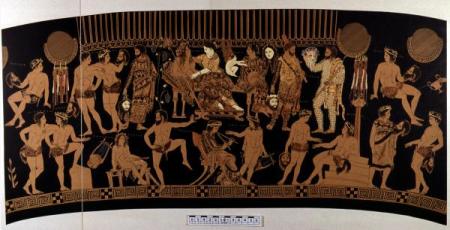
He then moved on to discuss the Pronomos Vase (pictured below) which is a depiction of a celebration after a victory in the Athenian tragic competition. The actors, having finished their satyr play are still in costumes and holding masks as they celebrate. Francois Lissarague actually used this particular photo of the famous Pronomos Vase. He explained that the vase was put in storage following an earthquake in Naples. Francois and a few other scholars were allowed to take it up to the roof of the museum to photograph it (which is why it sit here on a roof on a piece of newspaper).
 |
| I got this from a Google Image Search that lead me to this website [1]. |
 |
| This lovely and clear image comes from this website, which also includes other wonderful theatrically-related images. |
 |
| A flattened version of the Pronomos vase from this website. |
The front portion of the Pronomos Vase depicts Dionysus and his consort, presumably Ariadne, lying on a bed which looks suspiciously like a matrimonial bed rather than a symposium couch, according to Francois, amongst the victorious actors, choregos, and playwright after their performance. The victory is indicated by victory tripods, although these would not be the traditional indication of victory for a theatrical performance. All of the saytrs, save one who is still dancing, have taken off their masks and most hold them in various positions. The chorus, which is all uniformly dressed in costume, still has a large degree of variety to it and the citizen names of each individual are etched above the depiction.
Although there is a back panel and a front panel, the panels are continuous to some degree. The back panel depicts a group of "real" stayrs, not from a theatrical performance, with maenads and Dionysus and Ariadne, emphasizing the Dionysiac nature of theater.
 |
| A drawing of the back panel of the Pronomos Vase from Perseus. |
Although Francois Lissarrague did not voice much of a strong argument, he provided detailed instruction on the depiction of satyrs. Furthermore, his charming air and his excitement about his work prompted a number of the guests, my mom and me included, to immediately run up to see the Pronomos Vase after he finished speaking. He was quite fabulous.
Endnotes
- I have tried to link the "this website" under each photo to the website from which it came.
- Another version, possibly more easily accessible, of this image can be found here in Perseus's archives.
- This pot is number 12 out of 17 in the Getty Slideshow. It is called "Mixing Vessel with Dionysus and Comic Actors."