Showing posts with label Books. Show all posts

Saturday, January 7, 2012

Appetitive: The Top Shelf

Books

There are very few bookshops left near me. Even the big ones like Barnes & Noble and Borders have shut down now. I ran into a bookshop that I thought had closed down a few years ago. It's very small. I thought about not even looking for classics books, but I spotted an old copy of Herodotus on the shelf. I couldn't reach. I had to use the big ladder to get up to the top few shelves where I spotted a few Loebs and OCTs.

The books were actually a good price and rather wonderful. The selection is not very large, but it's nice to know there's still a bookstore around. I bought a couple of things but I am not sure how it stays in business.

Friday, August 19, 2011

Appetitive: Birthday Books

Birthday Books
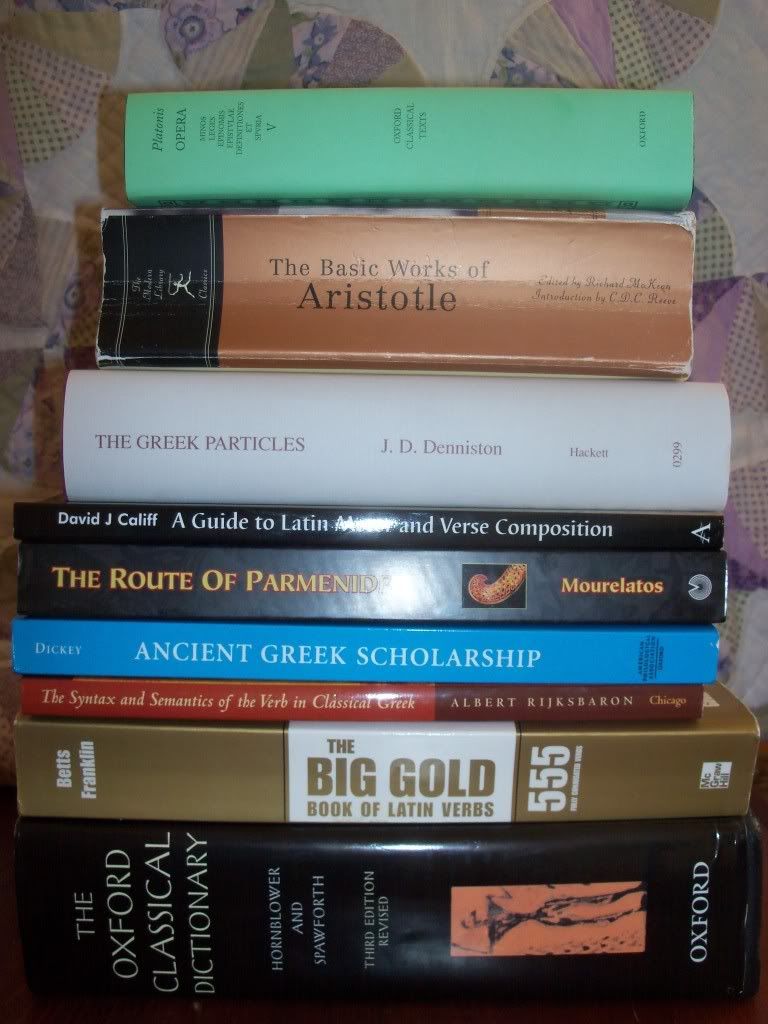
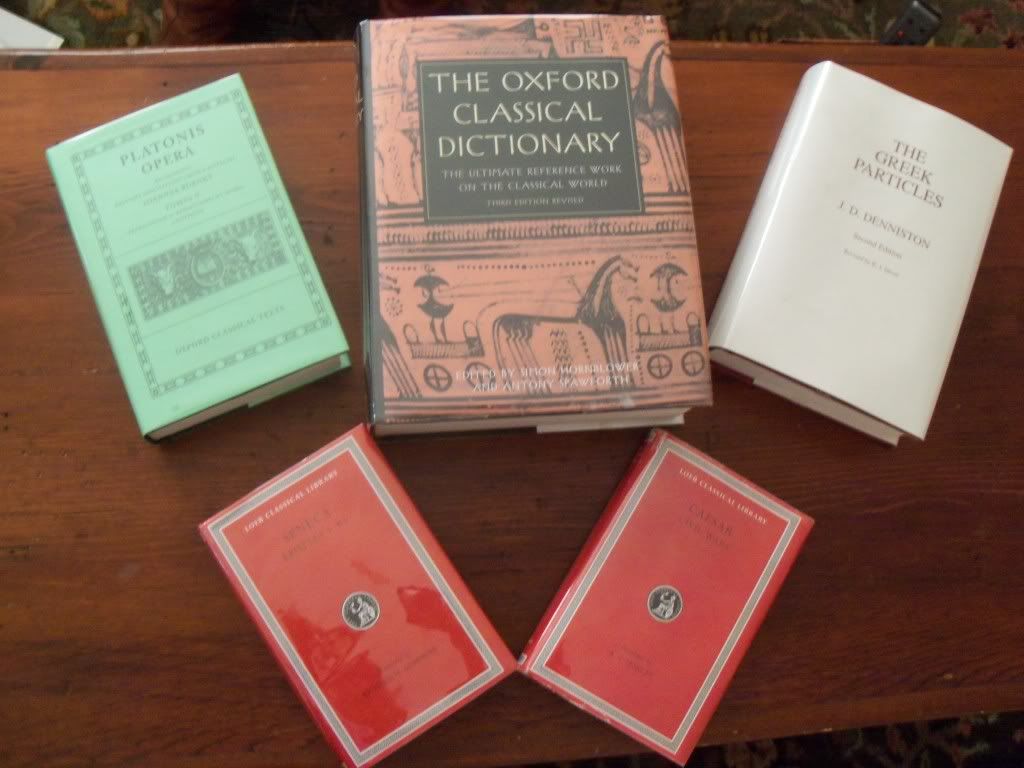
My birthday was recently. As I am starting up classes as the local large university in classics. So the theme of my recent birthday was books that will prepare me for school (or various other classically-related things). I am very excited by all of this. Propertius II, with whom I shared a thesis desk had a copy of the Oxford Classical Dictionary (OCD), and I used it a little. I really enjoyed it and I especially needed it for my current art history class where mythological background is crucial and my art history professor takes very unkindly to websites as resources. I am also really excited about having the OCT of the Laws so that I may reference the Greek easily and a copy of The Greek Particles, to which my Greek History professor sang paeans in my Herodotus class.
Covered books
I took the opportunity today between my German midterm and my doctor's appointment to cover some of the books. My mom volunteered at the library of both my elementary school and high school and she got me into those library covers over dust jackets to protect the books. Covering books is a very relaxing activity.

Monday, February 14, 2011

Appetitive: Books-- a Valentine's Day Tradition

The summer before my junior year in college, I almost entirely stopped eating chocolate. When Valentine's Day came, a package arrived for me. Inside the package was a box-- which looked very much like a chocolate box-- wrapped in white paper with a pink ribbon. I opened it, thinking I would have to figure out which of my friends I could convince to eat it. To my great pleasant surprise, it was a copy of the hardcover copy of Being and Time which I later used to start my Heidegger study group. The books-wrapped-like-chocolate have now become a tradition, and they are usually dense texts. This year my parents got me Hans-Georg Gadamer's Dialogue and Dialectic: Eight Hermeneutical Studies on Plato and a study of Dionysus by Richard Seaford titled DIONYSOS. I am quite excited to read both of them. Being by far the lighter of the two, I read the introduction to DIONYSOS earlier today and it looks great. Richard Seaford is brilliant; I read on of his essays from Reciprocity and Ritual: Homer and Tragedy in the Developing City-State in a Greek class I took on tragedy and the Oresteia.
Dialogue and Dialectic: Eight Hermeneutical Studies on Plato DIONYSOS
Happy Valentine's Day!

Friday, February 4, 2011

Appetitive: A Rant on Editions and Revisions

I thought there were supposed to be laws against false advertising. I was given a book I really wanted for the holidays, Nicole Loraux's The Invention of Athens: The Funeral Oration in the Classical City, so you might wonder why I am grumbling. As it turns out, this is an abridged version, but no where on the outside of the volume does it account for this fact.

It was not until I began reading Loraux's book that I realized the problem. The preface to the second edition refers to it in the early paragraphs as "abridged" and as "a shorter version. then, but not a rewritten version" (Loraux 15). The back of the book contradicts her statement, claiming that "this new edition of The Invention of Athens includes Loraux's significant revisions undertaken in 1993 to render this groundbreaking work accessible to nonspecialists." "Significant revisions" vs. "not a rewritten version" seems contradictory to me. Furthermore, the titles are exactly the same:The Invention of Athens: The Funeral Oration in the Classical City vs. The Invention of Athens: The Funeral Oration in the Classical City. The first one in that series is the new 2006 edition with the "revisions," i.e. cutting out a lot of stuff that might be really useful to me, and the second is the old 1986 edition.

In my opinion, if it's abridged, call it abridged. If you think it will sell less copies than do not abridge it in the first place!!!
The Invention of Athens: The Funeral Oration in the Classical City
The abridged version--2006 (539 pages).

As a note: I love the book. There is no reason to suppose it was abridged. I wish there was a way to hold publishers accountable for problems like this.

Thursday, February 3, 2011

Reasoning: Vlastos' Socratic Studies #3

This is the third installment in the chain of blogposts discussing Gregory Vlastos' work Socratic Studies. The third essay in the collection is "Is the 'Socratic Fallacy' Socratic?" I have been studying Plato for five years now, and in depth for about two years, and I never happened across the "Socratic Fallacy." Perhaps this is because I have shied away from the more philosophical approaches to Plato and preferred the classical interpretations. One of the prime examples, apparently, appears in the Lysis (223b) [1] which is one of the Platonic dialogues I have not yet read.

In more general terms, Vlastos phrases the Socratic fallacy as the following: "If you do not know what the F is, you will not know if you are predicating "F" correctly about anything whatever-- you will not know if anything is F" (Vlastos 69). As an example, if you do not know what the beautiful is, then you cannot know whether someone is beautiful (Vlastos 69).

Vlastos provides an argument made by other analytic ancient philosophy scholars (such as Myles Burnyeat) which he refers to as STB. The TB part of the acronym stands for "true belief" and it hinges upon the idea that even if one does not know something, a true belief is sufficient for acting as though they know it. As such, Socrates can maneuver around such a fallacy by saying that even though he doe snot know what a friend is, he has a true belief about it which allows him to call a particular individual a friend (Vlastos 72-73). Arguing based on the work on the different types of knowledge from his previous essay, Vlastos explains that Socrates not only asserts that he has moral knowledge, but also that such moral knowledge is required for being noble and living any semblance of a good life and true beliefs cannot possbily suffice (Vlastos 73).

After a series of arguments, Vlastos proposes an alternative solution: the Socratic fallacy is not Socratic but mathematical. He contends that the influence of mathematics upon Plato's work (notably in the Meno) provides the first introduction of this fallacy and that the fallacy is a perfectly logical statement in geometry (Vlastos 85). He argues that those works which fall directly in the Socratic period, as he calls it, where he believes that Plato represents Socrates' thought, do not include this fallacy while those after the influence of mathematics do include such a fallacy [2].
Socratic Studies
Here is my proposed answer to Vlastos' problem, as I find his mathematical answer to rely too much on the flawed traditional conceptions of the dates of the dialogues [3]: I think that Socrates' "fallacy" is rather a ploy. To some extent, I believe Plato's Socrates does mean what he says: e.g. if we cannot come to an answer of what friendship is through elenchus we could mistakenly consider someone as a friend who is not. However, what Socrates also points out through this statement is precisely that humans still have the inclinations to use words like justice and friendship despite their lack of a rigorous definition. This is extremely important because it shows that there is some kind of thought about these abstract concepts even if we cannot express it in a coherent manner. This, I believe, is what Plato's character of Socrates is getting at when he forces his interlocutors to speak from what they believe. These beliefs may not be true, but they provide a basis from which Socrates and his interlocutors can hone in on and question their innate sense, something that is often cultural [4]. It is, as Plato and his Socrates imply, the interrogation of these beliefs through elenchus that leads the philosopher to truth.

Endnotes
  1. Vlastos discusses the example which appears during a discussion of τό φίλον which Vlastos renders "the dear" (Vlastos 68-69) The concept is a difficult one to translate into English, but it generally expresses love of the type that one would have for friends or family rather than a romantic partner.
  2. The fallacy is then accounted for by what Vlastos refers to as "the wildest flight on which Plato's metaphysical imagination ever took off" (Vlastos 79), or the theory of recollection in the Meno.
  3. I discuss dates extensively in "Dates in the Platonic Corpus," and more specifically in the first installment with an alternative scheme proposed in the third installment.
  4. My supposition is that the implicit notions about justice and understanding partially come from the community, which is why Socrates does not leave Athens except for military service (or at least part of the reason).

Tuesday, February 1, 2011

Reasoning: Hippolytus

Today I read Philip Vellacott's translation of Hippolytus. I thoroughly enjoyed it.

Philip Vellacott is an odd scholar. I was introduced to his work when I was assigned his essay "Has the Good Prevailed?" (JSTOR) in my Agamemnon class. He has an unusual take on the ending of the Eumenides that I found intriguing (although I do not quite agree with it) and I became interested in his work. While Cerinthus was in New York, he bought a beautiful copy for me that he found at the Strand.

Hippolytus is the story of Hippolytus, Phaedra, and Theseus. Phaedra falls in love with her son-in-law, Hippolytus. Hippolytus spurns all human love and devotes himself entirely to Artemis. While Theseus is away, Phaedra begins to look sickly and worry her nurse. The nurse eventually discovers Phaedra's secret and tells Hippolytus who is very angry. The nurse makes Hippolytus promise not to tell anyone what he has heard. Phaedra hangs herself, claiming in her suicide note that Hippolytus raped her. Theseus, angry, sends Hippolytus into exile and curses him in Poseidon's name. Hippolytus, a man of moral standing, cannot correct the record because it would break his promise to the nurse, and dies in his chariot as he leaves. Only then does Artemis come down to reveal the truth to Theseus.

Although I enjoyed reading this translation of the play, I found that it lacked the compelling psychological drama of Μήδεια or the theatrical insanity of the Βάκχαι. The conflict seemed less real; instead of a conflict about human morals, religious values, or institutions depicted in Euripides' usual complex manner, the story forced a very black-and-white outlook on piety and moral value of truth. I look forward to reading some interesting scholarly criticism on the play.

Sunday, January 23, 2011

Reasoning: Vlastos' Socratic Studies #2

This is the second installment in a chain of blogposts discussing Gregory Vlastos' book Socratic Studies, which is a series of essays on Socratic philosophy and methodology. It discusses the second essay, "Socrates' Disavowal of Knowledge".
Socratic Studies
In this essay, Vlastos moves on from the the general method of Socrates' questioning Socrates' the profession of ignorance. Specifically, Vlastos tackles the problem that Socrates seems to know so much and is wise, but claims he knows nothing. Most scholars think that he is being ironic or deceitful, but some believe him to be telling the truth (Vlastos 39). Vlastos, rather unusually, argues that Socrates is doing both. he explains that there is a difference between "knowledge-c" or knowledge as truth that is absolutely infallible and "knolwedge-e" which is knowledge justified by elenchus. Socrates can then freely disavow knowledge-c while standing behind knowledge-e, which he does on rare occasion (Vlastos 55-56).

The problem that I see with this theory is that, as Vlastos recognises, Socrates uses a whole host of different Greek words that us moderns translate as "knowledge." Vlastos never states whether there is any correlation between knowledges "e" and "c" and particular Greek words. Moreover, he never articulates a reason why if there is no Greek word correlation between these two particular types of knowledge whether there is some overriding factor that causes Socrates to use the word he does, irrespective of meaning, as well as what makes him confident that two different Greek words could both, for example, stand for knowledge-c. On the other hand, the essay opens up the ability for a lengthy study of those Greek words to answer these questions.

Friday, January 21, 2011

Reasoning: Vlastos' Socratic Studies #1

As I mentioned in a previous blogpost, I recently finished reading Gregory Vlastos' Socratic Studies. I will review the work essay-by-essay, because each one brings up a different part about Socratic methodology (as represented by Plato) that I want to address separately.
Socratic Studies
The first chapter of is entitled "The Socratic Elechus: Method is All." This utilized the most strictly analytic philosophical approach of any of the essays [1]. He begins by refuting the definition of "Dialectic" given "by Rolland Hall in the Encyclopedia of Philosophy" (Vlastos 2). Vlastos explains that elenchus is not the process of eliciting a hypothesis and the cross-examining the person who provided it until there is a contradiction. Rather, "Socratic elenchus is a search for moral truth by question-and-answer adversary argument in which a thesis is debated only if asserted as the answerer's own belief and is regarded as refuted only if its negation is deduced from his own beliefs" (Vlastos 4).

Vlastos believes that there is a great difference between this elenchus and the elenchus of the later versions of Socrates in Plato's works. Like many others before him, Vlastos hypothesizes that this first Socrates is the true historical Socrates that Plato represents, and then Plato in the middle dialogues breaks away to use Socrates to spout Platonic philosophy [2]. As such, Vlastos approaches his project as discovering Socrates' true method of argument.There are two constraints put on any of the interlocutors with which Socrates speaks: a) "to refrain from speechifying" (Vlastos 7) and b) that the answerer must say what he or she believes.

This second constraint is the important one. The reason is that this eliminates the hypothetical premise (Vlastos provides examples on page 8 of Socrates' objections to hypothetical premises), which is something that estranges elenchus from modern methodology.

Vlastos concludes that an internally consistant belief set would contain entirely true beliefs, according to the premise behind Socrates' elentic method. I find the conclusion of the argument to be both reasonable and interesting, although I feel that it probably has no bearing on the actual method of the true Socrates.

Endnotes
  1. It was also the first of the essays that I read and the one of which I have the least recollection. As such, my summery might be less than clear. If it is, let me know in comments and I will try to revise it. I also welcome suggestions by anyone who has read the work.
  2. I disagree with this general viewpoint of the evolution of the dialogues. In my series of blogposts entitled "On Dates in the Platonic Corpus," I have discussed this at length (although there is more to come). I do not, however, deal significantly with the claim about why I do not believe this is the historical Socrates. This argument I must save for another blogpost.

Saturday, January 1, 2011

Spirited: All the Greek Verbs

So it seems my resolutions are not going very well so far as I have done no Greek or Latin as of yet and did not begin my blogpost until now. I also spent much of the day reading a book not on my reading list: Jeff Sharlet's The Family. It's just been one of those days.

However, I have been flipping through a gift I received: Nino Marinone's All the Greek Verbs. I have spoken before of my unintentional reliance on Perseus for the sake of efficiency in translating Latin and especially Greek. Part of this is because I do not know irregular verb conjugations (and sometimes cannot identify regular or common verb conjugations) off the top of my head. All the Greek Verbs is a list of verb forms, which tell you the person, number, tense, voice, and mood of each verb, as well as the verb itself so that one can look up a translation. I think this will help to ween me off of my Perseus addiction, because I can use a book instead of the computer and constantly looking up the verbs in paper dictionary will help not only to ingrain the verb forms but also the meanings in my head. I will update this review when I try it out on the next section of the Μήδεια.
Euripides: Medea (Cambridge Greek and Latin Classics) All The Greek Verbs (Greek Language)
Happy New Year, everyone!

Does anyone know if there is a similar book for Latin?

Monday, December 27, 2010

Appetitive: New Books

My new books!
So I thought I would put up a picture of the classics books that I received for Christmas. I am sure that this is a vain act in some ways, but I am really excited to read all of them. Thus far, I have only delved into Understanding Greek Vases: A Guide to Technical Terms, but I am thoroughly enjoying it. It is a great basic guide to Greek art history. It is not an explanation of the history itself, for that I am reading The Art and Culture of Early Greece and Archaic and Classical Greek Art, but as I mentioned in yesterday's blogpost, it provides a glossary of terms and techniques that my other books do not lay out systematically (as they are more focused on the chronology.


I am really excited for my new reading material. But for now, I have to read Horace...