Showing posts with label Satyr Play. Show all posts

Friday, October 1, 2010

Reasoning: The Iconography of Greek Theater #4, Francois Lissarrague

The second speaker was the charming and wonderful Francois Lissarrague (apologies for my inability to make a cedilla. Could someone tell to make one in unicode script?). I believe that I have read some of his work before because knew his name and that he worked on Greek art, but I am not entirely sure what I read. Francois, according to the brochure from the conference, is the director of the Centre Louis Gernet. He writes about the layering of images for increasingly complex narrative effects.

Francois started his talk by providing a brief note on the history of the satyr. He explained that satyrs are an Attic invention of the early sixth century, which are depicted as a cross between man and horse. There are other human animal hybrids and even human-horse hybrids (like centaurs) that are depicted, but satyr imagery only begins to show up int he 6th century. I found this to be fascinating because I assumed that the depiction of satyrs came long before the invention of the satyr play.

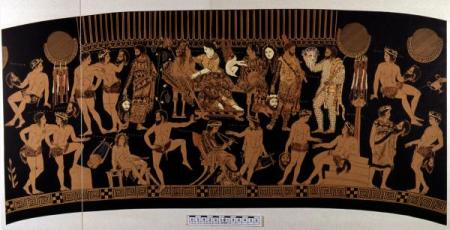
He then moved on to discuss the Pronomos Vase (pictured below) which is a depiction of a celebration after a victory in the Athenian tragic competition. The actors, having finished their satyr play are still in costumes and holding masks as they celebrate. Francois Lissarague actually used this particular photo of the famous Pronomos Vase. He explained that the vase was put in storage following an earthquake in Naples. Francois and a few other scholars were allowed to take it up to the roof of the museum to photograph it (which is why it sit here on a roof on a piece of newspaper).

I got this from a Google Image Search that lead me to this website [1].
Here is a slightly clearer picture so that some of the detail is discernible.
This lovely and clear image comes from this website, which also includes other wonderful theatrically-related images.
This final image flattens the vase in order to show the full range of characters depicted on the front of the vase. The back shows another scene.
A flattened version of the Pronomos vase from this website.
Francois' theme, which began with the Pronomos Vase and employed a number of other spectacular vases from Athens and South Italy seemed to be to show the variety of instances of the satyr, and especially the satyr in theater, portrayed on vases as well as the way in which theater is bound up with Dionysus on these vases. He also demonstrated the use of "metatheatricality" or the interplay between "real" mythological beings and theatrical portrays of those in the same scenes.

The front portion of the Pronomos Vase depicts Dionysus and his consort, presumably Ariadne, lying on a bed which looks suspiciously like a matrimonial bed rather than a symposium couch, according to Francois, amongst the victorious actors, choregos, and playwright after their performance. The victory is indicated by victory tripods, although these would not be the traditional indication of victory for a theatrical performance. All of the saytrs, save one who is still dancing, have taken off their masks and most hold them in various positions. The chorus, which is all uniformly dressed in costume, still has a large degree of variety to it and the citizen names of each individual are etched above the depiction.

Although there is a back panel and a front panel, the panels are continuous to some degree. The back panel depicts a group of "real" stayrs, not from a theatrical performance, with maenads and Dionysus and Ariadne, emphasizing the Dionysiac nature of theater.
A drawing of the back panel of the Pronomos Vase from Perseus.
The other eight vases that he showed demonstrated a variety of similar themes as well as depicting some fascinating images such as female satyrs, possible scenes from specific satyr plays such as Euripides' Cyclops, satyrs and Eros (which Lissarrague referred to as a "late improvement"), and a possible image of Dionysiac epiphany (which is one of my favorite Greek vases of all time [3]).

Although Francois Lissarrague did not voice much of a strong argument, he provided detailed instruction on the depiction of satyrs. Furthermore, his charming air and his excitement about his work prompted a number of the guests, my mom and me included, to immediately run up to see the Pronomos Vase after he finished speaking. He was quite fabulous.

Endnotes
  1. I have tried to link the "this website" under each photo to the website from which it came.
  2. Another version, possibly more easily accessible, of this image can be found here in Perseus's archives.
  3.  This pot is number 12 out of 17 in the Getty Slideshow. It is called "Mixing Vessel with Dionysus and Comic Actors."

Tuesday, September 28, 2010

Reasoning: The Iconography of Greek Theater #3, Ralf Krumeich

My mom took this picture in the gardens.

Ralf Krumeich spoke first, after Mary Louise Hart's introduction. I had not heard of him, because it appears that he writes only in German, but he is Privatdozent (which I assume is like a professor) of classical archaeology in at the Universitat Bonn and writes on archaeology, satyr plays, and the relationship between classical monuments in Athens and Delos as conceived by different cultures in the Hellenistic and Imperial periods.

Krumeich was a fascinating character. He was immediately likable and charismatic. His English was fabulous, although heavily accented. It made me realize how differently the Germans pronounce Greek names like Atreus (he said "aahh-traus"). He was perfectly understandable, and oddly enough when he was answering questions his English was better and more fluid than when he was reading his presentation. I want to be able to do that in German, someday.

Ralf Krumeich's ideas were also rich and well-explicated. He created a system for categorizing pottery and its relationship to theater and mythology:
  1. Images which explicitly show Athenians (or those from South Italy or Sicily) in or around the performance of a tragedy/satyr play/comedy.
  2. Mythological images which can be connected with theatrical performance through visual tropes such as masks, costumes, aulos players, etc.
  3. Myths where a character or characters are portrayed in theatrical costume. One of the main features that places a pot in this category is the lack of masks, as well as only some rather than all of the characters in theatrical dress.
He explained that a large portion of evidence about theater is tainted because it blurs these barriers. Most of the evidence that he problematized is scholars using pieces of pottery from the last two categories in order to make suppositions about the plot or staging of plays which remain only as fragments or titles.

From this information and these categories, he draws two interrelated conclusions. First,Theater, including rehearsals, and those who participated in theater (actors and dancers) have a social and religious significance which made them common themes. But second, although there are many images which incorporate the iconic tropes of theater, most of them are mythological paintings with a gesture toward theatrical performance and its cultural significance in the mythic narrative rather than any specific portrayal of theater or a theatrical performance.

I thought the paper provided valuable insights on the missteps of scholarship in equating art too closely with potential instances of theater. It also seemed to me that the three-level categorization was clear and useful. Overall, Ralf gave a great talk, accompanied by a wide variety of pictures of the different types of potter of which he spoke.