Showing posts with label Review. Show all posts

Friday, May 24, 2013

Appetitive: Review-- Anne Carson's Antigonick

A friend of the family gave me a copy of Antigonick for my birthday. I was excited to read it. Two of my best friends both raved over it and I generally love Anne Carson. However, as much as I hate to admit this, I just didn't get it.

It wasn't bad, but it wasn't really anything. It was a loose, quasi-postmodern translation of the Sophokles play with a sprinkling of moderately interesting language, quotes from Hegal, and some rather confusing drawings. It conveyed a sense of futility and desolation that reminded me of (but did not follow the tradition of) Camus, but not much more.

And there was a weird mute character, Nick, who "measures things". What things?-- well, as an audience, we don't know. My initial thought was that he provided a measure-- like the chorus was supposed to do in the ancient world. The chorus reacted, related stories, and as helpless witnesses, stood in for the audience. However, the chorus often has such insight (in their philosophical or mythical flights of fancy) or such blindness (when they are used for dramatic irony) in comparison to the audience, that I thought maybe, especially for a modern audience, Carson envisioned that it would help to have a character reacting-- thus measuring-- the play as a sort of intermediary. This idea made sense to me. And yet, that's not what he seems to be doing. Nick appears only once in the stage direction at the end of the play on the final page: "exunt omnes except Nick who continues measuring." This, in combination with Kreon and Eurydike's linguistic games surrounding the phrase "nick of time," inclined me to believe he was literally measuring.

I thought that I must be missing something, so I looked up a  couple of reviews online. It seems I didn't miss much. One review saw spirit and inspiration and one review hated the anachronistic touches, but neither seemed to be working with something fundamental that I missed.

One review reminded me that this is the second work of Anne Carson's in succession about mourning the loss of a brother (see Nox, which I loved). However, I'm kind of wary of such a biographical insight for obvious reasons.

Friday, April 15, 2011

Appetitive/Reasoning: Greek History Review #8: The Invasion of the Safety Pins

I mentioned in "Greek History Review #7" that I was listening to Berkeley's 2007 History 4A, which is a basic survey history of the Mediterranean world from Mesopotamia to late antiquity. The course is obviously brief, but it was a nice survey of Egypt for me, having little previous experience with Egyptian history. It was not until the moment where she spoke about the end of the Mycenean age that I decided that I really liked (now Professor, then doctoral student) Isabelle Pafford.
Ancient Greece: A Political, Social and Cultural History  The Landmark Thucydides: A Comprehensive Guide to the Peloponnesian War
I find Mycenean archaeology pretty fascinating, although I know little about it. Until this summer when I started my Greek history review, I had always assumed that the Dorian invasion was a myth made up by the Greeks. It was not until I read an ancient Greek history textbook my grandfather gave to me and (if I remember correctly) Early Greece, proposed the possibility of a possible historical Dorian invasion. Pomoroy et al say that this is problematic because "the only material signs of the Dorians are now dated much later than the destruction period, to around 1000 BC or later" (Pomeroy et al 39). What the book does not say is exactly what constitutes that material evidence. Pafford tells her audience it is a total of 48 non-Mycenean safety pins. Seriously. Safety pins. That just cracked me up. I really enjoy the humor of classical historians.

Apparently, according to Lecture 11, the "safety pins" may correspond to a section in Herodotus that talks about the women with the Heracedae who wore distinctive long pins in their manner of dress. Still, safety pins as the material evidence amuses me.

Perhaps I am an idealist, but I like the idea of an historical Dorian invasion. I am sure that if I ever study the safety pins and any other potential evidence I will be as much of a skeptic as anyone else. I guess I'll see.

Wednesday, April 13, 2011

Appetitive/Reasoning: Greek History Review #7: A Brief History of the Mediterranean

Although I have been working on improving my Greek and Latin reading, some of my attempt to review my history has fallen by the wayside. I have, however, been listening to various lectures while I do chores. I decided that I should listen to history in my own field (what a concept!) while I cook and do the various chores I have to do anyway. I am currently listening to Berkeley's History 4A which is a basic history of the Mediterranean. It can be found on Berkeley's Webcast Site or on iTunes U (the lectures are in reverse order on iTunes). The professor's voice is a little grating and she has a lazy way of speaking, but she is informative and reasonably engaging in her content. I am on the second lecture that is available, which is on Egypt. The lectures will move into Greece soon. I recommend the lectures thus far.

Saturday, April 9, 2011

Reasoning: Sports and War Review

The most recent lecture on Marathon 2500 was Thomas Scanlon's lecture "Sports and War." You can listen to the lecture by clicking on the link at the bottom of that post or you can download the lecture by right clicking on the link and (if you have firefox) clicking "Save Link As" and then saving the file.

I have to admit, I was not particularly excited about this lecture. Although my thesis adviser, Messalla, did most of his work in sports, my interested only extended to the odes of Pindar and references to sports in Plato's discussion of education. I decided I would listen to the lecture anyway and I was pleasantly surprised with the lecture and enjoyed the Q&A thoroughly.

The lecture spoke much about the different races from which the Phidippides/Philippides might have originated. That was pretty interesting. He also mentions that athletic training for war is highly overstated (with the exception of training in Sparta), which was something that I did not know and certainly goes against the ideas transmitted in Plato [1].

My favorite moments were a few tidbits I didn't know in the Q&A. First, I had no idea that there were races that included women. Scanlon revealed in the Q&A that there was a race for Hera that happened directly before the Olympics that was specifically for women. I also had no idea that, as there were small dramatic competitions which happened all year and offered cash to actors to come and perform, there were also small sports competitions all year that offered cash prizes. This is a striking contrast to the Olympics which only offered a laurel crown, although, as Scanlon pointed out, the home city of the winning athlete would often give him lifetime room and board for free. The lecture is good, but the Q&A has some really fabulous kernels of information and Scalon provides a short bibliography for future reading.

Endnotes
  1. Plato obviously models some of his political philosophy on Sparta, although I think the case is overstated by many scholars.

Wednesday, March 23, 2011

Reasoning: Vlastos' Socratic Studies #4

In a combination continuation of the chain of blogposts on Gregory Vlastos' Socratic Studies as well as a follow-up to yesterday's note on Gregory Vlastos and the historical Socrates. The fourth essay in the collection is "The Historical Socrates and Athenian Democracy." 
Socratic Studies
Vlastos begins the essay with his two principle theses:
  1. "In his own time and place Socrates was widely percieved as μισόδημος, i.e. as antipopulist (literally as a people-hater)" (Vlastos 87).
  2. "This public perception of him was a misperception: he had not been the crypto-oligarch many had thought he was" (Vlastos 87).
Vlastos spends only a little over three pages using quotations from a few authors to back this up. There are essentially two prongs to the evidence that he levels for the claims. Prong (a) was that Socrates was the educator of Critias, Charmides, and other members of the Thirty Tyrants [1]. He quotes a smattering of people (Aeschines, Plutarch and Xenephon) to back up this claim. Prong (b) is that Socrates was a condemner of democracy. He provides a Xenephon quotation (Memorabilia of Socrates 1.2.9) to back up this assertion, which asserts that choosing a person for any profession by lot is a problematic idea.

This thesis makes a lot of sense. Plato spent much of his career defending his Socrates from the charge that he educated Alcibiades and the Thirty Tyrants and taught them their unscrupulous and cruel ways [2]. Xenephon, according to the introduction of Penguin edition of Xenephon's Socratic dialogues, was exiled from Athens because of his elitist tendencies (Waterfield 7) both because of his own political proclivities, but also because he was one of Socrates' students, all of whom were under suspicion (Waterfield 6-7) [3]. Using only Xenephon as a source to corroborate the second prong of this first thesis seems problematic as Xenephon (at least in my view) sticks a lot of his own elitist political viewpoints in Socrates' mouth. This is not to say that Socrates was pro-democracy-- I have no basis on which to assert his political views-- but it seems that using Xenephon and Xenephon alone for this provides a warped view.

Vlastos spends the rest of the essay trying to prove his second thesis--that Socretes was pro-democratic government. He starts by looking at the evidence in Crito, where Socrates and him speaking as a personified form of the Laws of Athens attest his love of Athens, even above "well-ordered" oligarchies such as Thebes, Megara, Crete, and Sparta. The rest of the essay is essentially a proof by contradiction. He explains that the only way to establish the premise in the Crito is false would be to establish one of two other premises:

  1. "That this preference is contradicted by the other sentiments expressed by Socrates elsewhere in Plato's Socratic dialogues" [4] (Vlastos 93).
  2. "This it is contradicted by opinions voiced by Socrates in Xenophon, our other major source, and that we have evidence independent of both Xenophon and Plato for rating Xenophon's credibility more highly than Plato's" (Vlastos 93).

Vlastos argues that if there he cannot dig up evidence for either of these premises, than the pro-Athenian testimony from the Crito stands.

I think this is a perfectly irrational way to attempt to prove something for two reasons. First, this procedure for proving a claim is untenable, especially for ancient ideas. Proving by lack is difficult enough to do in the first place, because it requires the assumption that what one believes is true, until someone else finds a piece of evidence that challenges the work. To use this method in an ancient text is ridiculous, because there is always the possibility that the evidence necessary is now lost or will not be found until some later time. The fact that such evidence does not exist may be simply due to scribal error or disintegrating documents rather than truth.

Second, even if one is to buy the premise, for which Vlastos argues extensively elsewhere [5], that the "Socratic Dialogues" form a unit and endeavor to recreate the philosophy of historical Socrates, the Crito does not mean that Socrates was a particular proponent of Athenian democracy. On it's most basic level, the argument in the Crito is on of a social contract: Socrates has lived in the city all these years and has benefited from it's people and it's protection and raised his children there, so in return he must obey the laws that govern the city just like any other citizen. If we take into account Vlastos' argument that the historical Socrates and the Socrates from the "Socratic Dialogues" is only a moral philosopher (Vlastos 101), then this makes sense; Socrates is not endorsing a political political system, but instead a moral contract with the state, irrespective of the form of rule that governs it.

Third, in my opinion, there is no reason whatsoever to believe that the "Socratic Dialogues" are a group, nor that Plato tried to recreate the historical Socrates at all. A dialogue in which a character called Socrates, who somewhat resembles an historical figure, was a genre in itself. Plato, although only one of two authors of extant dialogues, was only one of at least thirteen authors who actually wrote Socratic Dialogues. Just because the main speaker is named Socrates does not hold any bearing over whether the Socratic dialogues portray Socratic philosophy as the historical Socrates might have practiced it. Vlastos rests much of his argument on the assumption that there are three distinct stages of dialogue in the Platonic corpus. I argue in the soon-to-be-complete series of blogposts on "Dates in the Platonic Corpus" that this is not the case.

Over the next few pages, Vlastos argues that in the moments where Socrates criticizes Athens in the Apology and the Gorgias that he is merely criticizing the people not following the laws rather than the democratic procedures themselves. He argues that this means that the preference expressed in Crito is not  "contradicted by the other sentiments expressed by Socrates elsewhere in Plato's Socratic dialogues" (Vlastos 93) and so he has fulfilled his first obligation in proving the second thesis.

Next, Vlastos tackles Xenephon's Socrates. Unlike Plato's, Xenephon's Socrates cannot be called a crypto-oligarch, but is easily in the oligarchic camp. Most importantly in this, statecraft is a "royal art" that can only be exercised by an elite group, and hence cannot operate in a system chosen by lot. So, as Vlastos sees is, Plato and Xenephon's Socrates are diametrically opposed. So now, if there is a reason to prefer Xenephon's view over Plato's than Vlastos' second thesis is proven false. Oddly enough, Vlastos does not tackle the argument of whose Socrates is more accurate (which he does in other texts). Instead, he faces the question as to whether governing is a "royal art" in Plato as well.

In Plato, Vlastos contends, Socrates may think that virtue is a "royal art," but he believes it is one that is necessary for all persons, regardless of their station or disposition, to practice and lead an examined life governed by moral knowledge (Vlastos 105). He claims that this Socrates considers the necessary wisdom with which people act to be a moral rather than a political statement. Vlastos then says that although he believes the Socrates of Plato is more accurate, a declaration of his faith is not convincing and he leaves the essay with two historical tidbits.

The problems I have with this argument are numerous. For the present moment I will stick with the procedural ones: Vlastos simply does not fulfill the things he lays out as necessary to prove his point. He says at the beginning that if Xenephon provides evidence of Socrates' oligarchic tendencies and if Xenephon can be proven to be more historically important/accurate than Plato, than Vlastos' second thesis is false. Instead, Vlastos sidesteps the essential last argument as to which of the two authors the audience should consider as more important because he claims it would be a "declaration of faith." As such, he cannot fulfill his second premise, and he cannot prove his second thesis.

He ends the essay with two historical "crumbs": first that Socrates taught and consorted closely with Chaerephon, an ardent democrat, and second that Lysias, who was also pro-democratic, is thought to have written an Apology of Socrates (now lost) in the few years following Socrates' execution (Vlastos 108).

The problem with these last two "crumbs" is that Socrates also consorted with anti-democratic proponants including Critias, Charmides, and Xenephon. d


Endnotes
  1. The Thirty Tyrants were a group of Sparta-sympathetic oligarchs installed by Sparta to rule Athens following the Peloponnesian Wars and they were kicked out of Athens a few years before Socrates' death. For more information, see Perseus or Wikipedia.
  2. See Symposium, Charmides, and Republic (Book 6 I think).
  3. I discussed this briefly in a blogpost musing on Xenephon.
  4. By the "Socratic Dialogues," Vlastos refers to the "early" elenchic dialogues: "Apology, Charmides, Crito, Euthydemus, Euthyphro, Gorgias, Hippias Major, Hippias Minor, Ion, Laches, Lysis, Menexenus, Protagoras, and Republic [Book] I [only]" (Vlastos 135), in which he believes Plato reconstructed the philosophy (although not actual historical circumstances) of the historical Socrates.
  5. This argument is the focus of "Socrates contra Socrates" from Socrates: Ironist and Moral Philosopher.

Tuesday, December 14, 2010

Reasoning: Phrasikleia

I finished Phrasikleia by Jasper Svenboro [1], Sunday morning. As I mentioned in my last blogpost, Ovid II recommended the book to me. The book was fabulous and I highly recommend it. No knowledge of Greek is required-- Svenboro translates all of the Greek into English.

There is a lot of scholarship on Greek writing, and there has been for almost a century. However, according to Svenbro, there is little scholarship on the practice of reading in Ancient Greece. Phrasikleia sets out to form an anthropological understanding of reading in Greece, starting with inscriptions on Archaic burial monuments. The beginning of his analysis focuses on the relationship between the inscription and the reading of that inscription. Silent reading was not something practiced in the Ancient world (or not at least until much later) and so reading involves literally giving voice to the implied speaker of the inscription or text.

Perhaps for this reason, or perhaps because of some artistic convention, many of the Archaic monuments address their audience-- and implied reader-- in the first person. Christiane Sourvinou-Inwood, in her book "Reading" Greek Death: To the End of the Classical Period, explains that the epitaphs on these monuments preserve part of the mourning of the funerary ritual in their inscriptions and often call for the passer-by (and reader) to continue that lamentation [2]. Svenbro takes this notion farther, by explaining that the reader actually immortalizes the dead by speaking for him/her when reading the inscription. There is a kinship relation between the person and the writing (s)he produces which immortalizes the subject of the writing (which may or may not be the writer him/herself). This metaphorical kinship is like fathers giving their daughters names which preserve the κλέος of the father in his lineage.

Svenbro traces a number of other Greek moments in reading. I do not have the time to trace all of them here and I highly recommend reading the book for yourself. The last one, which greatly interested me, was the conception of reading as pederastic. Lending one's voice to the words of another creates the potentiality for teaching, but also the vulnerability of being tricked or cheated (Svenbro, and the ancient sources he works from, framed this a "buggered").

The book was great. I highly recommend it. I will probably use parts of it when I rewrite the second chapter of my thesis.

As a note, my internet service has been patchy, so posting may be slightly irregular over the next few days.

Endnotes

  1. Phrasikleia was originally written in French. The version that I read was translated from the French by Janet Lloyd.

Friday, October 1, 2010

Reasoning: The Iconography of Greek Theater #4, Francois Lissarrague

The second speaker was the charming and wonderful Francois Lissarrague (apologies for my inability to make a cedilla. Could someone tell to make one in unicode script?). I believe that I have read some of his work before because knew his name and that he worked on Greek art, but I am not entirely sure what I read. Francois, according to the brochure from the conference, is the director of the Centre Louis Gernet. He writes about the layering of images for increasingly complex narrative effects.

Francois started his talk by providing a brief note on the history of the satyr. He explained that satyrs are an Attic invention of the early sixth century, which are depicted as a cross between man and horse. There are other human animal hybrids and even human-horse hybrids (like centaurs) that are depicted, but satyr imagery only begins to show up int he 6th century. I found this to be fascinating because I assumed that the depiction of satyrs came long before the invention of the satyr play.

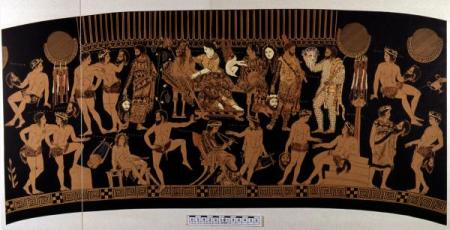
He then moved on to discuss the Pronomos Vase (pictured below) which is a depiction of a celebration after a victory in the Athenian tragic competition. The actors, having finished their satyr play are still in costumes and holding masks as they celebrate. Francois Lissarague actually used this particular photo of the famous Pronomos Vase. He explained that the vase was put in storage following an earthquake in Naples. Francois and a few other scholars were allowed to take it up to the roof of the museum to photograph it (which is why it sit here on a roof on a piece of newspaper).

I got this from a Google Image Search that lead me to this website [1].
Here is a slightly clearer picture so that some of the detail is discernible.
This lovely and clear image comes from this website, which also includes other wonderful theatrically-related images.
This final image flattens the vase in order to show the full range of characters depicted on the front of the vase. The back shows another scene.
A flattened version of the Pronomos vase from this website.
Francois' theme, which began with the Pronomos Vase and employed a number of other spectacular vases from Athens and South Italy seemed to be to show the variety of instances of the satyr, and especially the satyr in theater, portrayed on vases as well as the way in which theater is bound up with Dionysus on these vases. He also demonstrated the use of "metatheatricality" or the interplay between "real" mythological beings and theatrical portrays of those in the same scenes.

The front portion of the Pronomos Vase depicts Dionysus and his consort, presumably Ariadne, lying on a bed which looks suspiciously like a matrimonial bed rather than a symposium couch, according to Francois, amongst the victorious actors, choregos, and playwright after their performance. The victory is indicated by victory tripods, although these would not be the traditional indication of victory for a theatrical performance. All of the saytrs, save one who is still dancing, have taken off their masks and most hold them in various positions. The chorus, which is all uniformly dressed in costume, still has a large degree of variety to it and the citizen names of each individual are etched above the depiction.

Although there is a back panel and a front panel, the panels are continuous to some degree. The back panel depicts a group of "real" stayrs, not from a theatrical performance, with maenads and Dionysus and Ariadne, emphasizing the Dionysiac nature of theater.
A drawing of the back panel of the Pronomos Vase from Perseus.
The other eight vases that he showed demonstrated a variety of similar themes as well as depicting some fascinating images such as female satyrs, possible scenes from specific satyr plays such as Euripides' Cyclops, satyrs and Eros (which Lissarrague referred to as a "late improvement"), and a possible image of Dionysiac epiphany (which is one of my favorite Greek vases of all time [3]).

Although Francois Lissarrague did not voice much of a strong argument, he provided detailed instruction on the depiction of satyrs. Furthermore, his charming air and his excitement about his work prompted a number of the guests, my mom and me included, to immediately run up to see the Pronomos Vase after he finished speaking. He was quite fabulous.

Endnotes
  1. I have tried to link the "this website" under each photo to the website from which it came.
  2. Another version, possibly more easily accessible, of this image can be found here in Perseus's archives.
  3.  This pot is number 12 out of 17 in the Getty Slideshow. It is called "Mixing Vessel with Dionysus and Comic Actors."

Tuesday, September 28, 2010

Reasoning: The Iconography of Greek Theater #3, Ralf Krumeich

My mom took this picture in the gardens.

Ralf Krumeich spoke first, after Mary Louise Hart's introduction. I had not heard of him, because it appears that he writes only in German, but he is Privatdozent (which I assume is like a professor) of classical archaeology in at the Universitat Bonn and writes on archaeology, satyr plays, and the relationship between classical monuments in Athens and Delos as conceived by different cultures in the Hellenistic and Imperial periods.

Krumeich was a fascinating character. He was immediately likable and charismatic. His English was fabulous, although heavily accented. It made me realize how differently the Germans pronounce Greek names like Atreus (he said "aahh-traus"). He was perfectly understandable, and oddly enough when he was answering questions his English was better and more fluid than when he was reading his presentation. I want to be able to do that in German, someday.

Ralf Krumeich's ideas were also rich and well-explicated. He created a system for categorizing pottery and its relationship to theater and mythology:
  1. Images which explicitly show Athenians (or those from South Italy or Sicily) in or around the performance of a tragedy/satyr play/comedy.
  2. Mythological images which can be connected with theatrical performance through visual tropes such as masks, costumes, aulos players, etc.
  3. Myths where a character or characters are portrayed in theatrical costume. One of the main features that places a pot in this category is the lack of masks, as well as only some rather than all of the characters in theatrical dress.
He explained that a large portion of evidence about theater is tainted because it blurs these barriers. Most of the evidence that he problematized is scholars using pieces of pottery from the last two categories in order to make suppositions about the plot or staging of plays which remain only as fragments or titles.

From this information and these categories, he draws two interrelated conclusions. First,Theater, including rehearsals, and those who participated in theater (actors and dancers) have a social and religious significance which made them common themes. But second, although there are many images which incorporate the iconic tropes of theater, most of them are mythological paintings with a gesture toward theatrical performance and its cultural significance in the mythic narrative rather than any specific portrayal of theater or a theatrical performance.

I thought the paper provided valuable insights on the missteps of scholarship in equating art too closely with potential instances of theater. It also seemed to me that the three-level categorization was clear and useful. Overall, Ralf gave a great talk, accompanied by a wide variety of pictures of the different types of potter of which he spoke.

Saturday, September 25, 2010

Reasoning: The Iconography of Greek Theater #2, The Overview

getty villa,Greek Art
A picture from the exhibit "The Art of Ancient Greek Theater" at the Getty Villa [1].

The conference, "Artists and Actors: Iconography and Performance in Ancient Greece," was held over the last two days (although due to obligations at work I was only able to attend the first day). As Mary Louise Hart, the associate curator of antiquities at the Getty, remarked, it was primarily concerned with the "culture of performance," and the powerful images it inspired. The conference was held alongside a wonderful exhibit curated by Hart and entitled "The Art of Ancient Greek Theater." Although i did not get to see much of the exhibit, what I saw was magnificent. Mary did an incredible job not only gathering all of the wonderful pieces of pottery in one place for the first time, but also in the arrangement of the vases. Vessels with similar themes were placed together in order to display the juxtaposition of the depictions from different artists, places, and eras.

For my part, I would like to say thank you to Mary Louise Hart . To see all of this incredible craftsmanship in one place and to gather such an illustrious group of scholars, both among the contributors and the audience, was a phenomenal task. Hopefully, I will be able to return in the next few days to see the exhibit again and take the opportunity to study it.

Mary also put together a book, The Art of Ancient Greek Theater, from the images in the exhibit. The bookstore was a bit of a nightmare, so I did not get to look at it, but I can only imagine it's awesome.

The Art of Ancient Greek Theater

Endnotes
  1. Red-figured Neck Amphora showing Orestes slaying Klytaimnestra (detail), Paestum, South Italy, about 340 B.C. Terracotta, 18 3/4 x 7 13/16 in. The J. Paul Getty Museum, gift of Stanley Silverman (citation from the website). © 2010. The J. Paul Getty Trust. All rights reserved

Monday, September 20, 2010

Reasoning: Tracing Philosophy

On Saturday, I finished reading Andrea Wilson Nightingale's Genres in Dialogue: Plato and the Construct of Philosophy. I found it to be a thoroughly enjoyable read. Her insight was energetically written, insightful, and thoroughly footnoted.

The general premise of the book is to take literary theory, influenced particularly by the work of Bakhtin, and she uses this to analyze Plato's creation of the discipline of philosophy. According to Nightingale (and this seems to be pretty accurate), the term philosophos (philosophy) was originally used just as the generic term for intellectuals (wisdom-lovers) and was used to describe poets, preSocratics, and sophists. Plato is the person that designated the term as its own discipline and created a specific methodology for it. It was afterward employed by Isocrates and subsequent philosophers.
Genres in Dialogue: Plato and the Construct of Philosophy Plato's Philosophers: The Coherence of the Dialogues

I think this is a fascinating concept and plan on looking into it further. What is more important is that she claims that the evolution of the term philosophos used in Plato itself follows the pattern of the original dating of the Platonic corpus [1]. There a significant number of problems with the original dating system, as elucidated clearly in the first chapter of Catherine Zuckert's book Plato's Philosophers: The Coherence of the Dialogues. My thesis is based partially on Zuckert's premise about the dramatic dating of the dialogues. Although I do not thing that the premise that the dialogues are written in the order originally predicted does not necessarily violate the dramatic dates, it might put something of a damper on the revolutionary aspect of the theory. I am going through the TLG results in order to determine what I think.

Endnotes
  1. The description of the traditional methodology is traced by Leonard Brandwood in his book The Chronology of Plato's Dialogues  and his essay which is condensed into a 30 page essay, "Stylometry and Chronology," in The Cambridge Companion to Plato.

Wednesday, September 15, 2010

Spirited: Sophocles and the Gods

I used to be a Sophocles hater. I know, it's sacrilege. That was, until I read the Ajax in my Greek Tragedy Class. I was hooked at the first scene, where Athena displays an incredible combination of power, maniacal superiority, and cruelty. She demonstrates this complex nature of the gods (in Sophocles' view) who demonstrate a shocking lack of humanity in their dogged pursuit of a foreign ethics. However, much of the ethics is centered around the general Greek principle of "helping friends and harming enemies," but Athena takes this to a sick extreme.

Sophocles II: Ajax, The Women of Trachis, Electra & Philoctetes (The Complete Greek Tragedies) (Vol 9)

From that point, I re-evaluated all the Sophocles plays. Although Athena in Ajax the most explicit instance of the gods acting in any Sophocles I have read thus far [1], although they act in sly and interesting ways and often compel or propel the action of the plays. For example, in the Electra, Orestes explains that his plans for revenge by stealth come from Phoebus Apollo (Electra lines 33-39). The entire action of not only the play, Oedipus Tyrannos [2], but Oedipus' life stem from and are foretold by the actions of Apollo as well. Teiresias speaks for the gods, as some kind of a human intermediary between the two.

Sophocles' plays are much more interesting, in my opinion, when considered not from the perspective of Aristotilian interpretations of Greek tragedy [3] or the conflict between oikos (home and family) and polis (city and state), but rather because they paint a complex and fascinating picture of the interaction between heroes and gods. I have been told my view of Greek tragedy can be a little divine-centric, and this may be true, but the tragedians each demonstrate vastly different conceptions of the gods in their plays, which I believe not only provides rich theatrical masterpieces, but also sheds a new light on Greek religion [4].

Endnotes
  1. I have read Oedipus Tyrannos, Oedipus at Colonus (although I read it twice, I didn't understand it very well either time. it needs to go back on my reading list), Antigone, Ajax, Philoctetes, and Electra.
  2. The reason that I refer to this play as Oedipus Tyrannos rather than the more traditional Oedipus Rex is because I think that the Oedipus Tyrannos expresses the irony behind the play better. Rex, the Latin for king, is much more equivalent to the classical Greek Basileus (although in Homeric times this word was used for a lord, and wanax was the word for king) which means king. One of the primary distinctions between basileus and tyrannos (tyrant) was the idea that the basileus came from a line of inherited power and excellence-- the conception that the person was king by right of family. The tyrant, on the other hand, was not justified by hereditary right, but was rather someone who had taken power by persuasion or, more likely, by force. Although Oedipus is technically a basileus, because he is the hereditary heir of Thebes, he is ironically a tyrant, because he killed his father (former basileus of Thebes) and married his mother in order to gain power in the city.
  3. One of my favorite secondary sources that I read in the class was E.R. Dodd's "On Misunderstanding the Oedipus Rex" (click this link to download the Microsoft Word version of the document from NYU. Click this link to read as a HTML file). The document is short-- only about 6-7 pages if my memory serves, but it explains the problems with the traditional viewpoints on Oedipus Tyrannos.
  4. I plan on doing another blog post about Aeschylus' views on religion, which show gods with a strict social and political hierarchy, and Euripides' views on religion, which seem to show gods with similar faults and flaws of humans, but many times more powerful.

Monday, September 13, 2010

Reasoning: Sophocles' Electra

electra,getty villa
Getty Production Banner [1]


I saw a production of Sophocles' Electra the other night. The amphitheater has fabulous acoustics and the production used the Roman-style building behind the stage as the house that would appear on a traditional Greek stage. The translation was new, written for the production itself, by Timberlake Wertenbaker (which is just such an excellent name!).

First, I really liked the translation. I have not read Sophocles in the original except for a snippet of the Antigone back in high school, so I cannot comment first hand on the veracity of the translation. However, it seemed like a reasonable translation to me, from reading another version in English. Better yet, a lot of the passionate statements were untranslated, or spoken in Greek and then translated subsequently. I thought this had a wonderful effect of highlighting the characters' emotions, as well as providing a greater sense to a modern audience of the Greek tragic ethos. My one qualm is that the pronunciation was not very good. To be sure, I am not the best person to judge pronunciation (see my recent blogpost), but this pronunciation was not significantly better than mine (which is terrible).

Second, they started the play with a cello. This I thought was an interesting touch. The cellist played throughout the performance, setting the mood for various scenes as well as providing some jarring and foreign-sounding interludes, which may or may not have been in any way close to Ancient Greek music. Either way, it worked very well to preserve the tone of the play and I thought it was a nice touch.

Third, I thought the acting was phenomenal. Annie Purcell (Electra) and Pamala Reed (Clytemnestra) were a strong and brilliant pair. The mother daughter relationship was fabulous and I thought the interpretation between the actors, director, and translator did a nice job balancing the two sides. I also was impressed that Manoel Felciano made Orestes' character believable-- something which I did not find to be the case in the translation I read. Olympia Dukakis was also phenomenal.
Sophocles II: Ajax, The Women of Trachis, Electra & Philoctetes (The Complete Greek Tragedies) (Vol 9)

The one odd thing about the play was the choice of costumes. I was kind of apathetic toward them. They were generally soft, draping fabric, which alluded to the drapery of classical Greek statues, but they were modern. This was interesting but neither particularly clever nor particularly off-putting.

In general, I thought it was a great performance of a fabulous play, and thoroughly enjoyed it.

Endnotes
  1. © 2010. The J. Paul Getty Trust. All rights reserved