
Showing posts with label Art History. Show all posts
Showing posts with label Art History. Show all posts
Tuesday, August 23, 2011
Appeitive/Reasoing: Ancient Greek Death Monuments
I found a website today that I really wish I had discovered while writing my thesis. It's only got basic information, but it shows a nice trajectory of changing death monuments from the Geometric to the Hellenistic period. It is accompanied by a collection of short essays on each period. Check out this piece on the Metropolitan Museum of Art's website.


Thursday, August 11, 2011
Reasoning: The Landscape of Memory on the Acropolis
 |
| Photocredit: Cerinthus |
One of the textbooks for my Art History class, The Acropolis in the Age of Pericles
 , is fabulous [1]. Jeffrey Hurwit's writing style is engaging and, more importantly, he seems genuinely interested in his subject matter and he communicates this across the page to his reader. Having taken many classics courses over the years, I have read a lot of articles about the Parthenon and viewed a lot of pictures of the acropolis. However, Hurwit manages to point out new and fascinating tidbits that range in subject from materials to construction to ritual practice.
For example, in the chapter "Landscape of Memory on the Acropolis," which for me has been the high point of the book thus far (I am about halfway through), discussed the way that the architects of the Periclean Acropolis preserved and highlighted the history of both Athens and more specifically the acropolis. There still remain so-called Cyclopean walls (walls made of large limestone boulders which have the cracks between them filled in by smaller stones [2]) from the Bronze Age (presumably a Bronze Age Palace) which were given a place of honor rather than dismatled or hidden by the more regular and precise-looking classical walls (Hurwit
62-63) as well as remains of a Bronze Age Tower built into the Classical temple of the cult of Athena Nike. The building project went so far as to place windows into the tower so that Athenians could peer in at the original tower structure from the earlier age (Hurwit 64-65).It was not just the Bronze Age architecture that the Classical Athenian builders monumentalized; many Archaic structures were incorporated into their classical counterparts. This was particularly important to the Athenians because Xerxes sacked the Archaic Acropolis when he invaded Athens and destroyed not only the standing temples and shrines but also the so-called Older Parthenon which was under construction at the time. Pericles' plan for the classical Parthenon used some of the metopes and columns of the Older Parthenon and some of the foundations became a Persian War Memorial (Hurwit
70).Further incorporating Archaic predecessors, "the Erechtheion ...was not so much a temple as it was a composition of many shrines" (Hurwit
71), including the pre-Erechthieon and the shrine of Athena Polias and alters to other gods and heroes. The Erechtheion (see picture below) became an oddly-shaped monument to the past religious tradition and allowed it to continue to a flourish in a new and grander setting. |
| Photocredit: Cerinthus |
Endnotes:
- Walking the other day, I was thinking to myself how often I am harshly critical of textbooks and scholarly work and I was wondering whether I was becoming an arrogant curmudgeon. However, I remembered reading this book that my vehemence in the praise of scholarship I like is of the same degree of my criticism of those texts I find lacking. I am not sure if this ameliorates my harshness in any way, but at least it makes me feel slightly more balanced.
- Cyclopean walls were named thus because later Greeks thought the boulders in the Bronze Age walls were so big they must have been placed there by Cyclopes.
Sunday, August 7, 2011
Reasoning/Appetitive: The Parthenon Frieze
I have now read three different interpretations of the Parthenon Frieze for my art history classes next week: J.J. Politt's (Art and Experience in Classical Greece ), Joan Connelly's ("Parthenon and Parthenoi: A Mythological Interpretatin fo the Parthenon Frieze"), and Jenifer Neil's (The Parthenon Frieze
 , Chapter 6). I found it very difficult to chose between any of their claims on the evidence given. Not one of the three shows a complete picture or even a complete sketch of the frieze. So, I happened upon this website made by someone at Columbia (which, amusingly enough I posted on my blog in March). The website allows the viewer to scroll through and see the frieze in it's entirety as well as view famous pieces up close. Enjoy!
), Joan Connelly's ("Parthenon and Parthenoi: A Mythological Interpretatin fo the Parthenon Frieze"), and Jenifer Neil's (The Parthenon Frieze, Chapter 6). I found it very difficult to chose between any of their claims on the evidence given. Not one of the three shows a complete picture or even a complete sketch of the frieze. So, I happened upon this website made by someone at Columbia (which, amusingly enough I posted on my blog in March). The website allows the viewer to scroll through and see the frieze in it's entirety as well as view famous pieces up close. Enjoy!
Saturday, August 6, 2011
Reasoning/Appetitive: The Temple of Zeus at Olympia and Thoughts on Art History
 |
| Photocredit: Cerinthus |
When I was in the Greece and Rome survey that I took freshman year in college, the art history days were usually my least favorite. The art was fine, but my conference was lead by a philosophy professor and there was not a single art history student in my class. Furthermore, the art history textbooks were really boring, and almost no one wanted to read them. The only great discussion we had was when we discussed the Parthenon, because we read a more interesting (and I believe slightly controversial) article called "Parthenon and Parthenoi: A Mythological Interpretatin fo the Parthenon Frieze" by Joan Connelly. One of the textbooks for this class, Art and Experience in Classical Greece
(the only one we have used in the first week) similar to my old textbooks, lacks both the engaging writing style and interesting factoids that I believe makes art history so interesting. However, one article that we read (which I believe is out of another introductory textbook) grabbed my interest. I will discuss it below under the heading "The Temple of Zeus at Olympia."The lectures themselves are better in this class than they were in the introductory class at my Alma Mater (see previous blogpost), but to be fair, they are two hours instead of 50 minutes and the class is concentrating solely on the art and its context. One of the best parts of the lectures is discussion of how the pieces were constructed. My professor actually discusses the artistic methodology in depth for (thus far) marble sculptures, bronze sculptures, and Attic black and red figure vases. I thought the black on the vases was paint that was essentially polished [1], but in reality the black is a watery slip that is painted over the piece and turns black and glass-like when fired at very high temperatures (the process heats it at various times between 800-950 degrees C).
The Temple of Zeus at Olympia: The article we were assigned was "Early Classical Architectural Sculpture: The Temple of Zeus at Olympia" in An Introduction to Greek Art
 by Susan Woodford. Most of the chapter talks about the evolution from the stoic patterned forms of the archaic to the greater movement and personal differentiation that appears in high classical. This is especially evident as the East pediment [2] was made perhaps a decade later than the West pediment and demonstrates a great movement toward early classical styling. This was useful, and I especially like that the author chose to provide a reasonable detailed summery of all of the myths involved.
My favorite part of the text was the section on the metopes [3]. The metopes over the porches (the ones under the pediment were left blank) depicted the labors of Herakles. Although there are many stories associated with the hero, the number of metopes (6 on each side) restricted the number of scenes. These are the canonical twelve labors of Herakles depicted by most mythology books, but according to Woodford, "it is probably...that they were first assamebled as a group for the metopes at Olympia, for in their earlier history they varied greatly" (Woodford
99). I thought that was fascinating.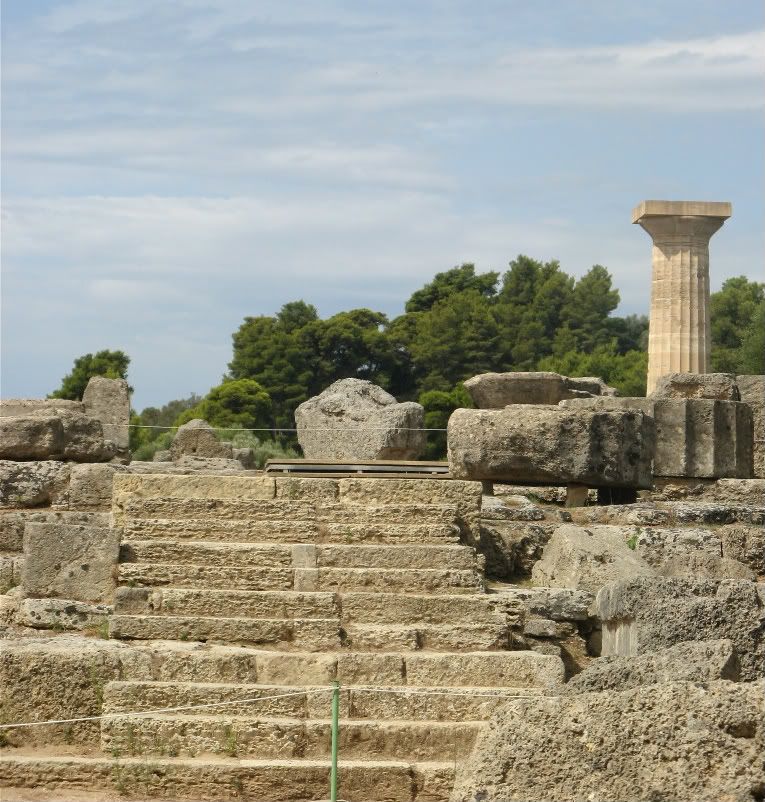 |
| Photocredit: Cerinthus |
1. In high school in my "archaeology" class (which was vaguely a Greek art history class) we had to make tiles to show us the difference in the difficulty level of black figure and red figure vases. I picked the Amphora by Exekias depicted Ajax and Achilles playing a game. I really love this vase. We used a stone to polish the image before firing, but I think I was so worried about chipping the paint that I didn't do a good job with the polishing:

This is the original image from the vase:
 |
| Picturecredit: Wikimedia Commons. |

3. A metope is a square or rectangular image interspersed with triglyphs (usually a vertical geometric pattern) underneath the pediment on a temple.
Wednesday, March 2, 2011
Appetitive: Parthenon Frieze
Someone at Columbia is totally awesome. A friend posted on Twitter that Columbia had created a digital model of the Parthenon Friezes. It is fabulous.
Monday, December 27, 2010
Appetitive: New Books
 |
| My new books! |
 and Archaic and Classical Greek Art, but as I mentioned in yesterday's blogpost, it provides a glossary of terms and techniques that my other books do not lay out systematically (as they are more focused on the chronology.
I am really excited for my new reading material. But for now, I have to read Horace...
Sunday, December 26, 2010
Reasoning: Greek Vase Shapes
One of the things I wanted and received for Christmas was Understanding Greek Vases: A Guide to Technical Terms . The book is essentially an expanded glossary of technical terms for Greek vase art from Protogeometric from Hellenistic. I wanted this in order to provide myself with a stronger basis for understanding Greek art history. One of the pieces that I was most excited about was a chart in the back identifying the different vase shapes.
Hopefully I can implement this knowledge and attempt to recognize some of the shapes when I go to see some of the vases in person.
As I discovered looking for these pictures, Wikipedia also has a fabulous page on the typology of Greek vases.
. The book is essentially an expanded glossary of technical terms for Greek vase art from Protogeometric from Hellenistic. I wanted this in order to provide myself with a stronger basis for understanding Greek art history. One of the pieces that I was most excited about was a chart in the back identifying the different vase shapes. |
| Clark et al 154 [1]. |
 |
| Clark et al 155 [1]. |
Hopefully I can implement this knowledge and attempt to recognize some of the shapes when I go to see some of the vases in person.
As I discovered looking for these pictures, Wikipedia also has a fabulous page on the typology of Greek vases.
Endnotes
- The pictures are from a forum on the Brown University website.
Friday, November 26, 2010
Appetitive: The Restoration of the Parthenon
This is a PBS special on the restoration of the Parthenon. Although the narration is a little melodramatic in places, it shows some incredible features of the restoration of the Parthenon and of the architectural structure of the Parthenon itself.
Unfortunately, there are some commercials in this, but it's pretty cool that PBS put the special on youtube.
The final (for now) installment of "Dates in the Platonic Corpus" will be up soon.
Unfortunately, there are some commercials in this, but it's pretty cool that PBS put the special on youtube.
The final (for now) installment of "Dates in the Platonic Corpus" will be up soon.
Tuesday, November 2, 2010
Reasoning: Greek History Review #6
I've been organizing my Greek History studying in order to put it into a coherent pattern and create a "syllabus" [1]. In tracing the history, I am not focusing on the Minoan and Mycenean developments because I although I have some interest in archaeology, it is not my primary interest nor something about which I have a lot of background. Some of this I have related before, but not in an organized fashion.
So here is my reading for Greek History from c.2000-600 BCE [2]:
So here is my reading for Greek History from c.2000-600 BCE [2]:
Minoans, Myceneans, Early Dark Ages, and Sources:
Secondary Sources (General background on Early Greece)- Early Greece
by Oswyn Murray, chapters 1-2 (pages 1-34)
- Ancient Greece: A Political, Social, and Cultural History
by Pomeroy et al, chapter 1 (pages 1-40)
- The Art and Culture of Early Greece, 1100-480 B.C.
- Archaic and Classical Greek Art
by Robin Osborne chapter 1 (pages 1-21)
- "The Emergence of the State in the Prehistoric Aegean" [3] by John F. Cherry.
- Histories
by Herodotus 1.56, 2.53
- The History of the Peloponnesian Wars
by Thucydides 1.1-8, 1.12
The Dark Age (c.1100-750):
Primary Sources (Possible evidence for Dark Age aristocracy and politics)- Odyssey
by Homer, Books 1-19 (I will read through 24 in order to check it off my reading list)
- Agamemnon by Aeschylus. Lines 1-907.
- Early Greece
- Ancient Greece: A Political, Social, and Cultural History
- The Art and Culture of Early Greece, 1100-480 B.C.
- Archaic and Classical Greek Art
- Sons of the Gods, Children of Earth
by Peter Rose, chapter 1-3 (pages 43-130) [4]
- "The Use and Abuse of Homer" Ian Morris (JSTOR)
The Early Archaic Age (c.750-600):
Primary Sources (Early Archaic politics and the beginnings of the polis)- The Works and Days
by Hesiod
- Early Greece
- Ancient Greece: A Political, Social, and Cultural History
- The Art and Culture of Early Greece, 1100-480 B.C.
- Archaic and Classical Greek Art
- "Hesiod and His World" [3] by Paul Millett
Endnotes
- I borrowed significantly from the Greek History syllabus from the class I took in Fall 2008. My own additions primarily are the art and archaeology sources (some of which I borrowed from my classical world survey course), and some textbook background on Greek History. I also changed many of the translations used either because I liked the editions or translations better, or they were more easily accessible.
- These dates are going to overlap a lot, and each of the articles and chapters deal with different eras. I am going to go by the traditional dates of the Mycenean's arriving in Greece c.2000 and the Dark Age beginning c.1100.
- I realize that this literary analysis-- and specifically an unorthodox Marxist literary analysis-- is a bizarre choice for a history reading list. However, I really like Rose's work and his methodology, and I think that his readings try to situate the reader in the culture of the period, and specifically in terms of what relations between ruling groups.
- The Cambridge Philosophical Journal: The Proceedings of the Cambridge Philosophical Society (1984). I happened upon this article when I was looking for the Hesiod article and I ended up enjoying it.
Wednesday, October 27, 2010
Reasoning/Appetitive: Cerinthus Reports on the Dipylon Vase
A few days ago I posted a blog about the Dipylon Vase, or rather vases (the amphora and the krater). In the process of doing so I spent a long time looking for a close up of the burial scene. I eventually found one. What I did not realize was that one had arrived in my email a few days previous when Cerinthus posted his Athens pictures. He took this wonderful shot for me when he was standing right next to the Dipylon amphora. I am so incredibly jealous:
Although the lights of the museum obscure two of the figures, the pictures shows the incredible detail of the patterns on the vase and the gestures of the figures. This photo inspires me to ask a few more questions that I could not see to ask in the smaller versions:
 |
| Cerinthus' photo: Dipylon Vase (amphora) close-up |
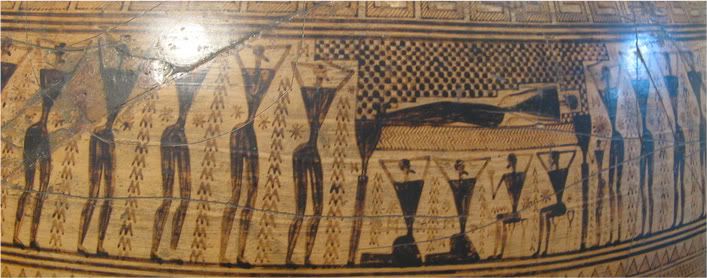
- Who are the figures under the body? Are they the family of the deceased?
- Are the two that are sitting on the ground (under the body) wearing skirts, and if they are, what does this this say about the gender of the mourners who are standing around the body. Should this indicate something about the gender composition of burials or this particular burial?
- Why is one of the figures under the vase not in a typical mourning position? Who is he and what is his roll in this prothesis?
Update 10/28/10
Cerinthus mentioned to me that not only are the figures under the table different from the rest of the figures, but the figures immediately on each side of the body are gesturing slightly differently than than those behind them. These two figures are lifting the sides of a canopy. The canopy is a common trope in the Geometric prothesis, according to the U Texas website. The Grove Encyclopedia of Classical Art and Architecture refers to it as "the chequered shroud is lifted to reveal the deceased on the bier" in the article on the Dipylon Master [1]. My assumption, is that the figures closest to the body are the family of the deceased, as they often are on these types of vases. However, if anyone wants to add to this information, or discuss these possibilities for my previous questions, comment or email me.
Endnotes
- This link will only work for those of you who have access to the Grove Encyclopedia of Classical Art and Architecture or those of you who are accessing the web from a university or library that has this access.
Sunday, October 24, 2010
Spirited: Notes on My Thesis, #2
I was walking through the corridor at the Getty in an attempt to find the stairs, when I found something amazing. This vase may not look striking at first glance-- it has muted colors and much of the paint has worn off the vase-- but to me, it is absolutely incredible. I will explain the reason behind my awe at such an unimposing object.
Like many Geometric vases, this vase displays a burial scene. On one side of the corpse, there are men with one hand on their heads, indicating mourning, and keeping the other hand behind them. On the other side of the corpse, there are women, shown with two hands on the top of their head, indicating mourning, and possibly, pulling of their hair as a sign of grief. A man and a woman head the procession on each side and touch the body. These are presumably relatives of the deceased and the artist indicates both their relationship and potentially elite status because they are larger than the other figures on the vase. There are two striking and exciting aspects of this depiction:
Like many Geometric vases, this vase displays a burial scene. On one side of the corpse, there are men with one hand on their heads, indicating mourning, and keeping the other hand behind them. On the other side of the corpse, there are women, shown with two hands on the top of their head, indicating mourning, and possibly, pulling of their hair as a sign of grief. A man and a woman head the procession on each side and touch the body. These are presumably relatives of the deceased and the artist indicates both their relationship and potentially elite status because they are larger than the other figures on the vase. There are two striking and exciting aspects of this depiction:
 |
| Athenian Vase from the Getty Villa [1] |

- The vase differentiates the mourners by gender, and not only are their gestures are different, but men and women stand on opposite sides of the vase. This is exciting because it shows a marked difference from the undifferentiated mourners in Dipylon Vases in my last blogpost.
- There are two figures differentiated strongly through gesture from the other figures. I am not an art historian so this may be a little shaky, but I think there is a stronger sense of individualism in these figures than the ones in the Dipylon Vases.
Endnote
- This is "Storage Jar with a Funerary Scene," a terracotta vase made in Athens between 710-700 BCE. Photographed by Sulpicia III.
- The prothesis was the parading of the body as it was mourned by the family before burial.
Saturday, October 23, 2010
Reasoning: Useful Internet Miscillany
Horatian Meter: I am still continuing on my quest to read Horace. Propertius II has finally succeeded in convincing me that meter is both awesome and useful, which has lead me to scan the poems I am reading. Horace employs a variety of lyric meters that he borrowed from Alcaeus and Sappho. Since I am a fairly new student to the study of meter (although I did some dactyllic hexameter in high school Greek), I do not tend to have a sense of what lyric meters go with which poem. However, I found a great page on Diotima which provides the background for and explanations of Horatian meter.
Digital Papyrology Navigator: A friend recently sent me a blogpost from AWOL: The Ancient World Online, which is a fabulous site that appears to compile vast amounts of classics data for online access. One of it's recent entries talks about the updated version of the Digital Papyrology Navigator, which allows classicists and friends to digitally search for information in papyri and suggest emendations. The blog by the people who run this awesome resource also will probably be pretty cool.
Art Index [1]: After stumbling across a semi-dormant blog called "What do I know...?," I realized that I should create a better system for organizing the art that I discuss on Platonic Psychology. So I created a new page, An Index of (Mostly) Art on Platonic Psychology, which organizes the art I have discussed by the period to which it belongs. The page is still in progress because I have not figured out a comprehensive system, but there is also a list of archaeological sites on the bottom, mostly with pictures from Cerinthus' adventures around Greece.
Digital Papyrology Navigator: A friend recently sent me a blogpost from AWOL: The Ancient World Online, which is a fabulous site that appears to compile vast amounts of classics data for online access. One of it's recent entries talks about the updated version of the Digital Papyrology Navigator, which allows classicists and friends to digitally search for information in papyri and suggest emendations. The blog by the people who run this awesome resource also will probably be pretty cool.
Art Index [1]: After stumbling across a semi-dormant blog called "What do I know...?," I realized that I should create a better system for organizing the art that I discuss on Platonic Psychology. So I created a new page, An Index of (Mostly) Art on Platonic Psychology, which organizes the art I have discussed by the period to which it belongs. The page is still in progress because I have not figured out a comprehensive system, but there is also a list of archaeological sites on the bottom, mostly with pictures from Cerinthus' adventures around Greece.
Endnotes
- Placing a feature I created after these two fabulous resources is not trying to compare my work with that of greater digital monuments, it was just a convenient place to introduce the topic. No arrogance intended.
Friday, October 22, 2010
Reasoning: Sophistocation and Idiots in Greek Art
In my first year of college I took an interdisciplinary survey course on the classical world. The class had a lecture component, in which professors gave lectures, primarily in their own field, one some aspect of the Greek or Roman world in vaguely chronological order. One of the early lectures was by an Art History professor who I will call William, since I cannot come up with an adequate late Republican pseudonym, and it concerned one of the most famous works in early Greek art: the Dipylon Vase (750-700 BCE).
After the lecture, I thought to myself what an ugly vase and what a stupid lecture. Little did I know that not only would I ultimately grudgingly vindicate the ideas in this lecture that I initially excoriated, but I would also write a chapter of my thesis on the funerary images like that prominently figured on the Dipylon Vase (close up below).
Willaim's Claim: In his lecture William claimed (almost verbatim) was that the Greeks had perspective, they just were not employing it because it was not the proper means to the end they were trying to achieve. More infuriated by the wording of the claim than anything, but specifically incensed that a tenured art history professor was allowed to make such a bogus claim.
It was not until now that I realized what he meant. He was not making the claim that the Dipylon Master [3] could achieve Renaissance-style perspective, but rather that the art of this time period had it's own particular style of representation and visual formula that it employed to depict certain recognizable images to its audience. This pottery conveyed the events in a recognizable and stylized manner because it effectively communicated to the audience, possibly more effectively than a more realistic attempt. For evidence of this, when I decided to write this blogpost, I was scouring the internet for images and happened upon the Dipylon Krater (below) and it took me about half-an-hour before I realized that this was not the Dipylon Vase which I was seeking.
Obviously I am not saying that any attempt at an accurate depiction would have been particularly life-like, especially given the almost complete absence of figure drawing in Submycenean and Protogeometric art (Hurwit 53-59) [4]. My contention is that the oddities of representation, such as the three-quarter legs, the full-frontal torso, and the profile head on the mourners, has a stylistic purpose rather than evidence of crude, "bad" art.
The tropes and stylization in this art is actually something of a bonus for scholars/students like me who are looking not for artistic sophistication, but rather evidence of burial practices. In a future blogpost, I will show images of the geometric vase that I found on display at the end of a hallway at the Getty that provides incredible evidence for early differentiation of the genders in mourning practices which is not shown in either of the Dipylon vases in this blogpost.
 |
| Dipylon Vase from this website [1]. |

 |
| A close-up of the burial scene from this website [2]. |
Willaim's Claim: In his lecture William claimed (almost verbatim) was that the Greeks had perspective, they just were not employing it because it was not the proper means to the end they were trying to achieve. More infuriated by the wording of the claim than anything, but specifically incensed that a tenured art history professor was allowed to make such a bogus claim.

It was not until now that I realized what he meant. He was not making the claim that the Dipylon Master [3] could achieve Renaissance-style perspective, but rather that the art of this time period had it's own particular style of representation and visual formula that it employed to depict certain recognizable images to its audience. This pottery conveyed the events in a recognizable and stylized manner because it effectively communicated to the audience, possibly more effectively than a more realistic attempt. For evidence of this, when I decided to write this blogpost, I was scouring the internet for images and happened upon the Dipylon Krater (below) and it took me about half-an-hour before I realized that this was not the Dipylon Vase which I was seeking.
 |
| Dipylon Krater (700-750 BCE) from this website [5]. |
The tropes and stylization in this art is actually something of a bonus for scholars/students like me who are looking not for artistic sophistication, but rather evidence of burial practices. In a future blogpost, I will show images of the geometric vase that I found on display at the end of a hallway at the Getty that provides incredible evidence for early differentiation of the genders in mourning practices which is not shown in either of the Dipylon vases in this blogpost.
Endnotes
- This picture is from the University of Texas Webpage. Because there are two Dipylon Vases, this one is sometimes known as the Dipylon Amphora.
- I found a clean, but rather small close-up from a humanities blog. Below is a much clearer close up of a similar scene from the Dipylon Krater.
- The Dipylon Master is the name given to the artist who painted the Dipylon Amphora.
- For a more in-depth but still succinct description of the evolution of art from the collapse of the Mycanean Palace system through the Geometric period, see Jeffrey Hurwit's The Art and Culture of Early Greece
- Both pictures of the Dipylon Krater are from the Glendale Community College webpage.
 |
| Close up of burial on Dipylon Krater from this website [5]. |
Subscribe to:
Posts (Atom)