Showing posts with label Getty Villa. Show all posts

Monday, October 18, 2010

Reasoning: The Gela Krater and Corrections

My apologies for not posting the notes from Oliver Taplin's talk yet. They are taking longer than I expected due to the need to decipher my notes and having various other chores to which I must attend. It will be up within the next 36 hours (and probably fairly soon).

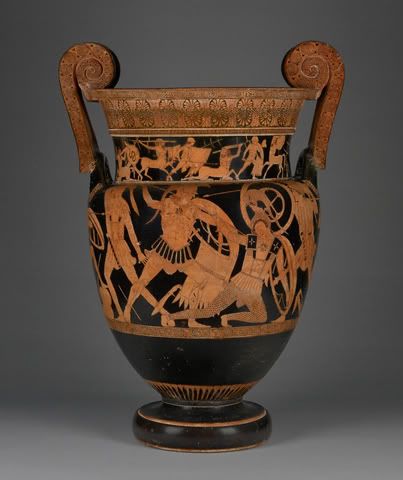
The Gela Krater [1]
Today was the last day that the Gela Krater was housed at the Getty Villa and my mom and I ventured out to see it, as well as to wander around the other exhibits. The Gela Krater was featured in an exhibit that showed vases with depictions of scenes from the Trojan War, and primarily scenes from Homer's Iliad.

The Gela Krater is an Athenian-made krater which archaeologists discovered in Gela, a city in South Sicily. According to the Getty Website, it is "attributed to the Niobid Painter (Greek, active about 470–445 B.C.), [and] this monumental red-figured volute krater was produced in Athens between 475 and 450 B.C." (Getty's Press Release).

One of the great things about the Getty having immense amounts of money is that they can create mechanisms for conservation and protection and give them away to places that need them. For example, the Gela Krater now has a new display case that will help protect it in the case of an earthquake:
"Before installing the Gela Krater at the Getty Villa, the Museum's conservation team collaborated with conservators from Agrigento's Museo Archeologico Regionale to construct a custom seismic isolation base and pedestal.When the krater returns to Sicily, it will be accompanied by its new pedestal and earthquake-resistant mount for display in its home museum" (Getty's Press Release).
A similar and even more impressive project is MEGA, a computer network to catagorize and mark artifacts and systematize their protection which I discussed in an earlier blogpost.

Correction
So when I was listening to the lectures at Artists and Actors Conference, I heard a lot of talk about volute kraters (a particular shape of large vase, demonstrated by the Pronomos Vase). I misheard this as a "volume" krater, but it is actually volute krater. My apologies.

Endnotes
  1. © 2010. The J. Paul Getty Trust. All rights reserved.

Friday, October 1, 2010

Reasoning: The Iconography of Greek Theater #4, Francois Lissarrague

The second speaker was the charming and wonderful Francois Lissarrague (apologies for my inability to make a cedilla. Could someone tell to make one in unicode script?). I believe that I have read some of his work before because knew his name and that he worked on Greek art, but I am not entirely sure what I read. Francois, according to the brochure from the conference, is the director of the Centre Louis Gernet. He writes about the layering of images for increasingly complex narrative effects.

Francois started his talk by providing a brief note on the history of the satyr. He explained that satyrs are an Attic invention of the early sixth century, which are depicted as a cross between man and horse. There are other human animal hybrids and even human-horse hybrids (like centaurs) that are depicted, but satyr imagery only begins to show up int he 6th century. I found this to be fascinating because I assumed that the depiction of satyrs came long before the invention of the satyr play.

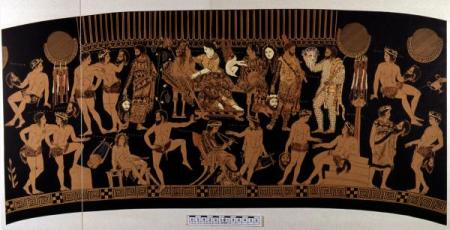
He then moved on to discuss the Pronomos Vase (pictured below) which is a depiction of a celebration after a victory in the Athenian tragic competition. The actors, having finished their satyr play are still in costumes and holding masks as they celebrate. Francois Lissarague actually used this particular photo of the famous Pronomos Vase. He explained that the vase was put in storage following an earthquake in Naples. Francois and a few other scholars were allowed to take it up to the roof of the museum to photograph it (which is why it sit here on a roof on a piece of newspaper).

I got this from a Google Image Search that lead me to this website [1].
Here is a slightly clearer picture so that some of the detail is discernible.
This lovely and clear image comes from this website, which also includes other wonderful theatrically-related images.
This final image flattens the vase in order to show the full range of characters depicted on the front of the vase. The back shows another scene.
A flattened version of the Pronomos vase from this website.
Francois' theme, which began with the Pronomos Vase and employed a number of other spectacular vases from Athens and South Italy seemed to be to show the variety of instances of the satyr, and especially the satyr in theater, portrayed on vases as well as the way in which theater is bound up with Dionysus on these vases. He also demonstrated the use of "metatheatricality" or the interplay between "real" mythological beings and theatrical portrays of those in the same scenes.

The front portion of the Pronomos Vase depicts Dionysus and his consort, presumably Ariadne, lying on a bed which looks suspiciously like a matrimonial bed rather than a symposium couch, according to Francois, amongst the victorious actors, choregos, and playwright after their performance. The victory is indicated by victory tripods, although these would not be the traditional indication of victory for a theatrical performance. All of the saytrs, save one who is still dancing, have taken off their masks and most hold them in various positions. The chorus, which is all uniformly dressed in costume, still has a large degree of variety to it and the citizen names of each individual are etched above the depiction.

Although there is a back panel and a front panel, the panels are continuous to some degree. The back panel depicts a group of "real" stayrs, not from a theatrical performance, with maenads and Dionysus and Ariadne, emphasizing the Dionysiac nature of theater.
A drawing of the back panel of the Pronomos Vase from Perseus.
The other eight vases that he showed demonstrated a variety of similar themes as well as depicting some fascinating images such as female satyrs, possible scenes from specific satyr plays such as Euripides' Cyclops, satyrs and Eros (which Lissarrague referred to as a "late improvement"), and a possible image of Dionysiac epiphany (which is one of my favorite Greek vases of all time [3]).

Although Francois Lissarrague did not voice much of a strong argument, he provided detailed instruction on the depiction of satyrs. Furthermore, his charming air and his excitement about his work prompted a number of the guests, my mom and me included, to immediately run up to see the Pronomos Vase after he finished speaking. He was quite fabulous.

Endnotes
  1. I have tried to link the "this website" under each photo to the website from which it came.
  2. Another version, possibly more easily accessible, of this image can be found here in Perseus's archives.
  3.  This pot is number 12 out of 17 in the Getty Slideshow. It is called "Mixing Vessel with Dionysus and Comic Actors."

Thursday, September 30, 2010

Appetitve/Reasoning: Great Getty Resources and the Problems with Publishing Classics Books

There are some really fabulous features attached to the Getty Villa exhibition The Art of Ancient Greek Theater. So even if you are not fortunate enough to go see the exhibit, you can experience some of the fabulous work put together there.

First, there is a slideshow with audio commentary which displays seventeen of the art pieces displayed. Check out the slideshow.

Second, they put up a reading of a fragment of a Sopholces satyr play called the trackers. As far as I can tell, the pronunciation is pretty good. However, my pronunciation and linguistic understanding is still not what it should be. If anyone has any thoughts, I would love to hear him. The audio can be found here.

Although I did not get to peruse them very thoroughly, there are three books that the Getty published in conjunction with exhibit. Two of them, The Pronomos Vase and It's Context and Pot's and Plays, are edited by Oliver Taplin. The Art of Ancient Greek Theater is edited by Mary Louise Hart.

The Pronomos Vase and its Context The Art of Ancient Greek Theater Pots & Plays: Interactions between Tragedy and Greek Vase-painting of the Fourth Century B.C. (J. Paul Getty Museum)

Sadly, the books are all extraordinarily expensive. This, however, is not unexpected given the price of classics books in general. In a thesis meeting, I was told by Messalla, my fabulous thesis adviser, that classics textbooks were originally significantly cheaper (with adjustment for inflation). Publishers eventually realized that a large portion of the audience for these books was comprised of professors and libraries, most of whom had access to some portion of the University budget. As such, the publishers realized that they could increase their profit margin by making the books ridiculously expensive-- thereby cutting out the student and causal-reader market-- and sell the books significantly more expensively from smaller printings (which were more expensive per book to make). I do not have any specifics on the Getty as a publisher, but think that, in general, the expense trend with classics books is ridiculous. Although libraries are a great resource, with public funding decreasing everywhere, a lot of libraries are having trouble affording the same books that students cannot afford for themselves. Also, the rarer and more expensive the books are, the more likely they are to be stolen (a bunch of expensive classics books were stolen from my college last year) and then resold.

I do not believe there is any real way to break the trend of such expensive books. Some publishing houses obviously provide significantly better prices than others. And, of course, I would never want to deny money or publishing access to the scholars who produce the wonderful things that I read. I know this might sound a little hypocritical given my recent blogpost, but would it not be better if publishing houses just made books less expensive, rather than making them really expensive and then putting some portion of the scholarly collection up for free online (see the incredible CDL archive). I love ebooks and free books, but I would not search for them quite so hard if the books I needed were less expensive or appeared in more libraries.

Tuesday, September 28, 2010

Reasoning: The Iconography of Greek Theater #3, Ralf Krumeich

My mom took this picture in the gardens.

Ralf Krumeich spoke first, after Mary Louise Hart's introduction. I had not heard of him, because it appears that he writes only in German, but he is Privatdozent (which I assume is like a professor) of classical archaeology in at the Universitat Bonn and writes on archaeology, satyr plays, and the relationship between classical monuments in Athens and Delos as conceived by different cultures in the Hellenistic and Imperial periods.

Krumeich was a fascinating character. He was immediately likable and charismatic. His English was fabulous, although heavily accented. It made me realize how differently the Germans pronounce Greek names like Atreus (he said "aahh-traus"). He was perfectly understandable, and oddly enough when he was answering questions his English was better and more fluid than when he was reading his presentation. I want to be able to do that in German, someday.

Ralf Krumeich's ideas were also rich and well-explicated. He created a system for categorizing pottery and its relationship to theater and mythology:
  1. Images which explicitly show Athenians (or those from South Italy or Sicily) in or around the performance of a tragedy/satyr play/comedy.
  2. Mythological images which can be connected with theatrical performance through visual tropes such as masks, costumes, aulos players, etc.
  3. Myths where a character or characters are portrayed in theatrical costume. One of the main features that places a pot in this category is the lack of masks, as well as only some rather than all of the characters in theatrical dress.
He explained that a large portion of evidence about theater is tainted because it blurs these barriers. Most of the evidence that he problematized is scholars using pieces of pottery from the last two categories in order to make suppositions about the plot or staging of plays which remain only as fragments or titles.

From this information and these categories, he draws two interrelated conclusions. First,Theater, including rehearsals, and those who participated in theater (actors and dancers) have a social and religious significance which made them common themes. But second, although there are many images which incorporate the iconic tropes of theater, most of them are mythological paintings with a gesture toward theatrical performance and its cultural significance in the mythic narrative rather than any specific portrayal of theater or a theatrical performance.

I thought the paper provided valuable insights on the missteps of scholarship in equating art too closely with potential instances of theater. It also seemed to me that the three-level categorization was clear and useful. Overall, Ralf gave a great talk, accompanied by a wide variety of pictures of the different types of potter of which he spoke.

Saturday, September 25, 2010

Reasoning: The Iconography of Greek Theater #2, The Overview

getty villa,Greek Art
A picture from the exhibit "The Art of Ancient Greek Theater" at the Getty Villa [1].

The conference, "Artists and Actors: Iconography and Performance in Ancient Greece," was held over the last two days (although due to obligations at work I was only able to attend the first day). As Mary Louise Hart, the associate curator of antiquities at the Getty, remarked, it was primarily concerned with the "culture of performance," and the powerful images it inspired. The conference was held alongside a wonderful exhibit curated by Hart and entitled "The Art of Ancient Greek Theater." Although i did not get to see much of the exhibit, what I saw was magnificent. Mary did an incredible job not only gathering all of the wonderful pieces of pottery in one place for the first time, but also in the arrangement of the vases. Vessels with similar themes were placed together in order to display the juxtaposition of the depictions from different artists, places, and eras.

For my part, I would like to say thank you to Mary Louise Hart . To see all of this incredible craftsmanship in one place and to gather such an illustrious group of scholars, both among the contributors and the audience, was a phenomenal task. Hopefully, I will be able to return in the next few days to see the exhibit again and take the opportunity to study it.

Mary also put together a book, The Art of Ancient Greek Theater, from the images in the exhibit. The bookstore was a bit of a nightmare, so I did not get to look at it, but I can only imagine it's awesome.

The Art of Ancient Greek Theater

Endnotes
  1. Red-figured Neck Amphora showing Orestes slaying Klytaimnestra (detail), Paestum, South Italy, about 340 B.C. Terracotta, 18 3/4 x 7 13/16 in. The J. Paul Getty Museum, gift of Stanley Silverman (citation from the website). © 2010. The J. Paul Getty Trust. All rights reserved

Friday, September 24, 2010

Appetitive/Reasoning: Iconography of Greek Theater #1, Thoughts

I went to an incredible symposium today on the Iconography of Greek Theater. I was a little worried because I read the edited transcript of the last symposium held by the same people in 2003 and was highly irritated by it's contents (JSTOR). However, the symposium was absolutely incredible. Every single speaker was fabulous, the display was incredible-- gathering much of the available pottery that deals with tragedy, comedy, and satyr play, and it was a distinguished group of scholars.

I will tell more details of the conference over the next few days (as well as what I hated about the 2003 transcript). It was just so incredible to be there. I was totally starstruck when I saw Helene Foley, whose research I utilized in my thesis. I was like a little kid who had just seen her favorite movie star.

I also saw Kathryn Morgan, with whom I was told I should work if I go to UCLA. She seemed brilliant and terrifying and she reminded me very much of my Greek history professor. Overall, it was a pretty awesome day.

Monday, September 13, 2010

Reasoning: Sophocles' Electra

electra,getty villa
Getty Production Banner [1]


I saw a production of Sophocles' Electra the other night. The amphitheater has fabulous acoustics and the production used the Roman-style building behind the stage as the house that would appear on a traditional Greek stage. The translation was new, written for the production itself, by Timberlake Wertenbaker (which is just such an excellent name!).

First, I really liked the translation. I have not read Sophocles in the original except for a snippet of the Antigone back in high school, so I cannot comment first hand on the veracity of the translation. However, it seemed like a reasonable translation to me, from reading another version in English. Better yet, a lot of the passionate statements were untranslated, or spoken in Greek and then translated subsequently. I thought this had a wonderful effect of highlighting the characters' emotions, as well as providing a greater sense to a modern audience of the Greek tragic ethos. My one qualm is that the pronunciation was not very good. To be sure, I am not the best person to judge pronunciation (see my recent blogpost), but this pronunciation was not significantly better than mine (which is terrible).

Second, they started the play with a cello. This I thought was an interesting touch. The cellist played throughout the performance, setting the mood for various scenes as well as providing some jarring and foreign-sounding interludes, which may or may not have been in any way close to Ancient Greek music. Either way, it worked very well to preserve the tone of the play and I thought it was a nice touch.

Third, I thought the acting was phenomenal. Annie Purcell (Electra) and Pamala Reed (Clytemnestra) were a strong and brilliant pair. The mother daughter relationship was fabulous and I thought the interpretation between the actors, director, and translator did a nice job balancing the two sides. I also was impressed that Manoel Felciano made Orestes' character believable-- something which I did not find to be the case in the translation I read. Olympia Dukakis was also phenomenal.
Sophocles II: Ajax, The Women of Trachis, Electra & Philoctetes (The Complete Greek Tragedies) (Vol 9)

The one odd thing about the play was the choice of costumes. I was kind of apathetic toward them. They were generally soft, draping fabric, which alluded to the drapery of classical Greek statues, but they were modern. This was interesting but neither particularly clever nor particularly off-putting.

In general, I thought it was a great performance of a fabulous play, and thoroughly enjoyed it.

Endnotes
  1. © 2010. The J. Paul Getty Trust. All rights reserved