 |
| From Wikimedia Commons. |

Showing posts with label Minoan Art. Show all posts
Showing posts with label Minoan Art. Show all posts
Tuesday, July 12, 2011
Appetitive: Minoan Archaeology


Tuesday, September 14, 2010
Appetitive: Octopus=Awesome (Cerinthus Reports)
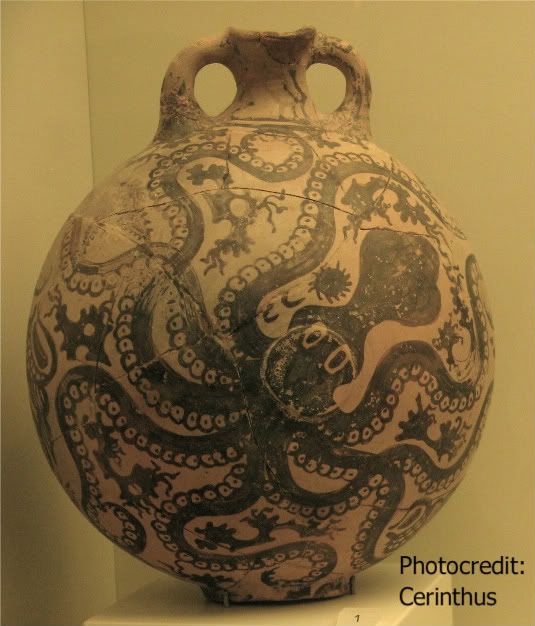
This was originally featured on Fragments of Sulpicia III, but I updated it and have reposted it here. Enjoy, once again, this awesome jar.
Sulpicia Asks: Could you send me some awesome photos.
Cerninthus Answers: Look! An octopus!
(Just kidding. Cerinthus actually responded by sending 93 incredible photos from Crete but this one is totally my favorite)
 This is Minoan. Other than that I don't know. I think Cerinthus saw it in a museum on Crete. More information forthcoming.
This jar was made circa 1500 BCE found at the palace at Knossos and now sits in the Herakleion Museam, Crete (Saskatewan University).
Sulpicia Asks: Could you send me some awesome photos.
Cerninthus Answers: Look! An octopus!
(Just kidding. Cerinthus actually responded by sending 93 incredible photos from Crete but this one is totally my favorite)
Update (09/14/10):
This is known as the "Octopus Jar" and is from the late Minoan period. The Stanford Humanities lab website says:
"At the end of the Middle Minoan era the Kamares style has been relegated to background and a new style stealing from wall paintings of this period was developed. This new style delt mainly with vivid representation of human and animal figures in dark colors on light colored clay. This trend of naturalism is extreamly short lived however. The return to the formulated decorative patterns and stylized plant forms returns and is the basis for future styles."
Subscribe to:
Posts (Atom)