Thursday, August 23, 2012

Spirited: The Craft of Writing

 
I've been putting off working on my writing sample for PhD applications all summer. I have had a lot of other things to do, but I've also just been procrastinating-- doing anything else to avoid it. At first glance it might seem odd that this is the task which I have been avoiding. While I do find writing to be slow and difficult at times, I enjoy writing in general and I really loved writing my undergraduate thesis.

The issue is doing battle with my undergraduate thesis again. While I still believe in most of it, the copy editing is a mess and there are places where the writing is downright unwieldy or the ideas are expressed in an excessively convoluted manner. Yet, even this was not the main turn off. I've been hitting my head against the page restriction on writing samples for a long time. 25 pages is just not much space to express the ideas in an 80 page thesis. I honestly didn't think I could do that. In my head this was just something I couldn't get around.

For my birthday, my parents very smartly bought me a copy of Writing Your Journal Article in Twelve Weeks: A Guide to Academic Publishing Success. Avoiding drilling more Latin vocabulary, yesterday, I decided to read the beginning of this wonderful book. While I am not turning this into an article for publication, the book helped me feel that I could probably mine something out of my thesis to make a solid 25 page stand-alone piece.

One of the things that Belcher recommends is to read the paper through twice, once without a pen and once with a pen. Most of the time, I read the binder copy I have of my thesis which already has some notes with typographical errors and snide comments. This time, I borrowed the nice, clean, bound copy I gave to my parents. Looking at it clean and not looking for problems at the level of sentences, I realize that there are at least 10 pages I can cut out of my introduction and first chapter because I wrote my thesis in the hope that someone without expert knowledge of Plato (and particularly someone who had not read the Laws) could read and understand it (as it will reside in the library of my alma mater). My new target audience (1) will mostly be people who have a solid knowledge of Plato and (2) who don't necessarily need to be up on the data because they are more looking for argumentative structure and originality than understanding. I'm sure I will find even more passages that I can cut the further I go.

Beyond this, I noticed that my writing style tends to imitate the authors I have been reading most recently. During my thesis I read a lot of two wonderful scholars: Catherine Zuckert and Christiane Sourvinou-Inwood. While I hope I incorporated some of their flair for analysis my writing definitely picked up some of their faults (Zuckert: over-inclusion of summary in arguments; Sourvinou-Inwood: clunky, overly-complex sentences). Divesting myself of some of this will also make my thesis more cogent and streamlined.

If anyone has any tips for doing similar things, I'd love to hear them. Also, so far, I would highly recommend Belcher's book. In the first 60 pages she tackled so many of my writing excuses and insecurities and made me feel like I should just go for it. I'm hoping it continues to be stellar.

Saturday, August 11, 2012

Appetitive: Want to Try 2,000 Year Old Food?

Want to try 2,000 year old food? Well, you're chance just came up. According to the Daily Mail, a roman shipwreck has been discovered that is so well preserved, there is still food in the jars. It sounds absolutely amazing. Maybe this is one archaeological report I will actually read.

Wednesday, August 8, 2012

Spirited/Reasoning: The 80% Rule

I wanted to make sure that I covered the verbs that would come up most often. Egnatius pointed me to this article from CPL Online to add to the list of the most important verbs in Greek. According to the article,
"Core vocabulary tends to cluster at two levels, 50% and 80%. The percentage refers to the proportion of a text made up by a certain amount of vocabulary. Half of most English texts, for example, consist of the same one hundred or so lemmas1 repeated as the situation demands. Words like “the” “to” and “is,” for example, generate a fair amount of text by themselves. In these statistics, linguists count lemmas, so different forms of a word (“is” and “was”; “camel” and “camels”) count as a single lemma, not separate vocabulary items. Despite some irregular words (“go” and “went”) and vocabulary items of considerable flexibility (“do”), these are words absolutely fundamental to any communication and comprehension of English. The Perseus Project (http://www.perseus.tufts.edu) provides an invaluable database, and its vocabulary tool (http://www.perseus.tufts.edu/cgi-bin/vocab?lang=greek) has allowed scholars to generate similar analyses for Greek. Whereas an English 50% list consists of more than a hundred lemmas, which is normal enough for languages, a comparable Greek list contains about 65 (the exact number can vary depending on whether some items are grouped together as a single lemma or separated as distinct lemmas). The list itself, with further discussion, follows later in this article, but the key points now are that Greek has a much smaller list at this level and that these are unquestionably vocabulary items a student of Greek will need to be comfortable with" (Major 2).
It seems only reasonable to make the verbs of this frequency a priority. I will start working on this right away.

One think I've bee having a little bit of trouble with is the categorization of verbs. There is some conflicting depictions of verbs in terms of whether they fall under active or deponent.

Tuesday, August 7, 2012

Spirited/Reasoning: Verbs

I haven't been getting much of my Greek and Latin review done lately. In fact, I haven't been getting much of anything at all done. However, I decided to finish up inputting all of the verbs from Hansen and Quinn into my list of verbs. At the moment I have the approximately 100 verbs from there as well as around 50 verbs from Eleanor Dickey's unpublished prose composition manual. More to come.

Monday, July 23, 2012

Appetitive: The Pindarophilic Olympic Hosts

Egnatius sent me this wonderful article this morning about an upcoming attraction at the Olympics: an ode read aloud in Ancient Greek. At the Olympics in Athens, Dr. D'Angour was asked to write an Olympic ode in Ancient Greek. At a classics conference, the Mayor of London requested that Dr. D'Angour write one about the 2012 Olympics which the Mayor will read himself in both Greek and English. The ode is based on Pindar's famous Olympian odes and written in Alcaeic Strophes. How cool is that?

Tuesday, July 17, 2012

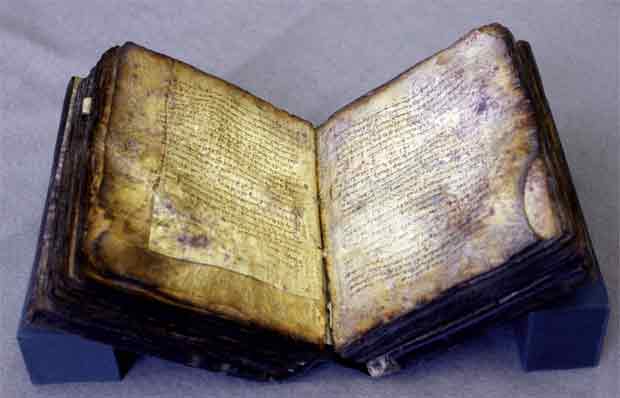
Back After A Long Absence: The Archimedes Palimpsest

So I haven't been posting much lately. I'm going to try to rejoin the classical world and post a little bit more.
Archemedes Palimpsest, the Walters

To start us off, I figured that I would continue on the theme of "back after a long absence" and post the wonderful TED talk on the reconstruction of the Archemedes palimpsest.
Enjoy!

Monday, April 23, 2012

Appetitive: Update

Wow, it's been a long time! I've been incredibly busy with school and friends. I am going to try to get back to posting some things more regularly. For the moment, I have posted a few more verbs on my Principle Parts page.

Also, two Egyptology News article grabbed my attention this morning. The first is that a statue of Cleopatra and Marc Antony's children has been discovered. The second is about the recovery of fragments from the Egyptian Book of the Dead. Interestingly enough, both of these "discoveries" were actually found years ago, but scholars didn't realize what they were until recently. It shows that there are still new things to be discovered, even in museum archives.