Since I haven't been able to post much, I thought I would post a few short notes now and again about things I encounter in my study of classics that I didn't know before. I encountered a few doing my Latin Prose Composition homework.
Bradley's Arnold: 180 [1]: dum (while) always takes an historical present when it denotes the time within which something occurs. I'm not sure if this was something I just missed or if it actually wasn't in my Latin textbook, but this was news to me. Amusingly enough, I bought this textbook used and the person who had the textbook before me circled this as well.
181: The Latin perfect cannot express the equivalent of the English "I have been doing"," so the Romans used the present plus an adverb connoting the idea of the past for the same effect. Teh adverbs are iampridem, iamdiu, and iamdudum. This definitely did not show up in my Latin textbook, but i also can't think of a situation when I've run across it "in the wild" so I guess I can't really blame Moreland and Fleischer for the oversight.
Bradley's Arnold: 180 [1]: dum (while) always takes an historical present when it denotes the time within which something occurs. I'm not sure if this was something I just missed or if it actually wasn't in my Latin textbook, but this was news to me. Amusingly enough, I bought this textbook used and the person who had the textbook before me circled this as well.
181: The Latin perfect cannot express the equivalent of the English "I have been doing"," so the Romans used the present plus an adverb connoting the idea of the past for the same effect. Teh adverbs are iampridem, iamdiu, and iamdudum. This definitely did not show up in my Latin textbook, but i also can't think of a situation when I've run across it "in the wild" so I guess I can't really blame Moreland and Fleischer for the oversight.
Notes:
- Bradley's Arnold references are by paragraph number, not by page.


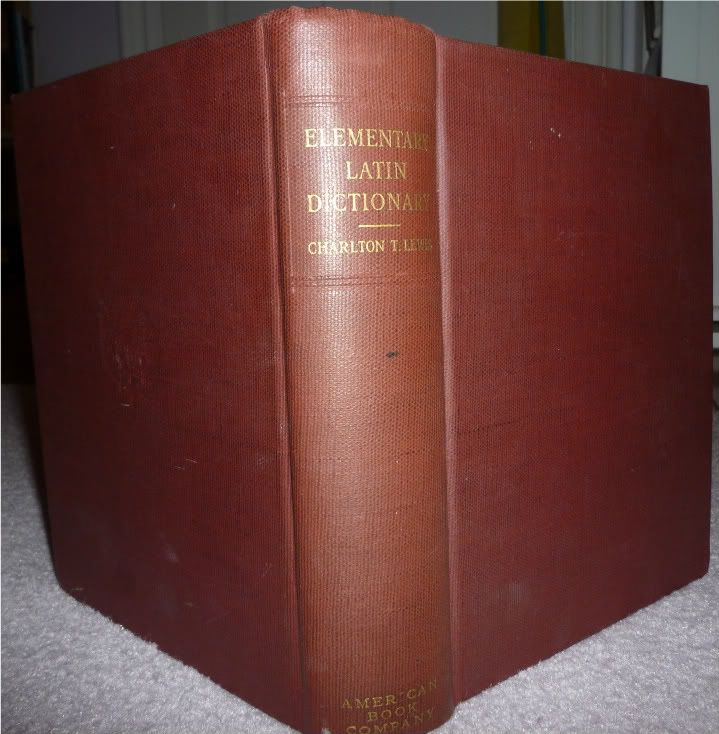
 , which is quite full and fantastic for prose composition, but I wanted a fuller dictionary. So I bought an
  . It's a beautiful copy from 1915 I got cheaply. It's lovely.