For any of you out there who, like me, are reviewing your Ancient Greek grammar for fall classes, I have found an interesting resource. Somebody posted a set of Ancient Greek paradigms for nouns, pronouns, adjectives, and verbs on Berkeley's old Socrates server. Enjoy.
Also, because I have a lot to do before the summer ends, I am postponing my reworkings of "Dates in the Platonic Corpus" until after September 8th.

Tuesday, August 30, 2011


Saturday, August 27, 2011
Appeitive: The Original Windy City
Propertius II and I finally finished reading Iliad Book 13 this morning, mostly due to my slowness and brief interruptions where each of us were busy. I have to say, I really enjoyed the process of reading Homer in the original. I know I confessed in a previous blogpost that I did not like Homer, but the Iliad has grown on me more and more since we began three months ago (for reference, we have also been reading plato beside the Homer and taking time off). We start Book 14 this coming week after some work on the Crito
 .
One of the many things that I noticed in our most recent trek through the Iliad, was epithets. When reading 130 lines over two sittings, I became familiar with certain epithets often used: great-hearted (μεγάθυμος), godlike (δῖος), lord (ἄωαξ), etc. The end of Book 13 focuses on the Trojans, so there were many references to Troy (Ilion) which also bore epithets. My favorite was "Ἴλιον ἠωεμόεσσαν" (Iliad 13.724) or "windy Ilion." It amused me that Troy was the original windy city.
has grown on me more and more since we began three months ago (for reference, we have also been reading plato beside the Homer and taking time off). We start Book 14 this coming week after some work on the Crito.One of the many things that I noticed in our most recent trek through the Iliad
, was epithets. When reading 130 lines over two sittings, I became familiar with certain epithets often used: great-hearted (μεγάθυμος), godlike (δῖος), lord (ἄωαξ), etc. The end of Book 13 focuses on the Trojans, so there were many references to Troy (Ilion) which also bore epithets. My favorite was "Ἴλιον ἠωεμόεσσαν" (Iliad 13.724) or "windy Ilion." It amused me that Troy was the original windy city.
Friday, August 26, 2011
Appetitive/Reasoning: The Mystery of the Propylaea
 |
| Picture Credit: Wikimedia Commons {{PD-1923}} |

 |
| Photocredit: Cerinthus |
 |
| Photocredit: Wikimedia Commons |

The truth is, we don't know. Some scholars suggested that it was due to lack of funds from the Peloponnesian War that the Propylaea was never finished, but Jeffrey Hurwit convincingly argues that "frugality does not explain why the finishing touches were not applied to the Propylaia later. A city that could in 434/3 allot 20 talents a year to get the Acropolis in shape (one of the provisions of the Kallias Decrees) and that in the last third of the fifth century could afford to complete the Erechtheion and Nike sanctuary and create the Nike parapet could surley have afforded to return of the gateway and shave off a few unsightly lumps of stone from its walls" (Hurwit
 160-161).
Hurwit and my professor both contended that the Propylaea, being a secular structure, did not merit the same attention, especially during hard times like the Peloponnesian War, and hence it was abandoned for more more important sacred buildings (Hurwit
161). I am not convinced. The old Propylon, which was destroyed by the Persians, was one of the few buildings repaired before the Periclean building project (where it was replaced witht he Propylaea) (Hurwit 157-158). Even the sacred temple to Athena Polias, the guardian goddess of the city was not rebuilt. Clearly this gateway is important. So why not add those finishing touches (even if the possible extra wings that were planned were too expensive to complete)? I don't know. I have a theory-- although it's a bit strange: all of the other buildings on the Acropolis are beautified, even though the Periclean building project left windows into the past (sometimes literally) to demonstrate the historical significance of the sacred ground. Maybe the Propylaea was left unfinished as a monument to the Persian sack-- showing that buildings that seem timeless in their majesty and beauty were actually new and replacing something that came before and was so sacrilegiously destroyed. It might incur the wrath of some god to show the marks of barbarism on his/her temple, but on a secular structure there was no such fear of retribution.
Tuesday, August 23, 2011
Appeitive/Reasoing: Ancient Greek Death Monuments
I found a website today that I really wish I had discovered while writing my thesis. It's only got basic information, but it shows a nice trajectory of changing death monuments from the Geometric to the Hellenistic period. It is accompanied by a collection of short essays on each period. Check out this piece on the Metropolitan Museum of Art's website.
Friday, August 19, 2011
Appetitive: Birthday Books
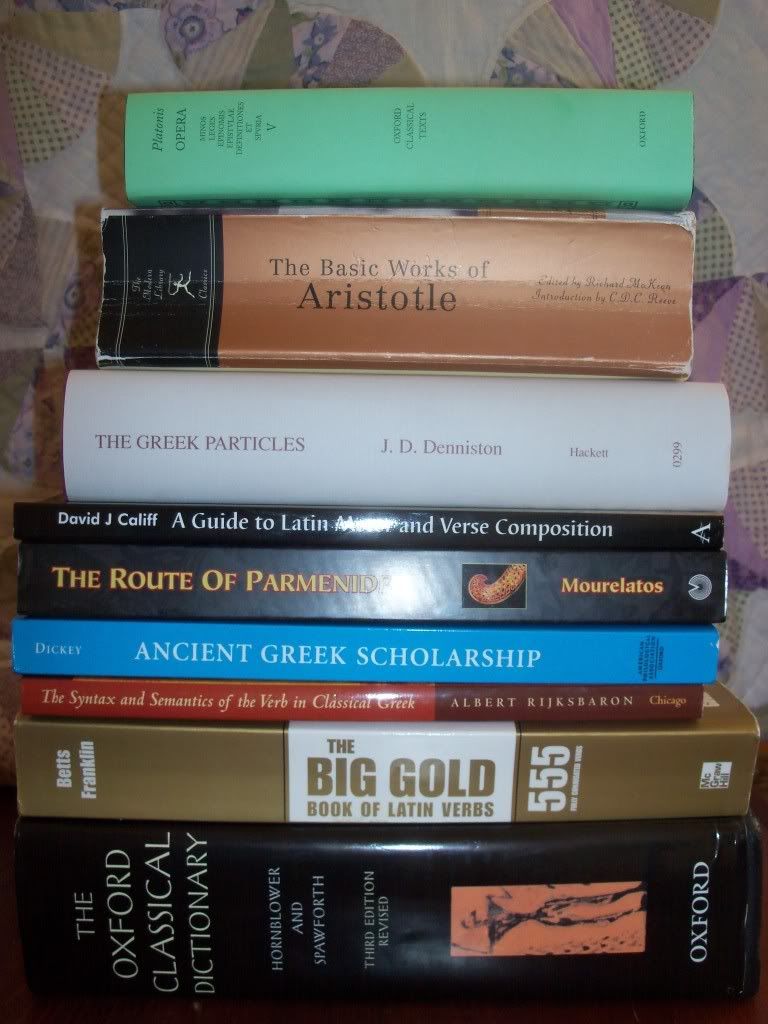 |
| Birthday Books |
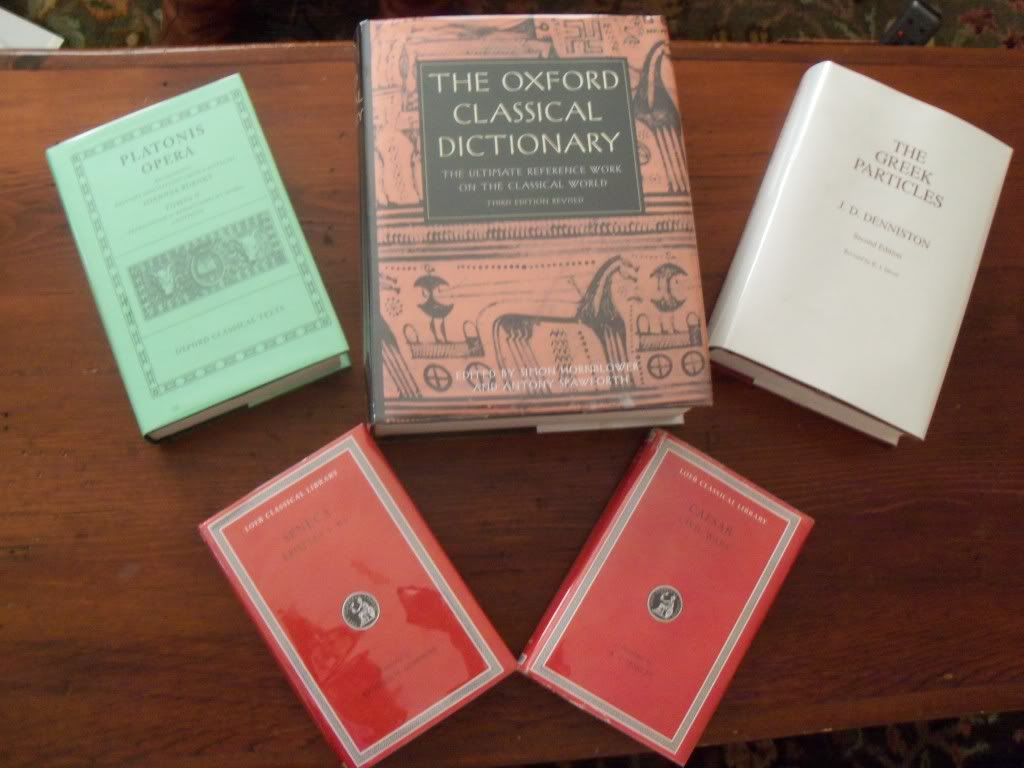 |
| Covered books |
Tuesday, August 16, 2011
Appetitive/Reasoning: Reviews and Things to Come
I've got a cold so I have not been as productive as I might have been. I am still in the process of working on some of my arguments on Plato which should appear at the end of the week sometime. The first one will be trying to dispute the conception of Socrates (the character) as a mouthpiece for Plato's philosophy. I also should be posting some Catullus and maybe some Horace.
In the meantime, I have written a review (thus far) of the a new book that just came out: David Schaps' Handbook for Classical Research . It is on Fragments of Sulpicia.
In the meantime, I have written a review (thus far) of the a new book that just came out: David Schaps' Handbook for Classical Research
. It is on Fragments of Sulpicia.
Saturday, August 13, 2011
Appetitive: Praise with Homeric Terms
Back in the early days of my freshman Mediterranean humanities course, my classmates and I replaced common words for praise (like "kudos") with the Greek word τιμή (esteem, honor) which is so important in the Homeric epics. So instead of saying "awesome job" we would say silly things like "mad τιμή."
As I was reading Homer this morning, I happened upon the word κῦδος. This really surprised me because we all replaced "kudos" with the Greek, but it turns out κῦδος is a similar word to τιμή as it means "glory" or "renown."
Note: I have been working hard on some research on the Laws and I am planning on retelling the argument from my "Dates in the Platonic Corpus" series in a clearer fashion over the next few weeks as I work on editing my thesis. I do not think that I did justice to either the persuasive power of the Zuckert argument or the complexities of dating the Laws. I shall attempt to do a better job this time around.
As I was reading Homer
this morning, I happened upon the word κῦδος. This really surprised me because we all replaced "kudos" with the Greek, but it turns out κῦδος is a similar word to τιμή as it means "glory" or "renown."Note: I have been working hard on some research on the Laws
and I am planning on retelling the argument from my "Dates in the Platonic Corpus" series in a clearer fashion over the next few weeks as I work on editing my thesis. I do not think that I did justice to either the persuasive power of the Zuckert argument or the complexities of dating the Laws. I shall attempt to do a better job this time around.
Subscribe to:
Posts (Atom)