Wednesday, September 15, 2010

Spirited: Sophocles and the Gods

I used to be a Sophocles hater. I know, it's sacrilege. That was, until I read the Ajax in my Greek Tragedy Class. I was hooked at the first scene, where Athena displays an incredible combination of power, maniacal superiority, and cruelty. She demonstrates this complex nature of the gods (in Sophocles' view) who demonstrate a shocking lack of humanity in their dogged pursuit of a foreign ethics. However, much of the ethics is centered around the general Greek principle of "helping friends and harming enemies," but Athena takes this to a sick extreme.

Sophocles II: Ajax, The Women of Trachis, Electra & Philoctetes (The Complete Greek Tragedies) (Vol 9)

From that point, I re-evaluated all the Sophocles plays. Although Athena in Ajax the most explicit instance of the gods acting in any Sophocles I have read thus far [1], although they act in sly and interesting ways and often compel or propel the action of the plays. For example, in the Electra, Orestes explains that his plans for revenge by stealth come from Phoebus Apollo (Electra lines 33-39). The entire action of not only the play, Oedipus Tyrannos [2], but Oedipus' life stem from and are foretold by the actions of Apollo as well. Teiresias speaks for the gods, as some kind of a human intermediary between the two.

Sophocles' plays are much more interesting, in my opinion, when considered not from the perspective of Aristotilian interpretations of Greek tragedy [3] or the conflict between oikos (home and family) and polis (city and state), but rather because they paint a complex and fascinating picture of the interaction between heroes and gods. I have been told my view of Greek tragedy can be a little divine-centric, and this may be true, but the tragedians each demonstrate vastly different conceptions of the gods in their plays, which I believe not only provides rich theatrical masterpieces, but also sheds a new light on Greek religion [4].

Endnotes
  1. I have read Oedipus Tyrannos, Oedipus at Colonus (although I read it twice, I didn't understand it very well either time. it needs to go back on my reading list), Antigone, Ajax, Philoctetes, and Electra.
  2. The reason that I refer to this play as Oedipus Tyrannos rather than the more traditional Oedipus Rex is because I think that the Oedipus Tyrannos expresses the irony behind the play better. Rex, the Latin for king, is much more equivalent to the classical Greek Basileus (although in Homeric times this word was used for a lord, and wanax was the word for king) which means king. One of the primary distinctions between basileus and tyrannos (tyrant) was the idea that the basileus came from a line of inherited power and excellence-- the conception that the person was king by right of family. The tyrant, on the other hand, was not justified by hereditary right, but was rather someone who had taken power by persuasion or, more likely, by force. Although Oedipus is technically a basileus, because he is the hereditary heir of Thebes, he is ironically a tyrant, because he killed his father (former basileus of Thebes) and married his mother in order to gain power in the city.
  3. One of my favorite secondary sources that I read in the class was E.R. Dodd's "On Misunderstanding the Oedipus Rex" (click this link to download the Microsoft Word version of the document from NYU. Click this link to read as a HTML file). The document is short-- only about 6-7 pages if my memory serves, but it explains the problems with the traditional viewpoints on Oedipus Tyrannos.
  4. I plan on doing another blog post about Aeschylus' views on religion, which show gods with a strict social and political hierarchy, and Euripides' views on religion, which seem to show gods with similar faults and flaws of humans, but many times more powerful.

Tuesday, September 14, 2010

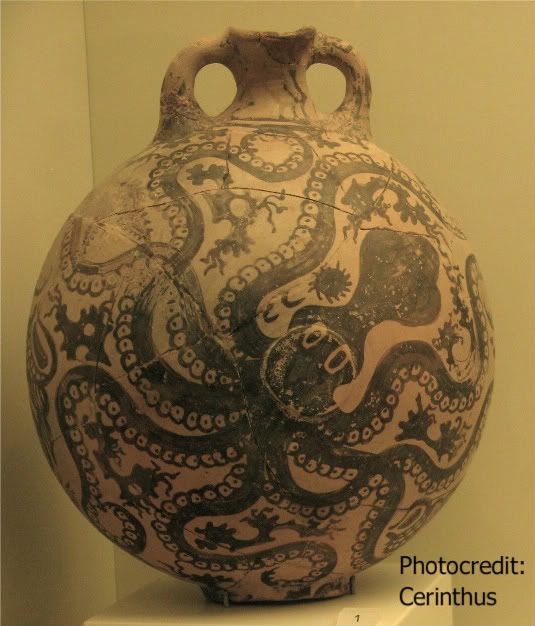
Appetitive: Octopus=Awesome (Cerinthus Reports)

This was originally featured on Fragments of Sulpicia III, but I updated it and have reposted it here. Enjoy, once again, this awesome jar.

Sulpicia Asks: Could you send me some awesome photos.

Cerninthus Answers: Look! An octopus!
(Just kidding. Cerinthus actually responded by sending 93 incredible photos from Crete but this one is totally my favorite)
 This is Minoan. Other than that I don't know. I think Cerinthus saw it in a museum on Crete. More information forthcoming.

Update (09/14/10):
This is known as the "Octopus Jar" and is from the late Minoan period. The Stanford Humanities lab website says: 
"At the end of the Middle Minoan era the Kamares style has been relegated to background and a new style stealing from wall paintings of this period was developed. This new style delt mainly with vivid representation of human and animal figures in dark colors on light colored clay. This trend of naturalism is extreamly short lived however. The return to the formulated decorative patterns and stylized plant forms returns and is the basis for future styles."
This jar was made circa 1500 BCE found at the palace at Knossos and now sits in the Herakleion Museam, Crete (Saskatewan University).

Monday, September 13, 2010

Reasoning: Sophocles' Electra

electra,getty villa
Getty Production Banner [1]


I saw a production of Sophocles' Electra the other night. The amphitheater has fabulous acoustics and the production used the Roman-style building behind the stage as the house that would appear on a traditional Greek stage. The translation was new, written for the production itself, by Timberlake Wertenbaker (which is just such an excellent name!).

First, I really liked the translation. I have not read Sophocles in the original except for a snippet of the Antigone back in high school, so I cannot comment first hand on the veracity of the translation. However, it seemed like a reasonable translation to me, from reading another version in English. Better yet, a lot of the passionate statements were untranslated, or spoken in Greek and then translated subsequently. I thought this had a wonderful effect of highlighting the characters' emotions, as well as providing a greater sense to a modern audience of the Greek tragic ethos. My one qualm is that the pronunciation was not very good. To be sure, I am not the best person to judge pronunciation (see my recent blogpost), but this pronunciation was not significantly better than mine (which is terrible).

Second, they started the play with a cello. This I thought was an interesting touch. The cellist played throughout the performance, setting the mood for various scenes as well as providing some jarring and foreign-sounding interludes, which may or may not have been in any way close to Ancient Greek music. Either way, it worked very well to preserve the tone of the play and I thought it was a nice touch.

Third, I thought the acting was phenomenal. Annie Purcell (Electra) and Pamala Reed (Clytemnestra) were a strong and brilliant pair. The mother daughter relationship was fabulous and I thought the interpretation between the actors, director, and translator did a nice job balancing the two sides. I also was impressed that Manoel Felciano made Orestes' character believable-- something which I did not find to be the case in the translation I read. Olympia Dukakis was also phenomenal.
Sophocles II: Ajax, The Women of Trachis, Electra & Philoctetes (The Complete Greek Tragedies) (Vol 9)

The one odd thing about the play was the choice of costumes. I was kind of apathetic toward them. They were generally soft, draping fabric, which alluded to the drapery of classical Greek statues, but they were modern. This was interesting but neither particularly clever nor particularly off-putting.

In general, I thought it was a great performance of a fabulous play, and thoroughly enjoyed it.

Endnotes
  1. © 2010. The J. Paul Getty Trust. All rights reserved

Saturday, September 11, 2010

Appetitive: Reconstruction of Rome, 320 CE

I am sure that most classics geeks have already found this by now. Google Earth has put up a virtual reconstruction of Rome in 320 CE. I have not downloaded it, but the video tutorial on the webpage is pretty cool.


Once again, I am not an archaeology person, and this part of the Roman Empire is not anywhere close to my usual field of study, so I am not sure how accurate this is. However, it looks pretty cool. Maybe they'll do 5th century Athens sometime. That would be awesome...

Friday, September 10, 2010

Reasoning: Technological and Non-Technological Innovations in Archaeology

Although I truly appreciate and love archaeology, it is not my field. Ever since I was a kid I have been watching the wonderful (albeit controversial) British series Time Team. Of course classics as a discipline relies upon archaeology. However, I, in general, am very much a text person and have no idea what the new developments in archaeology are or how to find out.

In the last few weeks, two archaeology-related pieces in the New York Times have caught my attention (both of which I was referred to by my mom).

MEGA
The first was an incredible piece on new computer technology in archaeology. Apparently, the Getty has set up a system for Jordan (called MEGA), in conjunction with Google Earth, in order to mark on a database and monitor ancient sites:
"These let users find any of Jordan’s more than 10,000 sites, from the ancient city of Petra to tiny unearthed remnants from antiquity, like wine presses, threshing floors and burial grounds dating to the Neolithic period." (see article)
The database functions in both English and Arabic and should help authorities prevent grave robbery and other problems by allowing them to efficiently distribute their resources based on the information.

The system was originally intended for Iraq, where the monitoring is desperately needed, but it was difficult to get the technology there and ensure that it was set up. There are, according to the article, possible plans for expanding to Iraq in the future.

Desert Roads
The second piece that caught my attention focuses on two archaeologists, the Darnells, who worked on the Theban Desert Road Survey. According to the article, this type of surveying focuses on the importance of old caravan trails for finding archaeological remains of settlements. The Darnells discovered a Persian settlement from the 6th century, which lead them to much earlier material:
"Zahi Hawass, secretary general of the Supreme Council of Antiquities, said the archaeologists had uncovered extensive remains of a settlement — apparently an administrative, economic and military center — that flourished more than 3,500 years ago in the western desert 110 miles west of Luxor and 300 miles south of Cairo. No such urban center so early in history had ever been found in the forbidding desert." (see article)
The Darnells say in the article that this provides an explanation for the rise of Thebes as an important center in Egypt.
A picture from the NY Times of the bakery at the dig site

Thursday, September 9, 2010

Reasoning: Sanskrit Library

I have spent most of the day working on a time line for the art history in the second chapter of my thesis. I am trying to do some revision to see if I can get anyone interested in my thesis, and I also to use it for a writing sample.

Some of the programs that I am looking at, e.g. Brown, require Sanskrit. Ever since I was in high school and my first Greek teacher talked about the relationship between Greek and Sanskrit, I have been interested in learning Sanskrit. My interest was stoked further by a beautiful green leather book I discovered in one of my friends rooms when hanging out one day. The book was beautiful, thick with cream pages, and became much more so when I realized that the book was in fact a Sanskrit Grammar. A few summers ago, two friends of mine decided to teach themselves Sanskrit (one of whom was Propertius). I was going to do it with them, but it became complicated, although I believe they did manage to pick up some amount of the language. In the process, I received my own copy of the Sanskrit Grammar. I have planned on looking into it this summer, but I have not gotten around to it yet. You can download it for free online on the Internet Archive.


While I was searching around, I found a Sanskrit Library. It appears to have Sanskrit texts and materials of some kind, although I haven to looked into much of it yet. I hope that I would manage to teach myself a little at some point.

Wednesday, September 8, 2010

Appetitive: A Reading of Ovid

I was looking for something online the other day, I cannot even remember what it was when I stumbled across the podcast of a Dickinson Classics Professor, Christopher Francese, who reads poems in Latin. I listened to my first one this morning and I thought that it was thoroughly enjoyable. I listened to "The Art of Love (Ovid, Ars Amatoria 1.1-24)," Released: Jul 31, 2010. I can't link directly to the podcast, but it is the one called "The Art of Love" dated 07/30/10. He reads in his own translation and then reads in Latin:
"Siquis in hoc artem populo non novit amandi, Hoc legat et lecto carmine doctus amet. Arte citae lecto carmine doctus amet. Arte citae veloque rates remoque moventur, Arte leves currus: arte regendus amor. Curribus Automedon lentisque erat aptus habenis, Tiphys in Haemonia puppe magister erat: Me Venus artificem tenero praefecit Amori; Tiphys et Automedon dicar Amoris ego. Ille quidem ferus est et qui mihi saepe puppe magister erat: Me Venus artificem tenero praefecit Amori; Tiphys et Automedon dicar Amoris ego. Ille quidem ferus est et qui mihi saepe repugnet: Sed puer est, aetas mollis et apta regi. 10 Phillyrides puerum cithara perfecit Achillem, Atque animos placida contudit arte feros. Qui totiens socios, totiens exterruit hostes, Creditur annosum pertimuisse senem. Quas Hector sensurus erat, poscente magistro erberibus iussas praebuit ille manus. Aeacidae Chiron, ego sumtotiens exterruit hostes, Creditur annosum pertimuisse senem. Quas Hector sensurus erat, poscente magistro Verberibus iussas praebuit ille manus. Aeacidae Chiron, ego sum praeceptor Amoris: Saevus uterque puer, natus uterque dea. Sed tamen et tauri cervix oneratur aratro, Frenaque magnanimi dente teruntur equi; Et mihi cedet Amor, quamvis mea vulneret arcu Pectora, iactatas excutiatque faces. Quo me fixit Amor, quo me violentius ussit, Hoc melior facti vulneris ultor ero" (Ovid, Ars Amatoria 1.1-24) [1].
I have no idea about the accuracy of his pronunciation, but I enjoyed listening to it.

Pronunciation in both Greek and Latin is one of my greatest weaknesses. When i was originally learning the languages, I decided that other aspects were more important to me. I always loved listening to my friends speak in classical languages, but I never spent any time on developing my own ability. I did not realize how embarrassed of my lack of skill I was until this last year, when I was in a class where I had to read in Greek a lot more than I had bargained for. I enlisted the help of a Propertius, who rivals silver-tongued Hermes in pronunciation abilities, and after an hour of his patient help I realized what an arduous process learning pronunciation was going to be.

On his recommendation, I acquired a copy of Vox Graeca, but I have not gotten around to flipping through it. I read the preface and the Phonetic Introduction today, and it looks like it will be a lot of work. I have hopes that the process will pay off.
 Vox Graeca: The Pronunciation of Classical Greek Vox Latina: A Guide to the Pronunciation of Classical Latin
I was also excited to learn today that there was a Vox Latina. I do not know anything about it but I assume that it would provide a similar service. Does anyone know if it is any good?

Endnotes
  1. I am not at all sure how to make the poem display in couplets (as one can easily guess from my problematic formatting on my translation of Sulpicia.