Showing posts with label Perseus Project. Show all posts

Friday, February 25, 2011

Reasoning: TLG does LSJ

The Liddell, Scott, and Jones (LSJ for short) is the standard dictionary of classical Greek. I have had my intermediate LSJ (Middle Liddell) since high school. I love it, even though I often use the faster version of the big LSJ (Great Scott) on the Perseus Project.
Liddell and Scott Greek English Lexicon - 9th ed. w 1996 Revised Supplement An Intermediate Greek-English Lexicon: Founded upon the Seventh Edition of Liddell and Scott's Greek-English Lexicon An Intermediate Greek-English Lexicon (text only) 7th (Seventh) edition by H. G. Liddell,R. Scott
The Thesaurus Linguae Graecae (TLG), according to AWOL, has now put out a digital version of the 9th edition (revised and with supplements). This version will be searchable in both English and Greek (an invaluable tool for anyone taking a Greek composition class) and sounds fabulous.

Thursday, January 20, 2011

Reasoning: Using "All the Greek Verbs"

No matter what I try to do, I seem to end up relying on the Perseus Project to translate texts (at the moment Μήδεια). My resolve seems to falter. However, I have been trying to at least reference All the Greek Verbs, when I run into something tricky or a verb that I know I should remember. Although Herodotus II claims that we have a friend that swears by it, I have found no use in it so far. Maybe it just has a distaste for Euripides.
All The Greek Verbs (Greek Language)
More updates on it as I try to use it more and wean myself off of Perseus.

Saturday, January 1, 2011

Spirited: All the Greek Verbs

So it seems my resolutions are not going very well so far as I have done no Greek or Latin as of yet and did not begin my blogpost until now. I also spent much of the day reading a book not on my reading list: Jeff Sharlet's The Family. It's just been one of those days.

However, I have been flipping through a gift I received: Nino Marinone's All the Greek Verbs. I have spoken before of my unintentional reliance on Perseus for the sake of efficiency in translating Latin and especially Greek. Part of this is because I do not know irregular verb conjugations (and sometimes cannot identify regular or common verb conjugations) off the top of my head. All the Greek Verbs is a list of verb forms, which tell you the person, number, tense, voice, and mood of each verb, as well as the verb itself so that one can look up a translation. I think this will help to ween me off of my Perseus addiction, because I can use a book instead of the computer and constantly looking up the verbs in paper dictionary will help not only to ingrain the verb forms but also the meanings in my head. I will update this review when I try it out on the next section of the Μήδεια.
Euripides: Medea (Cambridge Greek and Latin Classics) All The Greek Verbs (Greek Language)
Happy New Year, everyone!

Does anyone know if there is a similar book for Latin?

Saturday, November 20, 2010

Appetitive: Herodotus and Ancient Temples

So I checked my twitter this morning and reaffirmed my reason for having a twitter (no matter how stupid Cerinthus and his parents think it is).

First, I happened upon (through Marathon 2500's twitter) an online version of Herodotus with facing Greek on sacred-texts.com. Unlike the Perseus version, this does not have a built in dictionary, but it is a clean format for browsing the English and Greek.

Second, I came upon a Huffington Post slideshow of Ancient Greek and Roman temples in Europe and the Middle East. The pictures are not fabulous (many of Cerinthus' pictures are better), but they show a number of temples in France and the Middle East that I had not seen before.

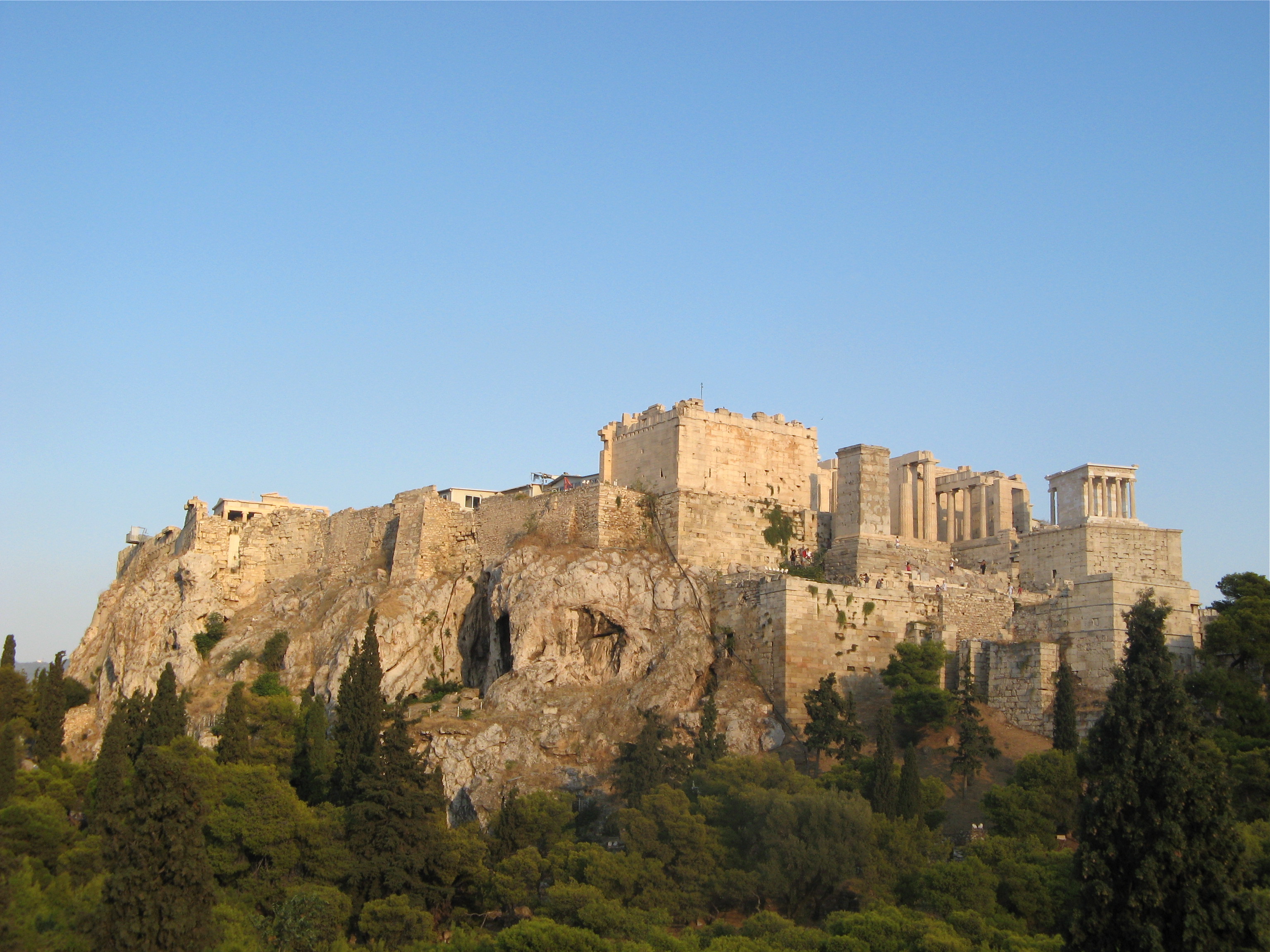
Acropolis, from Cerinthus' photos

This is not Cerinthus' best photo, but I thought I would include something of the pictures that he took and there are a few thousand of them so I thought I would just pick one I liked. More on Plato coming soon.

Monday, September 6, 2010

Reasoning/Spirited: A Grand Narrative Approach to Greek History #2

Although I criticized The Origins of Greek Thought on both specific points and general approach in my last blog post, Vernant incorporates a number of persuasive and thought-provoking claims in his narrative tale of the origins of Greek Rationality. One of the descriptions that caught my attention is his description of the bureaucratic royalty of the Mycenean palace culture:
"social life appears to have been centered on the palace, whose function was at once religious, political, military, administrative, and economic. In this palace-centered economic system, as it has been called, the king brought together and fused in his own person all aspects of power and sovereignty. Through the agency of the scribes, who formed a professional class established by tradition, and a complex hierarchy of palace dignitaries and royal inspectors, the king controlled and closely regulated all sectors of economic life and spheres of social activity" (Vernant 24).
This passage struck my attention because it reminded me of a passage in Herodotus on which I spent a lot of time and concentration. In Book I when Herodotus describes the founding of the Persian empire by Deiokes, he describes a similar bureaucratic palace structure, except of course that Deiokes becomes so paranoid that he no longer leaves the palace. Furthermore, the palace structure itself sounds somewhat like the image that Vernant describes for the Mycenean palace:
"the Mycenean manor, centered on the megaron [a great central hall] and the throne room, is a walled fortress, a chieftain's den, dominating and keeping watch over the plain at is feet. Constructed to withstand siege, this citadel sheltered the quarters of the king's intimate associates, the military leaders and the palace dignitaries, alongside the princely dwelling and its outbuildings" (Vernant 28)
Unlike the Persian palace that Herodotus describes [1], the Mycenean palaces were not built in concentric circles. Here is an example of the palace floorplan at Pylos [2]:

However, the fortified structure around the king and the treasury and the specialized circle of scribes to maintain a stranglehold on the life of the subject who build their homes around the palace directly follows the description that Herodotus provides. My guess would be that Herodotus saw (or heard about) the ruins of the old Persian palaces, heard the name Deiokes from local history and legend, and attributed aspects of the Greek past to the Persian past of a similar time period.

For anyone who reads Ancient Greek: 1.97-1.100 in Herodotus was one of my favorite passages (when I find my notes, I will do a translation of this section) in any Greek text I have read. The nested structure of the sentence that describes the concentric circles is so incredibly cool. I highly recommend it.

Endnotes
  1. I believe that Herodotus does describe an actual Persian type of architecture, although I do not believe that there were ever seven concentric walls surrounding this type of palace. I would cite the source for this belief, but unfortunately I cannot find the paper that I wrote on Deiokes' palace (which is also the reason that I have not taken the time to do my own translation of the passage from the original Greek). I do believe, however, that this was the book that provided me with the information about the archaeological evidence for Persian architecture: Culican, William. The Medes and the Persians. New York: Praeger, 1965. 
  2. This image comes from the Brown website. More awesome images of this type can be found at the Bryn Mawr website.

Saturday, August 28, 2010

Reasoning: Greek History Review #2

, I finished the next the chapters of Early Greece, which consider the aristocracy and the community in the Dark Age and "Euboan Society and Trade." These chapters are not on the afore-mentioned Greek History Syllabus. However, I decided that I would finish the book as well as reading through the entirety of A Brief History of Ancient Greece alongside the secondary sources from the syllabus. The idea is to provide a broad base for further study. This I am sure would offend the sensibilities of my Greek History professor, given that A Brief History of Ancient Greece is written in part by one of her greatest rivals. Amusingly, I have to thank this same professor's rant against this rival which demonstrated the proper way to criticize a historical argument and served as a model for me to scrutinize the arguments of others (specifically some of the arguments in "Male Lament in Greek Tragedy") and my own arguments in my thesis.


Although most of what I'm reading is not new to me, there are a couple of things that came as a surprise to me. The first was that there was a period of pottery between the Geometric Period and the Black figure period. This was the Proto-Corninthian period of pottery, which flourished during the Orientalizing period 725-600 BCE [1]. Most of the pottery was miniature [1].
This owl is only 5cm long. It is my favorite Proto-Corinthian piece of which I have found a picture [2]. These pieces tend to employ the black, white, and terra cotta color scheme. The pieces have the influence of the eastern trading partners (Murray 32-33).

The pieces seem to me, from my mostly untrained eye, to be a mix of geometric period influences (although this vase shows the orientalist influence of the flowing curves in the painting and the pictures of animals (Murray 84-85), the animals are arranged in seemingly geometric patterns)
and the Athenian black figure that replaced it (this reminds me of the composition of the Athenian black figure, but the colors are quite obviously from the proto-Corinthian period).

Another, although slightly less vital, piece of information that I missed in my classical education was the origins of the Phoenicians. Murray says:
"the earliest Greek contacts were with the Canaanites of the Levantine coast, a people known to the Greeks as the Phoenicians, probably because of their monopoly of the only colour-fast dye in antiquity, the purple (phoinix) extract from the murex shellfish" (70).
I had no idea how the Phoenicians were named by the Greeks, and I thought that was pretty cool. I also thought they were island people, and had no ideas that they controlled the forests of Lebanon which provided timber to Egypt (Murray 70).

Endnotes:
As a Note: Project Gutenberg is now posting texts in their original language. They may have done this before, and I just did not notice. It's a fabulous resource. Although I would traditionally turn to the Perseus Project for Greek texts. However, I might put these on my kindle in order to translate without the crutch of a built in dictionary.
  1. This comes from Encyclopaedia Britannica.
  2. All of the pictures come from Wikimedia.