He is a professor emeritus at Magdalen College, University of Oxford and he has written a plethora of incredible books and articles, including The Stagecraft of Aeschylus
 which I read about half of for my class on the Agamemnon and was fortunate enough to receive as a birthday gift this year. Two books he edited which I would love to read are The Pronomos Vase and its Context and Pots & Plays: Interactions between Tragedy and Greek Vase-painting of the Fourth Century B.C..


Taplin opened his talk by explaining that he would be considering three questions.
- What was the importance of traveling players in Ancient Greece?
- How did those traveling players influence art?
- Did traveling players manage to reach a non-Greek audience [1]?
Beside this, Aeschylus spent time a Heiron's court in Syracuse, both before he wrote the Oresteia [3] and during the end of his life (in fact, he died there [4]). Hieron, the tyrant of Syracuse at the time, commissioned a play at the founding of Aetna, The Women of Aetna [5]. Euripides died in Macedonia and may have written the Bacchae
 there [6].
 Furthermore, vases containing theatrical imagery have been found in burials at Phanagoria, Cyrene, Korinth, Olbia, and Ruvo. In the non-Greek areas, scholars often dismiss the pots and assume that people just liked the pictures. Taplin, and especially Carpenter, seek to challenge this assumption.
According to Taplin, between Hieron and Alexander the Great, there was an increase in the theater outside of the festival of Dionysus at Athens. First, there were rural Dionysias in the outer demes [7]. These were serious cult events in the 5th century. In Republic 475d, Socrates disparages those theater-goers who do not miss any Dionysian in the cities or villages. Demosthenes, according to Taplin, also criticizes Aischenes for going to the lesser theater competitions. Furthermore, actors came from all over the Mediterranean, not just from Athens. Taplin cites Aristedemus from Metapontion as an example [8]. By 440, there were at least five regular theatrical festivals, and there is some evidence for 14 all together, although many of these were not held in traditional stone theaters.
Furthermore, Plato provides evidence of dramatic competition in outside of Athens. In Laws
 659b-c, Plato disparages the demos-centric way that the judges decide competitions in Italy and Sicily (i.e. judges were swayed by public opinion). This provides evidence that there was some kind of theatrical competition that took place in these areas. Taplin argues that the actors in these competitions were probably from traveling troupes, and that these performers would respond to invitations to various festivals. He hypothesizes that there would be three actors, with a possible fourth actors playing the chorus. In the third century, according to Taplin, choruses would travel with the bands, but probably not before that. He notes, in reference to Kowalzig, that the Dithyramb was part of Hellenic culture, and it makes sense that choruses of all types would be part of civic coherence not just in Athens, but also Magna Graeca.
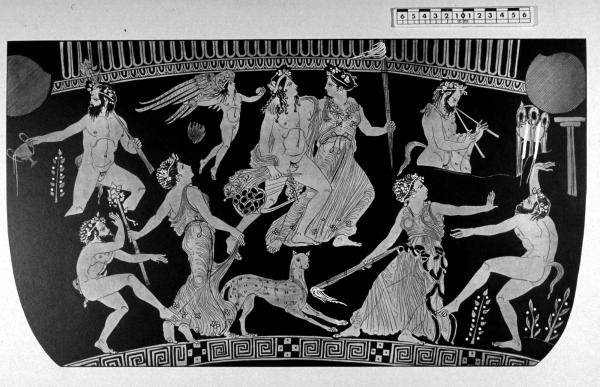
Taplin claims that the vases from Syracuse, Lukania, and other places in the Greek world serve as material evidence of traveling troupes [9]. Tombs in around Magna Graeca contain vases with theatrical imagery that appear to be made outside of Athens.
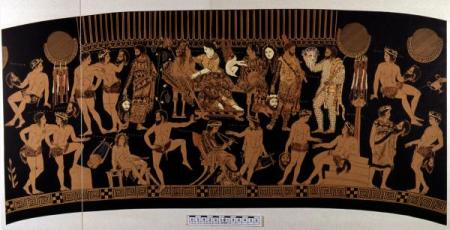
At the end, Taplin addressed Carpenter's case for Greek plays in the Italic areas of Apulia. Taplin agreed with Carpenter, saying that 10% of the dramatically related vases in Italy come from Ruvo. However, Taplin believed that the Pronomos Vase must have been bought on the secondhand market and brought back to Ruvo, possibly by someone who got to see the theatrical competition in Athens and bought it as a keepsake.
Endnotes
- This is the same subject, on a larger scale, as Carpenter's talk. Near the end, Taplin directly responded to Carpenter, and he agreed with everything except Carpenter's discussion of the Pronomos Vase.
- See this in Herodotus' Histories
section 6.21. However, I think it's important to note that there is no indication in this that the plays would be re-performed outside of Athens, but also no indication that they would only be reprised in Athens. For context, Phrynikos' play, the Sack of Miletus (not extant), was the last play that depicted an real, current, tragic event (with the possible exception of the Persians because I am not sure of the comparative dates and also because the Persians was slightly different in tone and perspective). It was a play about the devastating Sack of Miletus and, according to Herodotus, the entire audience burst into tears. For causing such a disturbance, Phryikos was fined and the play was banned from ever being performed again.
- There are some fascinating similarities in the description of fire/gold in Pindar's Olympian I and the opening speech of the Agamemnon, but I will save this discussion for another time.
- The story of Aeschylus' death has functioned somewhat as an urban myth and has even invaded modern popular culture. I have heard two versions of the story. Both are premised on Aeschylus being bald. The first version says that as Aeschylus was walking along the beach in Sicily, an eagle mistook his bald head for a tortoise and dropped a rock on it to break it open. The second version, which I believe is at some point retold by Dr. Donald "Ducky" Mallard on NCIS, is that an eagle, carrying a turtle, mistakes Aeschylus' head for a rock and drops the turtle on it to crack open the shell. Whether he died in one of these ways or not, it makes for a great story.
- All that remains is a fragment.
- There is a wonderful moment about this in Nietzsche's Birth of Tragedy
, but I cannot seem to find it. If anyone knows where it is, comment or email me.
- A deme is much like a village that is part of the polis.
- I am not sure about the spelling on either of these names.
- A vase depicting the Medea shows the version of the story in which Medea slaughters her children. According to Taplin (citing Mastronarde), this was not a version of the myth in popular culture until Euripides' version.