
Showing posts with label Mycenean Palace Culture. Show all posts
Showing posts with label Mycenean Palace Culture. Show all posts
Monday, April 11, 2011
Appetitive: A Follow -Up on the Linear B Tablet
Servia sent me this latest piece (New York Times) on the new discovery of the Linear B tablet in Iklaina which I mentioned in two previous blogposts (#1, #2). The peice shows not only an image of the tablet, but a sketch that allows a clearer view of the writing.


Sunday, October 31, 2010
Reasoning: Greek History Review #5, the Minoan Palace Culture
I found (what I deem to be) a fascinating article on the emergence of the Palace culture in the Aegean. The article is called "The Emergence of the State in the Prehistoric Aegean" [1] written by John F. Cherry [2]. The article is both methodologically reasonable and provides a persuasive case for the problems with and conclusions that may be drawn from Minoan archaeology. However, I am no expert on early (or really any) Minoan culture and if anyone has a perspective on the article, I would love to hear your comments.
Methodology
Cherry tries to balance between a comparative historical approach and while not generalizing the comparison so far that it yields no useful results. He argues that Aegean provides a situation within a small area in which there were multiple cycles of complex societies in which the early society completely collapsed before the next cycle (Cherry 18). He explains that it is unusual for scholars (or was in the mid-1980s) to do so, and "the lack of incentive is no doubt attributable to the feeling that there are simply too many real differences, both in general structure and particular detail, between the political systems of the Classical world and those of the Bronze Age for a unified analytical framework to be anything other than superficial" (Cherry 19). He balances against the "too much writing both about Greek Bronze Age states and about the later poleis has been bedevilled by the assumption that they are simply sui generis and thus cannot stand in comparison with other institutions" [3] (Cherry 24).
He has two aims: first, to crystalize the analysis around the central concept of the state in order to understand changes in the archeological record and second to distill a long history of analysis in different fields in order to place the 'polities of the Minoan and Mycenean worlds in the broader contests they demand" (Cherry 24).
Historical Analysis
According to Cherry, there are a number of different factors that are often included in the explanation for ancient state formation, including agriculture, the nature of the earlier settlements, etc but there are a large group of similar societies that did not develop into states (e.g. place-like cultures). Cherry's question, then, is what makes the Minoan settlements, and specifically Crete, develop unlike other areas with similar circumstances (Cherry 21-23).
The first major change is the shift from the subsistence basis of the economy in the Neolithic to the cultivation of the grape vine and the olive tree (Cherry 24) and the "secondary products revolution" using livestock for "milk, wool, riding. traction, and pack transport" (Cherry 25) rather than solely for meat. However, although this certainly boloster the economic base, it cannot be sufficient for the creation of a palatal society because many places experienced this "secondary products revolution" and did not become full civilizations (Cherry 26-27).
Another problem with the traditional model of understanding the rise of Minoan civilization is that scholars and archaeologists usually assume a slue period of growth over 2 millennia that lead to the emergence of palace culture, including a culture of "proto-palaces." However, according to Cherry, there is little evidence of this slow growth, especially because more recent excavations and analysis shows the "proto-palaces" to be small villages rather than single manors (Cherry 27-29). This points to a quicker development, but there is little evidence of this developmental phase (Cherry 33).
One of the unique things about the evidence of Minoan society is a lack of defensive walls a militaristic culture. This lead to the dominant "'consensus' model of palace origins, in which the palaces are seen as the focal points of activities contributing to the general welfare" (Cherry 33). However, as Cherry points out, "Rather than asking 'What services did Minoan rulers provide for society', perhaps the question should be inverted: 'In spite of the fact that their activities serve their own ends, how did the elite establish and maintain their control?' No ruler can hope to retain power without using the stick as well as the carrot" (Cherry 34). So if there was not a militarism of direct force, ther must have been a strong ideological basis for the rule, although I think cherry goes too far when he compares it to the Augustan ideological reforms (Cherry 35).
The final point that Cherry makes is that the location of Crete, with easy trade-routs to the established cultures in the east might have provided the necessary edge for the development of an organized and bureaucratic palatal society (Cherry 36) based more on wealth and diplomatic contacts than military might.
Methodology
Cherry tries to balance between a comparative historical approach and while not generalizing the comparison so far that it yields no useful results. He argues that Aegean provides a situation within a small area in which there were multiple cycles of complex societies in which the early society completely collapsed before the next cycle (Cherry 18). He explains that it is unusual for scholars (or was in the mid-1980s) to do so, and "the lack of incentive is no doubt attributable to the feeling that there are simply too many real differences, both in general structure and particular detail, between the political systems of the Classical world and those of the Bronze Age for a unified analytical framework to be anything other than superficial" (Cherry 19). He balances against the "too much writing both about Greek Bronze Age states and about the later poleis has been bedevilled by the assumption that they are simply sui generis and thus cannot stand in comparison with other institutions" [3] (Cherry 24).
He has two aims: first, to crystalize the analysis around the central concept of the state in order to understand changes in the archeological record and second to distill a long history of analysis in different fields in order to place the 'polities of the Minoan and Mycenean worlds in the broader contests they demand" (Cherry 24).
Historical Analysis
According to Cherry, there are a number of different factors that are often included in the explanation for ancient state formation, including agriculture, the nature of the earlier settlements, etc but there are a large group of similar societies that did not develop into states (e.g. place-like cultures). Cherry's question, then, is what makes the Minoan settlements, and specifically Crete, develop unlike other areas with similar circumstances (Cherry 21-23).
The first major change is the shift from the subsistence basis of the economy in the Neolithic to the cultivation of the grape vine and the olive tree (Cherry 24) and the "secondary products revolution" using livestock for "milk, wool, riding. traction, and pack transport" (Cherry 25) rather than solely for meat. However, although this certainly boloster the economic base, it cannot be sufficient for the creation of a palatal society because many places experienced this "secondary products revolution" and did not become full civilizations (Cherry 26-27).
Another problem with the traditional model of understanding the rise of Minoan civilization is that scholars and archaeologists usually assume a slue period of growth over 2 millennia that lead to the emergence of palace culture, including a culture of "proto-palaces." However, according to Cherry, there is little evidence of this slow growth, especially because more recent excavations and analysis shows the "proto-palaces" to be small villages rather than single manors (Cherry 27-29). This points to a quicker development, but there is little evidence of this developmental phase (Cherry 33).
One of the unique things about the evidence of Minoan society is a lack of defensive walls a militaristic culture. This lead to the dominant "'consensus' model of palace origins, in which the palaces are seen as the focal points of activities contributing to the general welfare" (Cherry 33). However, as Cherry points out, "Rather than asking 'What services did Minoan rulers provide for society', perhaps the question should be inverted: 'In spite of the fact that their activities serve their own ends, how did the elite establish and maintain their control?' No ruler can hope to retain power without using the stick as well as the carrot" (Cherry 34). So if there was not a militarism of direct force, ther must have been a strong ideological basis for the rule, although I think cherry goes too far when he compares it to the Augustan ideological reforms (Cherry 35).
The final point that Cherry makes is that the location of Crete, with easy trade-routs to the established cultures in the east might have provided the necessary edge for the development of an organized and bureaucratic palatal society (Cherry 36) based more on wealth and diplomatic contacts than military might.
Endnotes
- Early on in the article, Cherry addresses the problem with the anachronism and problematic model connoted by the word "state" and explains it as such: " The state can be defined as a powerful, complex, permanently instituted, system of centralised political administration; it exercises sovereignty in carrying out basic political functions (e.g. maintaining territorial rights and internal order, or making and executing decisions regarding group action) and its authority in these matters is buttressed by sovereignty in the use of force within its jurisdiction. States are also societies with relatively complex and specialised administrative organisation, involving hierarchically ordered personnel who perform specialised administrative task and make decisions" (Cherry 23).
- Cherry, John F. "The Emergence of the State in the Prehistoric Aegean," The Cambridge Classical Jounral: Proceedings of the Cambridge Philological Society. No. 210 (New Series, No. 30). 1984. p18-28.
- While I found myself banging my head against the wall in classes listening to wind-bag history majors making absurd claims comparing Athenian metics to 19th century Eastern European emigrants and subsequently decided that all comparative historical claims were totally bogus for the Ancient World, I realized that Cherry has a point. Restricting comparisons by location and period, as well as critically evaluating the comparative frameworks, could provide useful information that might not arise from avoiding comparative methodology entirely.
Friday, October 22, 2010
Reasoning: Sophistocation and Idiots in Greek Art
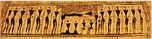
In my first year of college I took an interdisciplinary survey course on the classical world. The class had a lecture component, in which professors gave lectures, primarily in their own field, one some aspect of the Greek or Roman world in vaguely chronological order. One of the early lectures was by an Art History professor who I will call William, since I cannot come up with an adequate late Republican pseudonym, and it concerned one of the most famous works in early Greek art: the Dipylon Vase (750-700 BCE).
After the lecture, I thought to myself what an ugly vase and what a stupid lecture. Little did I know that not only would I ultimately grudgingly vindicate the ideas in this lecture that I initially excoriated, but I would also write a chapter of my thesis on the funerary images like that prominently figured on the Dipylon Vase (close up below).
Willaim's Claim: In his lecture William claimed (almost verbatim) was that the Greeks had perspective, they just were not employing it because it was not the proper means to the end they were trying to achieve. More infuriated by the wording of the claim than anything, but specifically incensed that a tenured art history professor was allowed to make such a bogus claim.
It was not until now that I realized what he meant. He was not making the claim that the Dipylon Master [3] could achieve Renaissance-style perspective, but rather that the art of this time period had it's own particular style of representation and visual formula that it employed to depict certain recognizable images to its audience. This pottery conveyed the events in a recognizable and stylized manner because it effectively communicated to the audience, possibly more effectively than a more realistic attempt. For evidence of this, when I decided to write this blogpost, I was scouring the internet for images and happened upon the Dipylon Krater (below) and it took me about half-an-hour before I realized that this was not the Dipylon Vase which I was seeking.
Obviously I am not saying that any attempt at an accurate depiction would have been particularly life-like, especially given the almost complete absence of figure drawing in Submycenean and Protogeometric art (Hurwit 53-59) [4]. My contention is that the oddities of representation, such as the three-quarter legs, the full-frontal torso, and the profile head on the mourners, has a stylistic purpose rather than evidence of crude, "bad" art.
The tropes and stylization in this art is actually something of a bonus for scholars/students like me who are looking not for artistic sophistication, but rather evidence of burial practices. In a future blogpost, I will show images of the geometric vase that I found on display at the end of a hallway at the Getty that provides incredible evidence for early differentiation of the genders in mourning practices which is not shown in either of the Dipylon vases in this blogpost.
 |
| Dipylon Vase from this website [1]. |
 |
| A close-up of the burial scene from this website [2]. |
Willaim's Claim: In his lecture William claimed (almost verbatim) was that the Greeks had perspective, they just were not employing it because it was not the proper means to the end they were trying to achieve. More infuriated by the wording of the claim than anything, but specifically incensed that a tenured art history professor was allowed to make such a bogus claim.
It was not until now that I realized what he meant. He was not making the claim that the Dipylon Master [3] could achieve Renaissance-style perspective, but rather that the art of this time period had it's own particular style of representation and visual formula that it employed to depict certain recognizable images to its audience. This pottery conveyed the events in a recognizable and stylized manner because it effectively communicated to the audience, possibly more effectively than a more realistic attempt. For evidence of this, when I decided to write this blogpost, I was scouring the internet for images and happened upon the Dipylon Krater (below) and it took me about half-an-hour before I realized that this was not the Dipylon Vase which I was seeking.
 |
| Dipylon Krater (700-750 BCE) from this website [5]. |
The tropes and stylization in this art is actually something of a bonus for scholars/students like me who are looking not for artistic sophistication, but rather evidence of burial practices. In a future blogpost, I will show images of the geometric vase that I found on display at the end of a hallway at the Getty that provides incredible evidence for early differentiation of the genders in mourning practices which is not shown in either of the Dipylon vases in this blogpost.
Endnotes
- This picture is from the University of Texas Webpage. Because there are two Dipylon Vases, this one is sometimes known as the Dipylon Amphora.
- I found a clean, but rather small close-up from a humanities blog. Below is a much clearer close up of a similar scene from the Dipylon Krater.
- The Dipylon Master is the name given to the artist who painted the Dipylon Amphora.
- For a more in-depth but still succinct description of the evolution of art from the collapse of the Mycanean Palace system through the Geometric period, see Jeffrey Hurwit's The Art and Culture of Early Greece
, pages 53-70.
- Both pictures of the Dipylon Krater are from the Glendale Community College webpage.
 |
| Close up of burial on Dipylon Krater from this website [5]. |
Monday, September 6, 2010
Reasoning/Spirited: A Grand Narrative Approach to Greek History #2
Although I criticized The Origins of Greek Thought on both specific points and general approach in my last blog post, Vernant incorporates a number of persuasive and thought-provoking claims in his narrative tale of the origins of Greek Rationality. One of the descriptions that caught my attention is his description of the bureaucratic royalty of the Mycenean palace culture:

However, the fortified structure around the king and the treasury and the specialized circle of scribes to maintain a stranglehold on the life of the subject who build their homes around the palace directly follows the description that Herodotus provides. My guess would be that Herodotus saw (or heard about) the ruins of the old Persian palaces, heard the name Deiokes from local history and legend, and attributed aspects of the Greek past to the Persian past of a similar time period.
For anyone who reads Ancient Greek: 1.97-1.100 in Herodotus was one of my favorite passages (when I find my notes, I will do a translation of this section) in any Greek text I have read. The nested structure of the sentence that describes the concentric circles is so incredibly cool. I highly recommend it.
"social life appears to have been centered on the palace, whose function was at once religious, political, military, administrative, and economic. In this palace-centered economic system, as it has been called, the king brought together and fused in his own person all aspects of power and sovereignty. Through the agency of the scribes, who formed a professional class established by tradition, and a complex hierarchy of palace dignitaries and royal inspectors, the king controlled and closely regulated all sectors of economic life and spheres of social activity" (VernantThis passage struck my attention because it reminded me of a passage in Herodotus on which I spent a lot of time and concentration. In Book I when Herodotus describes the founding of the Persian empire by Deiokes, he describes a similar bureaucratic palace structure, except of course that Deiokes becomes so paranoid that he no longer leaves the palace. Furthermore, the palace structure itself sounds somewhat like the image that Vernant describes for the Mycenean palace:24).
"the Mycenean manor, centered on the megaron [a great central hall] and the throne room, is a walled fortress, a chieftain's den, dominating and keeping watch over the plain at is feet. Constructed to withstand siege, this citadel sheltered the quarters of the king's intimate associates, the military leaders and the palace dignitaries, alongside the princely dwelling and its outbuildings" (VernantUnlike the Persian palace that Herodotus describes [1], the Mycenean palaces were not built in concentric circles. Here is an example of the palace floorplan at Pylos [2]:

However, the fortified structure around the king and the treasury and the specialized circle of scribes to maintain a stranglehold on the life of the subject who build their homes around the palace directly follows the description that Herodotus provides. My guess would be that Herodotus saw (or heard about) the ruins of the old Persian palaces, heard the name Deiokes from local history and legend, and attributed aspects of the Greek past to the Persian past of a similar time period.
For anyone who reads Ancient Greek: 1.97-1.100 in Herodotus was one of my favorite passages (when I find my notes, I will do a translation of this section) in any Greek text I have read. The nested structure of the sentence that describes the concentric circles is so incredibly cool. I highly recommend it.
Endnotes
- I believe that Herodotus does describe an actual Persian type of architecture, although I do not believe that there were ever seven concentric walls surrounding this type of palace. I would cite the source for this belief, but unfortunately I cannot find the paper that I wrote on Deiokes' palace (which is also the reason that I have not taken the time to do my own translation of the passage from the original Greek). I do believe, however, that this was the book that provided me with the information about the archaeological evidence for Persian architecture: Culican, William. The Medes and the Persians. New York: Praeger, 1965.
- This image comes from the Brown website. More awesome images of this type can be found at the Bryn Mawr website.
Subscribe to:
Posts (Atom)